
LEFFEST – Lisboa & Sintra Film Festival 2019


leffest.jpg

We at Camera Coverage have been attending to the 2019 edition of the biggest film festival in Portugal and thought of speaking a little bit about the films we have been able to see. We got our heads around the whole section of the films in competition to the festival’s awards, and some of the new releases on other sections of the festival. Between all of these we thought of making our brief selection of films that are for us the highlights of the festival. Also, from Wednesday forth we are thinking of making more focused texts on what we think is our favourite of the festival, and the films that were awarded by the selected jury of the festival – that are to be announced in the 24th of November.

For our list we have picked three highlights from the festival selection in the competition.


Atlantis, by Valentyn Vasyanovych


atlantis 3.jpg

This year’s competition was packed with two films from the old Eastern Block that find themselves in somewhat the same category. These are The Criminal Man, by Dmitry Mamuliya and the afforementioned Atlantis, by Valentyn Vasyanovych. Both of these films are paced with care and drag the viewer into a very slow pacing, being easy to put them in what some call the “slow-cinema” category. However, while Atlantis presents consisted cathartic and poetic imagery, The Criminal Man seems to be a film in which there is a great central scene – arguably greater than any scene in Atlantis – and feeling a bit empty in comparison. Atlantis is a film that has its setting in a dystopic post-war Ukraine, following a main character suffering from PTSD. There are many scenes of despair, many moments where we may be led to think that Vasyanovych really has no hope for his country and his people after the consequences of the war. By the end though, we are faced with this flash of light, as poetically depicted as any of the shades of grey previously presented in the film, that remind us that the power of love and humanity  is strong enough, not only to be reborn from the remnants of such war, but I would even say taht there is here a suggestion that this light may even prevent us from falling into this dark utopia if we keep it close to us.


Beanpole [Dylda], by Kantemir Balagov

kinopoisk.ru


Arguably one of the most talked about films in the festival scene, Kantemir Balagov’s Beanpole deserves every bit of the attention it has received. The film deals with a plethora of complex themes, and presents them with, however extreme, 100% believable situations. The fluid sense we have – much of it provided by a sober set and art design – between all of these is impressive. From war trauma, to poverty, to complex romantic and motherhood dynamics, Beanpole seems to gather all of this seamlessly. It is a beautifully shot film, with a strong sense of colour and aesthetics, including a dynamic camera that switches from being handheld and really shaky to fluidity and steadiness at a pace that is hard to notice as we are mesmerized with everything that is being portrayed. The sense of pathos in Beanpole is the probably one of the strongest from the festival, and the performances are certainly the most convincing. A cinematic treat for the eyes, and an always important reminder of what extremes can the human soul deal with.


Fire Will Come [O Que Arde], by Oliver Laxe

fire will come

A personal favourite of ours, O Que Arde by Oliver Laxe is one of the most subtle and gentle depictions of the complex nature of human beings. Between the beautiful landscapes of Galicia and their absolute destruction there are humans and their complex, but nonetheless consequential, relationships. We follow Amador through his journey back home from being imprisoned for causing a massive forest fire in his region. He deals with his everyday chores in the countryside, next to his mother Benedita – a charming powerhouse of a 80 year old woman. There is a sense of silence and of the ephemeral throughout the whole of the film, despite the absolute chaos that is the nature of human existence. Even when filming the forest fire scenes there is a sense of calm, a sense of beauty and a sense of sobriety that gives opportunity to the viewer to mingle on the many subjects the film can extract from our lives. Family, ecology, social life, the rural world, decadence, destruction and limits. All of these and none of them at the same time. O Que Arde is without a doubt one of our 2019 favourites.


Other honourable mentions:

Tommaso, by Abel Ferrara
Balloon [Qi Qiu], by Pema Tseden
Atlantics [Atlantique] (out of competition), by Mati Diop


Vitalina Varela (2019)

Directed by Pedro Costa

vitalina

It’s poison!”

[“É veneno!“]

Pedro Costa is in 2019 already a well-established auteur. His work since Casa de Lava (1994) has been consistent theme-wise, and at the same time its progress is clear throughout. With Vitalina Varela the director still manages to stay true to the work he has been developing since Ossos (1997), on elevating the everyday lives of impoverished and endangered people into the realm of cinema. At the same time, there is a sense of evolution, and character development in a way, in this new feature. It is a film about Vitalina Varela, the main actress of the film, and her mostly true story of coming to meet her husband in Portugal after a 40 year waiting call for a ticket, arriving too late, as his funeral had taken place three days before her arrival.

vitalina 3.pngA film well worth noticing for its dark environments, captured as pristine as possible by Costa and his usual collaborator Leonardo Simões

As a standalone feature it is a great new way to introduce a new viewer to the director’s other films. In a way it’s one of the most linear narrative structures of the director, especially if we consider his last film Horse Money (2014) as comparison. In another hand, it is easily the most slow-paced of all of his films, making it the biggest chore to the casual moviegoer that wants to get in touch with his whole filmography. Nonetheless, Vitalina Varela has what is the most positive look towards the future of those depicted Cape Verdeans. It is at the same time, with the help of heavy stylization and immense technical care, a film that is as elevated and astray from reality as it is grounded, by its individual elements (real setting, non-actors, real stories, etc), on the truth surrounding these people’s social and economic lives.

vitalina 1.pngVentura

If we try and manage to contextualize Vitalina Varela in Costa’s full body of work, we can easily state as a fact that this is, as per usual when there is a new film by the director, the zenith of his career. If we consider the balance stated in the last paragraph, it is nothing new to the director’s other films. What is impressive is the development of the actor Ventura, the main character of his two last films Colossal Youth (2006) and Horse Money. It is the first time Ventura is not playing as himself, this is, as the character of Ventura. He plays a priest. This is the absolute next step on what we can consider as the big politics of Costa’s films. Ventura has now reached a new height, as a normal person being an actor playing himself, and now as a normal person being an actor playing a third-party character. The idea of cinema as proof of human potential in art, and of human potential in something that is transcendental, even transcendental of what may appear only as ethical, economical or political statements. This something is what makes these people worth much more than what the world gives to them, as every single person that suffers from similar conditions. This final goal is beautifully achieved in Vitalina Varela, and it presents us the in-depth story of a character that appeared briefly in Horse Money, a story that is tragic, but essentially true. The real truth, though, is not in these stories, it is not in these real people. The truth is their ability to make something great, a film, to be stars, even though that they were born in the dark side of Jesus’ face.

10 out of 10

The Beach Bum (2019)

Directed by Harmony Korine
mv5bmty3mduzmtazov5bml5banbnxkftztgwndk3odqynzm40._v1_sy1000_cr006751000_al_-1

“He may be a jerk, but he’s a great man.”

Korine became known on the movie industry for writing the screenplay for the critically acclaimed Kids (1995), being only 19 years old at the time. Made his directorial debut with Gummo (1997), Korine started to implement his vision for cinema. Unlike traditional American cinema (that depends heavily on the power of narrative), he prefers an approach not so plot based. The film flows freely along the small events that occur, without a sense of a strict plotline that must be respected. In a way his vision of cinema is closer to a European one, in line of a Godard or a Cassavetes (in terms of artistic inspiration, as in quality he is a few steps below still).

It is not in any sense a figure praised by everybody. His films create a divide both among critics and overall public. For instance, in his previous film Spring Breakers (2012) he tried to make a social commentary of naiveté and the new” American dream” the younger generations, using Florida as background. The result had some interesting notes but is one of those films that tries way hard to be more profound than it really is. And that is usually the reason that leaves people often disappointed with his work.

In Beach Bum Korine returns once again to Florida but using a different approach. Florida still maintains the very saturated colours that were used in Spring Breakers, along with some great cinematography. It carefully translates the warmness and tropical aspect of the place with some gorgeous backgrounds. The difference lies on the overall tone of the film. Florida is depicted usually in film as this tropical paradise, but the reality is usually grimmer than that. The Florida Project (Sean S. Baker,2017) did a great job portraying the lives of lower classes in a cheap motel, showing a rather dark side to the stifling blissfulness.

There are no taboos in Korine’s films, either it be sexual, drug use or violence and Beach Bum continues to follow that line. As the protagonist we have Moondog (Matthew McConaughey), this hardcore stoner that lives this extremely hedonistic life without rules. McConaughey plays with great ease a role that its not that new to him (as for instance Linklater’s Dazed and Confused (1993) ). As the film progresses, we learn that he used to be a great writer but now lives of his multimillionaire wife Minnie’s (Isla Fisher) bank account. It´s a non-conventional and open relationship, noted by the multiple affair that they both have, something that don’t seem to bother them that much. It’s only the event of their daughter Heather´s (Stefania LaVie Owen) wedding that brings them together once again. The absurdity of the wedding brings along some great comedic scenes as well some interesting caracters such as Lingerie (Snoop Dogg). Despite having an obvious affair with his wife, Moondog is still very fond of him. The film then takes an tragic turn that leaves Moondog completely broke and homeless. The only way of getting the money back if he writes a new book, something that he is avoiding for a long time.

These two events come without notice a shape the flow of the film. Throughout his ramblings he encounters some eccentric characters like Flicker (Zac Efron), an sociopath pyromaniac with an spiritual side, or Captain Wack (Martin Lawrence), with his fixation with dolphins. Everywhere he goes positivity follows him. There are no dirty places or bad people, everything is glowing in Beach Bum. His life seems completely chaotic and without any shape of planning. He is a free spirit, loved by everybody, and always with an unshakable positivity. It’s almost discomfortable his level of happiness, almost childlike and completely unaware of his surroundings. But it always works out well for him in the end, even when all could go wrong. The cathartic ending shows his views about money were purely utilitarian. He needed the money to continue his lifestyle, not for shows of grandeur and opulence. It can be seen as a critic to the money culture that rules over us and distracts us from the most important things in life.

Overall its an interesting experience that tries to convey a more positive outlook to the problems of the world. On a more profound level Moondog is a troubled soul showed by his alcoholism, drug abuse or his womanizer ways. Despite that he still has an inspiring way of guiding himself towards happiness as his main goal to life. It´s not a life changing film or his message is new by any chance but in the end, it makes up for a different and thought-provoking film experience.

6 out of 10

The Dead Don’t Die (2019)

Directed by Jim Jarmusch

the dead dont die cover

This is definitely going to end badly.

Probably the hardest film of 2019 to discuss so far, The Dead Don’t Die is the new film by the American director Jim Jarmusch. It was the film to open the 2019 Cannes Film Festival and is releasing worldwide since. We at Camera Coverage had the opportunity to watch the first showing of the film in Portugal and having passed two full days since watching it, we feel even more confused about it than what we did when getting out of the theater.

Adam Driver and Bill Murray play Ronnie Peterson and Cliff Robertson, two policemen that will lead us through the whole of the story. Out of nowhere it seems that in the small town of Centerville the days are now unusually longer. Quickly we aknowledge that the cause of this is that the axis of the Earth was messed up by some experimentation with polar fracking. Eventually this situation goes out of proportion, leading to weird behaviour on animal life and eventually, spoiler alert, leading to the rising of the undead.

the dead dont die cover 2.pngNot the dynamic duo that a zombie apocalypse world needs, but the one it deserves.

This is a weird one. Jim Jarmusch is known for his idiosyncrasies when it comes to plot development and genre play, but he goes full-on with his new film. Despite being rather slow, The Dead Don’t Die does not restrain itself to being a mere zombie film. It is not a mere parody or satire either, and despite the hyper-refentiality of the film it is hard to call it an exercise of pastiche. If for nothing else, the film should be taken into consideration for the odd balance it makes with all these known paradigms. By doing so, it gives the film an absurd edge that makes it so unnexpected that by the third act of the film one can only imagine that Samuel Beckett came back from the dead to rewrite the whole thing.

This is one of the best compliments that can be made towards Jarmusch’s new film. Despite the many issues with it, the writing is one of its key successes. All of the parts were clearly written for the actors that played them. The dynamic between these actors and the writing is unbelievable. It enhances what I suppose that was the main focus of the film, that is, the nonsensical aspect of the modern world. Despite it being clearly conscious of its overexplanations and lack of subtilty, as it all contributes to the enhancement of the film’s main idea, it retracts from what could honestly be a much more polished and complex film. That said, there are some nuances in the film that are really interesting. Some images regarding certain characters, especially the characters played by Selena Gomez and Tilda Swinton, really stay with you and are oddly poetic and subtle inside such a consciously obvious film.

dead dont die 1.pngWhat else could Tilda Swinton play in a Jim Jamursch directed zombie film than a Scottish (???) samurai mortician.
It is technically predictable but delightful, as many of the director’s other features. The soundtrack is really impressive and fit for the meta aspect of the whole film, playing with genres, clichés and expectations. The main problem with The Dead Don’t Die is its lack of catharsis. By creating an 100% self conscious film, and I mean 100%, and considering the gigantinc amount of references it has (and not restricted to references of zombie films either), it feels cold and hollow. Even if that was Jarmusch’s main focus, more than feeling cold and redundant, the film feels disapointing. It takes the more than dry idea of George A. Romero’s Dawn of the Dead (1978) and tries to elevate it, but it does not even elevate it that much for it to be original in the slightest. All in all, Jarmusch made a film that I truly believe that needs a rewatch to really get a grip of. Despite not being as likeable as one could hope, it is clear that there is something more to it. Or maybe not and we are just disapointed admirers of the director’s previous work.

6 out of 10

Us (2019)

Directed by Jordan Peele

1

“We’re Americans.”

After the massive hit that was Get Out (2017), Jordan Peele kept showing his love for horror and a will to keep on writing new material in the genre. The subtexts and politics of Get Out (2017) were clear and well transformed into a more or less consistent concept. The value of the film was deposited in the dynamic of this transaction of racial politics into the horror film discourse, and by provoking the viewer with suggestive and anarchic ideas (similar to the one’s by Spike Lee). It was a film that worked as a genre piece but utilized its strengths to reach the public and confront them with realities that while terrifying are enlightening. Daniel Kaluuya presented us one great performance, backed by an incredible supporting cast. That is the main thing that mirrors and is enhanced in Us. The performances are well-above average and the film owes its cast a lot for its dynamic between horror and comedy (presented even more extremely than in Peele’s previous).

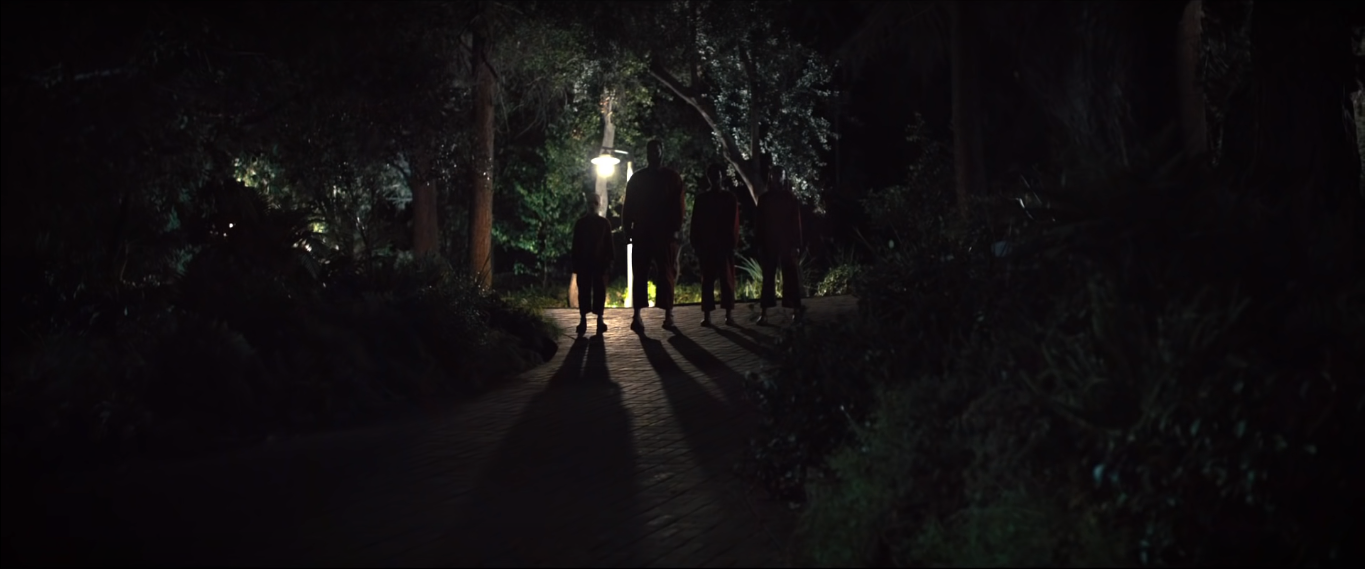
us 1.pngShadows and reflections are essential elements of the film
The game of mirrors presented in Us starts right of the bat with the name of the film. There is ‘Us’ and ‘US’, and with that information in mind we can expect the film to present certain political ideas. The problem with it is that most of the times the small scenes are full of certain meanings that contrast with the main concept of the film, creating a lot of room for interpretation, especially considering the film as an exercise in ideology. The best thing about the film (after Lupita Nyong’o’s mesmerizing performance) is arguably how vague its political readings can be. We are teased with the idea of it being a political film with the title alone, and yet the film challenges us to dig deeper to find any consistent concepts regarding its ideas. Despite touching on the subject of racism, Peele’s vision is now aiming at broader issues with Us.

Being a comercial film, it comes with its problems. Some of the scenes in the film are too predictable in its stereotypes. What helps the film to get over these scenes is its usage in an almost metalinguistic cinematic way. Peele knows his horror clichés and uses them in an ironic way briliantly, playing with our expectations and creating genuinely funny moments. As an European citizen it is hard to understand the realities of racism in America (mostly due to our racial prejudices being of a different nature and having a different expression), so probably these complaints at the end of the day are just conditioned by my personal life experience. Having this in mind, Us regards the subject of racism in a lighter way than what was expected, especially considering its main theme. This is not a negative criticism at all, because as I mentioned before, the vagueness of Us adds a lot to any reading of the film, including a reading inclined to the ideas of racism.”

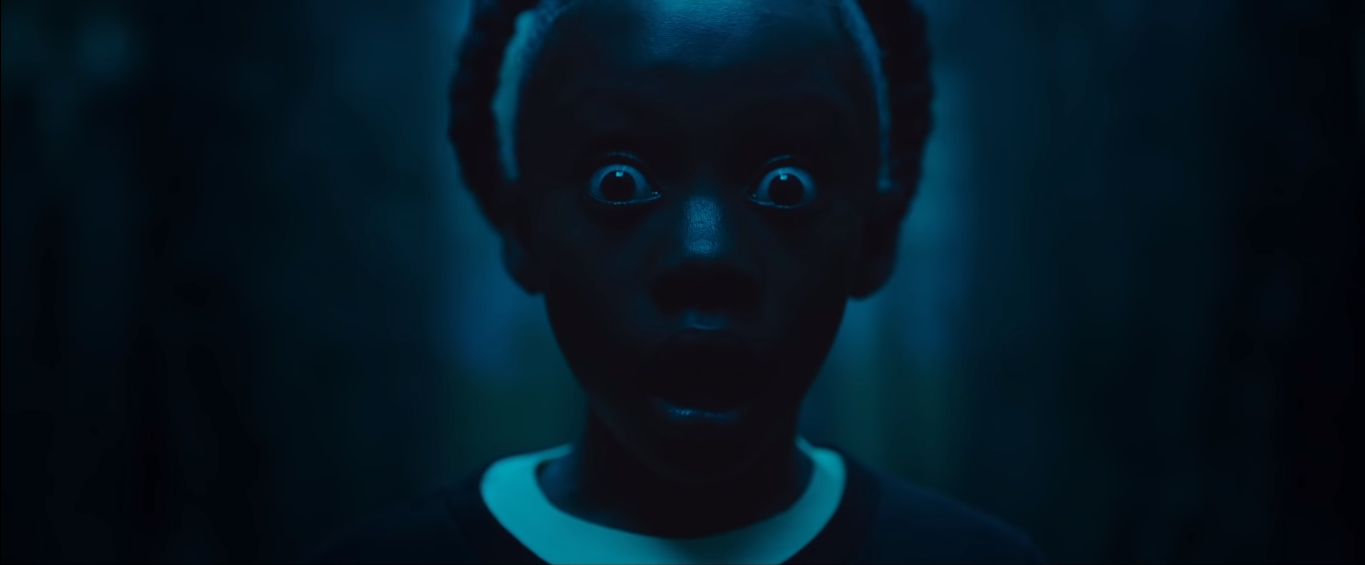
Visually it is more interesting than Get Out (2017), despite being a completely different film. It is creative and intelligent in its visual style, enough to be noticeable when comparing it to other big horror blockbusters. However, it still ends up feeling a little bit flat, just like Peele’s previous did. The use of music is brilliantly funny, and the original soundtrack is really great as well, especially the anthemic track (that reminds me almost of The Omen‘s (1976) soundtrack). Technically it is satisfying enough, never being truly flabbergasting.

us 2.pngThe already iconic shot from Us

By what I’ve said so far one would assume that Us is a brilliant film. But it is not. It is too vague and too self-conscious to be just a commercial film to watch at the mall, and too predictable in its techniques and paralells to be a really serious and innovative picture. One of the things that troubles me the most is that its vagueness translates a lot into meaninglessness, even though it is clear that there was a care in creating a well-rounded plot (in a Hitchockian way) and complete concept. The second thing that annoys me is the necessity to overexplain everything in the end. The “plot-twist” was rather predictable and despite the film having a lot of interesting buried plot points, it leaves a more experienced viewer feeling that the film is being condescending.

This text took into consideration spoilers and I decided to not discuss any of the plot, as it is very fun to watch without knowing what it is about. Gather some friends and go watch it. Probably every person will come out of the theater with a different reading of the film (I read somewhere that a guy thinks that the film is somehow anti-socialist. I highly doubt that though) and it is an enjoyable time in the cinema. Don’t expect too much out of it, but face it with enough seriousness to consider it, as it is clear that a lot of work and dedication went into it. Jordan Peele seems like he will be the new horror genre director to look out for, though.


6 out of 10

A Portuguesa (2019)

a portuguesa

Sempre a guerra. Agora já leva crianças pobres com ele. Para morrerem.

[It’s always the war. Now he takes the children of the poor with him. To their deaths.]

The new Rita Azevedo Gomes film may seem meaningless to people outside Portugal, but as a Portuguese Cinema fan it is exciting to know that a director with such a small but critically acclaimed filmography just released new work. As a director, she has claimed her main influences, and this time she did not even needed to talk about them, as they are clear to anyone that goes through the film. She is working with an old-school film festival favourite actress, Ingrid Caven, and her performance is probably the highlight of the picture. Despite being an interesting homage to many visionary directors and containing great shot compositions (with the help of what is arguably the greatest Portuguese cinematographer, Acácio de Almeida) and a hypnotic soundtrack by José Mário Branco, The Portuguese Woman falls short in its delivery.

The film adapts a story from the 1924 novella by Robert Musil with the same name, with dialogues adapted by Agustina Bessa-Luís, a favourite of Manoel de Oliveira. It follows the story of a Portuguese woman (weird hun?) when she marries a German lord and lives in a castle in Germany while his husband is busy leading a war. It trails their romantic lives while he is in war, and what changes in their relationship when he comes back from it.

a portuguesa 1.pngThe ever beautiful Ingrid Caven in the beginning of the film.

Before I present the reasons I think why this film does not fall into the category of being great at all, let me first point out what holds the film up. There is a clear sense of cinematic conceptualization. A balance between the images and the sound and the music that is absolutely mesmerizing and engaging enough to create hope in the viewer for something great. The incredible care with framing reminds me of, of course, Oliveira’s work (as the director herself has mentioned the film as being a follow up tribute to Oliveira’s body of work), but mainly reminds me of Dreyer and, oddly enough, Peter Greenaway. There is an insistence in The Portuguese Woman of transforming beautiful roccoco painting archetypes into film, working almost like tableaux vivants. Rita works with the tools of camera movement and actor movement to lead us through these living paintings in a way that is diegetic enough to counterpart the hardship you will have in deconstructing the dialogues themselves (especially if you are a casual Portuguese citizen watching the film without subtitles). The soundtrack complements beautifully the rhythm of the scenes, even though that sometimes you feel the sound design of the film (especially regarding dialogue) to sound a little strange in the overall composition of the scenes (at least odd enough for me to notice).

The main problem with the film, and comparing it with some of Oliveira’s films for instance (and I know comparing is not the right way to analyse a new film), is that despite having some brilliant scenes, as a whole, it leaves the viewer feeling like the film is an exercise in futility. There are singular moments that are brilliant, and most of them are visual moments. I have no disdain for Agustina Bessa-Luís’ work (especially considering her words in Vale Abraão (1993) and her novels), but I truly feel that her script combined with the less-amazing and unoriginal scenes create a feeling of decadence that hasn’t the right to be in a tribute film. It is frustrating to deconstruct a film that is as beautiful and competent as this to only find banal and tired ideas that were already messed with a million times, and no overarching concept to hold its existence. And this is where the comparison with Peter Greenaway disappears, because there is no breaking of the narrative conventions in The Portuguese Woman that compensate for the extensive use of the aforementioned indulgent filmmaking decisions. I know that the screenplay is supposed to sound theatrical and poetic (just as it was in, again, Vale Abraão or Francisca (1981) ), but there is something in this particular picture that is profoundly distasteful and tiring.

a portuguesa 2.pngAn example of the mentioned idea of tableaux vivants.

It is a frustrating film for the potential it had to be great. The faces, the costumes, the voices, the colours, all of the small elements are meticulously chosen to compose every scene. The presence of Ingrid Caven brings a mesmerizing element of a Greek Chorus-like nature to the film, another ingredient added to what could have been a great cinematic work. The themes of womanhood, lethargy and class-relations are there though, even if disappointing in their scope. The lighting is great and magnetic. The music – enchanting. Even Bessa-Luís’ words are beautiful, but feel misplaced, and even misspoken at times. The film itself… it really has nothing new to say, and while it is presenting nothing new, and in spite of its cinematic beauty and being a noticeable tribute, it is remarkably unsatisfying and inconsequential.

5 out of 10