Cat People (1942)

Directed by Jacques Tourneur

cat-people

“Let no one say, and say it to your shame / That all was beauty here, until you came.”

This week on Camera Coverage, after an unfortunate but necessary hiatus, we take a chance at yet another Horror Classic. This time we discuss one of RKO’s ultimate, but sadly forgotten classics, Jacques Tourneur’s Cat People. We often associate suspense films of this era with Alfred Hitchcock, and rightly so, but Tourneur is a French director that utilized the techniques of the afforementioned director to a new height in his Hollywood career. Despite being associated with B-movie fair, Cat People presents classic horror cinema at its best. There is a creature, there is melodrama, there is symbolism and there is masterful use of archaic techniques in order to portray (or not) all these cathartic elements.

The film plays with the character of Irena Dubrovna (Simone Simon), a Serbian fashion designer working in New York. Right from the beginning of the film we are introduced to her future husband Oliver Reed (Kent Smith), who’s relationship with will be the main focus of the whole film. Irena has a unsettling past and is afraid that some legends from her village in Serbia are true and inside her. Stories of witches, kings, witchhunters and, of course, cat people, live within her as she expresses her anxieties of the possibility of all of it being true. This will lead to a troubled marriage, in which physical contact is inexistant, and the insistence of another woman inside the relationship dynamic will be the key factor for Irena to release the panther within her.

the other woman cat people.pngAlice as, in a genre bending role, The Other Woman, a New Yorker intruding a troubled marriage between a Serbian (Irena) and an American (Oliver).

All of this is quite literal. Irena seems to really release, or rather transform into, a panther by the third act of the film. So what makes the film so fascinating despite its somewhat cheesy premise? Well, what could have turned into a really awkward puppet and silicone fest is dealt with incredible subtilty. Tourneur’s cinema uses shadows as one of its foundational elements. This is essential to a film working with metamorphosis as is Cat People. The idea of transformation is never portrayed directly onto the screen, but suggested. I believe, as many others do, that Tourneur utilized heavy indexicality mainly because of the somewhat low budget of the film. That said, when working with abductive imagery he manages to elevate the film not only in terms of ambiguity, but also in relation to films that utilize top-notch special effects but sadly do not hold so well nowadays. It must be noted and observed that this technique is not reduced to editing and cutting the scene when transformations are due, but there is a work of suggestive imagery throughout the whole of the film. From images of Irena with paintings of menacing cats in the background, to juxstaposition of her body and a reproduction of a statue of Anubis, to the crossing of Irena’s figure and the shadow of an armchair giving her some sort of cat ears. One of the key scenes works with Irena’s footsteps quickly silencing as she is chasing Alice (Jane Randolph), as we must only assume that her feet transmorphed into the silent, deadly paws of a black panther. This film represents the use of cinema’s rhethorical means at its best, using not only the resource of image and visual representation, but going as far as utilizing sound to its most effective.

game of shadows cat people.pngAnother example of suggestion – in this case premonition – of a scene through shadows and objects. If you look closely you can observe the shadow of the bird and its cage projected onto the black panther image, predicting what would later happen in that scene regarding the bird’s death.

One can love a film by its technical prowess, but what does it all really mean? Well, Cat People does not shy away from ambiguity. This is not only due to the decisions behind the technical aspects of the film, but also due to the broad themes that the film is dealing with. Probably the most clear readings of the film lay on the problem of sexuality, femininity and relationships as a whole. There is a clear suggestion throughout the whole film of Irena’s fear of touch, even though she is already married and social or even religious judgements are not an issue. This woman is dynamic in the film, as she can transform into a menacing beast that is awaken by the overextension of male activity in the world that is her own – this is, sexual intercourse regarding her own body. But what about her Serbian identity? The reading of the film as a cultural collision is another interesting perspective by which we can approach Cat People.

Despite all these possible perspectives on the film, its ambiguity and blank spaces should be respected and perceived as such. This is a film that is simultaneously meant to be enjoyed and discussed, but never reduced to x or y perspective. By trying to limit the film’s readings (there is an immense focus by critics in accessing the film with the perspective on sexual anxieties), we tend to leave its essential element of identity that it is dealing with. More than a woman or a Serbian, Irene is an individual trying to defend her individuality when in necessity of interacting with other individuals. Whether Irene is a cat person or not we will never get to really see, but what we get to see is that Irene is as human as she can as she tries to survive in our inherently intrusive world.

Ruben Brandt, Collector (2019)

Directed by Milorad Krstic

rub

“Art is the key to the troubles of the mind”

This week, for the first time on Camera Coverage, we’ll be taking a look at an animated feature. Coming from Hungary, Ruben Brandt, Collector is the first feature film of Milorad Krstic. A fairly unknown figure with only short movie credit (My Baby Left Me (1995) ), Krstic makes up a strong impression at the age of 66 years old. Regardless of its country of origin, the film is dubbed originally in English.

At the centre we have as the main character Ruben Brandt (voiced by Ivan Kamaras), a world-famous psychologist haunted by these weird and absurd dreams all connected with famous art pieces. The story advances between real life and dream sequences where famous paintings try to harm and kill Ruben. It is an extremely bizarre but captivating scenario to see; for instance, Velázquez’s Infanta Margarita Teresa in a Blue Dress (1659) trying to bite off his arm in a speeding train; or even a pistol duel against Andy Warhol’s Double Elvis (1963). These wonderful usages of famous art pieces from the western world redefine their meanings beautifully and with great taste.

vlcsnap-2019-05-11-15h46m58s874The duel with Elvis

Ruben Brandt is himself an art lover. His methods for helping his patients all connect with art, as he is a true believer of self-artistic expression to exorcise one’s ghosts of the past. Asking for help dealing with her problem with kleptomania is Mimi (Gabriella Hamori), an art robber escaping from detective Mike Kowalski (Csaba “Kor” Márton). She and the other patients in Brandt’s luxurious clinic discover his problems related to his dreams and agree they all must help him. The problems that made them enter the clinic are all related to crime and stealing so teaming up to rob to steal Manet’s Olympia (1863) is not that big of a deal. When they show this painting stolen from the Musée d’Orsay in Paris to Brandt, his nightmares with the woman portrayed suddenly disappeared. He then joins the group to steal the rest of the paintings that still haunted his dreams. The gang raids numerous museums all around the world like the Louvre, MoMa, the Uffizi Gallery or the Art Institute of Chicago, ending up getting the attention of both authorities and gang members alike.The above-mentioned detective Kowalski tries to catch Mimi and the rest of the group before other criminals get to them, attracted by the huge bounty on their heads.

The storyline ends up emulating the classic Hollywood spy and cop movies genre, being a somewhat disappointing experience especially in the last third of the film. This is a film that is to be appreciated more by the originality of the embedded details rather than the narrative itself. There are plenty of heist films clichés, and the personality of the characters is not that deep or original, maybe except for the protagonist. Regarding the plot, points go certainly to the importance given to art and its relation to the well being of an individual. The connection between psychology and art is an interesting and refreshing one, especially in a world dominated by scientific thought.

vlcsnap-2019-05-11-15h45m34s690Velazquez’s Infanta Margarida attack

Aesthetically this film leaves the viewer in awe by the gorgeous detail to both the characters and the world around them. People are portrayed as these cubistic with surrealistic undertones like a Picasso met Dali kind of style. Some have three eyes, others two heads, and, in a brilliant play with perspectives, there is a character that is bidimensional like a sheet of paper. It is an astonishing world completely filled with subtle references to all kinds of art, that goes from Soviet propaganda to American Realism painting. Besides that, a brilliant homage is also given to cinema, portrayed in the home collection of detective Kowalski. Filled with film memorabilia from Weneger’s Der Student von Prag (1913) poster to the small detail of ice cubes in the shape of Alfred Hitchcock, there´s a lot for any movie buff to enjoy in these small quirks.

Overall it was a pleasant surprise, and an animation like any other I’ve ever watched. The focus on the holistic aspect of art in the human mind is definably a positive aspect. In the end Ruben Brandt, Collector gives both an approachable introduction to art history and something that art enthusiasts can take also.

6 out of 10

The Spirit of the Beehive (1973)

(original title: El espíritu de la colmena)

Directed by Victor Erice

MV5BMTIzNjYwMTUzMl5BMl5BanBnXkFtZTcwNTE4MDQzMQ@@._V1_

“Why did he kill her?

Children in film are often used as a powerful tool to portray an array of heavy and dark sentiments through the eyes of naivety and without preconceptions. If we take, for instance, the experience of war, this innocence shattering event makes up for a potent art statement. For example, in a film like Elem Klimov’s Come and See (1985) the sheer expressions of horror in the face of the young Florya, during the Nazi’s invasion of the Soviet Union makes up for an image far more lasting than if it was an adult. There is something about the loss of innocence combined with a sense of escapism in a child’s mind to deal with that shocking reality. But it doesn’t need to be as eerie and explicit like that to make a deep impression. In a film like Children of Heaven (Majid Majidi, 1997) the journey for a poor child to get a new pair of shoes for his sister makes up for a simple but not less beautiful and warm experience.

The Spirit of the Beehive is not in anyway as a traumatic experience as the Klimov film mentioned above. The plot takes during the early years of Francisco Franco’s fascist regime in Spain. It is interesting to point out that this film was released during the last years of this dictatorship, marking perhaps, by the themes portrayed in the film, a pending weakness in the regime. The main characters are two young sisters, Ana (Ana Torrent) and Isabel (Isabel Telleria). Their father has a myriad of occupations that go from bookkeeper to beekeeper and poet.  Taking place in a small Castillian village in the Spanish Meseta, cinema is a motive for great excitement in this quiet town. The projector is set on an old barn and all the inhabitants, including the small girls watch a dubbed version of James Whale’s Frankenstein (1931). The impact is immense on the younger one Ana, who leaves the cinema traumatized by the famous drowning scene. Obsessed with the monster, she looks for any sign of the monster close to home. The search ends up leading her to an isolated old shed on a large and desolate piece of flat land. Inside there’s a wounded republican soldier, trying to escape death at the hands of the Francoist forces. The small girl, naïve to all the political struggles, steals food from home to feed the desperate soldier. The Republican partisan is found and shot by the Nationalists which leads to the suspicion that Ana’s father was the one helping him. The pressure for the daughter ends up being too much and she escapes next to a lake, making a clear parallel with the Frankenstein plot.

captura-de-ecracc83-2019-05-01-acc80s-17.04.18.png
The impact of the film reflected in her eyes

Portraying a Republican this way, like a wounded horse waiting for its demise, is an obvious example of a critique against the then fascist Spanish regime. In the seventies, dictatorships in Europe suffered an enormous amount of pressure by the rest of the western powers that already lived in democracy. Regimes like the Spanish (and as well the Portuguese one) grew more and more isolated. That could explain why films like this one or Viridiana (Buñuel, 1961, a ferocious critique of the catholic church, usual theme in Buñuel) passed the censors, despite the bad image they made of the regime. With general Franco’s death in 1975, Spain would finally make its transition to a democratic regime. Despite this obvious message, this film is much more than a political statement. It deals with the pureness of a child’s imagination, and how the make believes sometimes juxtaposes the sense of what is real. The innocence of Ana makes her completely unaware of the possible troubles she may be getting into by helping the soldier. Ana Torrent (that would end up working also with Carlos Saura in Cría Cuervos (1976)) makes up for an extremely sincere and sweet innocent child, in one of the more perfect roles played by a child that young. Merit has to be given to Erice for being able to blossom such a talent in a little child.

captura-de-ecracc83-2019-05-01-acc80s-16.55.38.png
The vastness of the Spanish “Meseta”

On top of the terrific performances, the cinematography is clearly an astonishing feat. The stellar work of Luis Cuadrado (who ironically was losing eyesight during the shoot) is found in creating this sense of emptiness both inside the buildings and in the vast Spanish flat lands. The house where the children live feels old and uninhabited and the small village is surrounded by immense of dry fields to lose sight on. The emptiness feels like a colossal canvas for a young child’s imagination. Together with the somewhat eerie but at the same time comforting soundtrack by Spanish composer Luis de Pablo, The Spirit of the Beehive is a cinematographic experience like any other.

High Life (2019)

Directed by Claire Denis

MV5BMDNjN2NjYmItMjAyZi00NmNkLWJmYTQtYzcwZGRiM2RmNGNlXkEyXkFqcGdeQXVyODUxNjcxNjE@._V1_SY1000_SX675_AL_

“It’s just a new religion for you.”

The presence of female directors in the worldwide film industry unfortunately is still somewhat lacking. For instance, over the last decade only 4% of the top 1,200 studio films were directed by women. Despite the odds, Claire Denis has throughout her career established herself as one of the most important French directors of the last decades. Her directing highlights go from Chocolat (1988), a film about France’s post-colonial issues; or Beau Travail (1999), dealing with the memories of war from French Foreign Legion soldiers. In this last one is especially interesting that themes like hypermasculinity and repressed homosexual feelings are explored by a female director, giving it a fresh new look on war films.

Claire takes now a shot at the science-fiction genre with High Life. The film tries to add new perspectives to what it means to be human when you are enclosed in a small spaceship far away from earth. It is not an easy task since the theme is well documented already, for instance in film classics like 2001, A Space Odyssey (Stanley Kubrick, 1968) or Solaris (Andrei Tarkovsky, 1972).  However, High Life is quite a different experience and references new ideas and problematics.

vlcsnap-2019-04-20-17h32m44s690.pngThe great use of red lighting

The plot functions around a group of inmates whose life sentence is to collect an unknown form of energy somewhere near a black hole. The intricacies deepen as we are introduced to the different individuals that compose the unlikely team. Dr. Dibs (Juliette Binoche) is a doctor obsessed with collecting sperm samples from the male crew members and then artificially inseminate the female ones. Failing to do so constantly she decides to double the sedative dosage and, through rape, collect the sperm from Monte (Robert Pattinson), the star of the film. The sexual tension is raised even higher with the introduction of this masturbatory machine that all of the crew, but Monte, use regularly. In a somewhat full of sexual tension and at the same time somewhat eerie scene (with a vibe that reminded me the killings in Under the Skin (2013) ) we see Binoche ride this contraption called “The Fuckbox”. In a complete trance-like state, this machine with a dildo end is set in a dark room with bondage straps hanging up from the ceiling. Making a companion to the heavy sexual tone is also the violence between the team. In a way it’s like the film tries to associate the presence of one with the other. It may start as a sexual violence situation like rape and end up in murder. These are a group of people that have lost a sense of purpose in life due to the uncertainty of their future and the claustrophobic aspect of living in a small ship in deep space.

vlcsnap-2019-04-20-17h33m45s030.pngInside “The Fuckbox”

The film begins with Monte living with a small child, alone in the spaceship. We later get to know that that child is the only success of Dr. Dibs and her mischievous tries to create newborns. Despite being an unwanted child, in a way it truly saves Monte from the same fate as his crew. Denis tries to show, especially between Monte and his little girl, some positive aspects about Humanity. In the final scenes we get to experience the wholesome relationship between the two until the ambiguous ending.

Its an interesting concept but not without its flaws. Starting with the cinematography, its somewhat lackluster, especially if we are talking about a revered director like Denis. The exterior space shots feel cheap and not very interesting either artistically or realistic, either way. Inside the spaceship it does get that much better. With points taken by the brilliant use of red light, there isn’t much there that blows you away. Maybe Denis was going for an homage to the spaceships of the 70’s because sure feels like we’re in one. The cast works well, especially Pattinson, but the dialogues feel sometimes forced and don’t add much to the plot.

It’s a peculiar film that will not appeal to the major movie goer for sure. It explores the most raw and vicious aspects about our sexuality and capacity to engage in violence. Nonetheless it’s not a missed shot by any means. Under its flaws there is a sense of novelty remarkable in this stage of her career, a director now 72 years old.

5 out of 10

Diamantino (2019)

Directed by Gabriel Abrantes & Daniel Schmidt

Poster_Diamantino_Cinemas

“They call me the Michael Angelo of the pitch”

Diamantino marks the debut of Gabriel Abrantes (with the partnership of Daniel Schmidt) into the world of full featured films. Abrantes has a long list of short films in his bag, such as A Brief History of Princess X (2016) or A History of Mutual Respect (2010). In his films he tries to ally a philosophical and critical stance to thematic such as history, gender and sexuality politics and the power of Art. With this long feature, Abrantes and Schmidt try to ally all these themes with an absurdist and at the same time comedic approach to serious and problematic contemporary problems. Almost a year after its Cannes debut, it finally showed up on Portuguese cinemas.

The plot follows Diamantino Matamouros (Carloto Cotta), the biggest football star in the world, who resembles an uncanny similarity to Cristiano Ronaldo. Either by the physical appearance or his narration of the events with a Madeira island accent (subtitled even to Portuguese audiences, although he is speaking Portuguese, something that may only be appreciated by the native speakers of the language) the resemblance is something that clearly pops on the viewer. Despite that, it’s not a direct reference and the character serves mainly as a caricature for nowadays biggest stars. He is a revered figured, almost like a god, astonishingly rich and with a personality ingrained with vanity and at the same time a tremendous ignorance for the events of the world. The very first scene, where we see him play in a sold-out stadium in the World Cup alongside with giant puppies in a pink cloudy haze, marks the surrealistic tone of the film. This scenario created in his head is the mechanism necessary to make him excel in what does best. Diamantino’s vanity and obsession with image and performance is not critiqued but instead he is presented as a deeply naïve and almost childish character. With the unexpected appearance of a refugee boat near his yacht, he completely loses all his ability to enter in that mental state represented by the pink haze and loses all his football skills. He goes from hero to zero, in a statement of the vapid celebratory status that rules our society, where one mistake is enough to fall from grace.

DIAMANTINO_BRAZIL-HD24_PRORES4444_VOLTRT_VO51_VILTRT_VI51-26062018.00_05_34_21.Still003The surreal place that Diamantino goes when he plays

Shocked by the migrant reality, he decides to adopt a Mozambican refugee boy, who is actually a female agent in disguise to discover possible financial frauds. Placed in an alternative timeline, Portugal is a neofascist country. One of the best aspects is the placement of small but very perspicuous clues that evoke the country’s forty-year dictatorship. It compares the creation of a glorious past with its big symbols with the new symbols created by today’s society in order to give a sense of national identity. The plot derives then into an almost espionage type of film. The despotic government convinces our lead character into a cloning process to make an entire football team full of skilful players like him in order to regain the glory lost in the World Cup final. This potentially deadly procedure would end up giving him breasts, something that deeply embarrasses him. The laughs of the audience to this scene maybe are a refection the director wants to make in relation to transphobia but unfortunately fails short to give any deep impact on the viewer.

The film’s first half results in an interesting critique of nowadays culture and politics. The long dictatorship (from 1926 to 1974) marked generations with a propaganda machine that created myths to justify a sense of identity. Despite a few decades passed since 1974, the mindset of the contemporary Portuguese people in some ways still rely in those myths of grandeur in a way of self-identity. Diamantino’s sisters (Anabela Moreira/ Margarida Moreira) also make an interesting point with their greed for their brothers’ money. With their sly personality, they are willing to sacrifice his own brother if needed. Alongside the positive points made before, Cotta’s performance is also a big highlight in the film, creating a deeply interesting character.

diamantino06.jpg.pngDiamantino and his “adoptive son”

The problem with the film relies essentially on pace. Past the first half of the film the repetition of the more poignant (or funny) aspects start to wear off and lose some of the charm. In a way, it reminds me of Capitão Falcão (2015) a Portuguese film that deals with similar political themes with also a comedic approach. The premises are smart and offer new ideas that deserve his praise, especially in dealing with ghosts of the past in a more cheerful that can help more easily engrain the audience in a political reflation without a more acute sense of guilt. The problem is that it is unable to deliver a more powerful second half without recycling most of the content used before. Worst than that, it finishes with a disappointing and cliché ending. Maybe Diamantino would be better if it was a short film, as it would be a more cohesive and well-rounded experience, instead of the constant repetition of tropes.


5 out of 10


Us (2019)

Directed by Jordan Peele

1

“We’re Americans.”

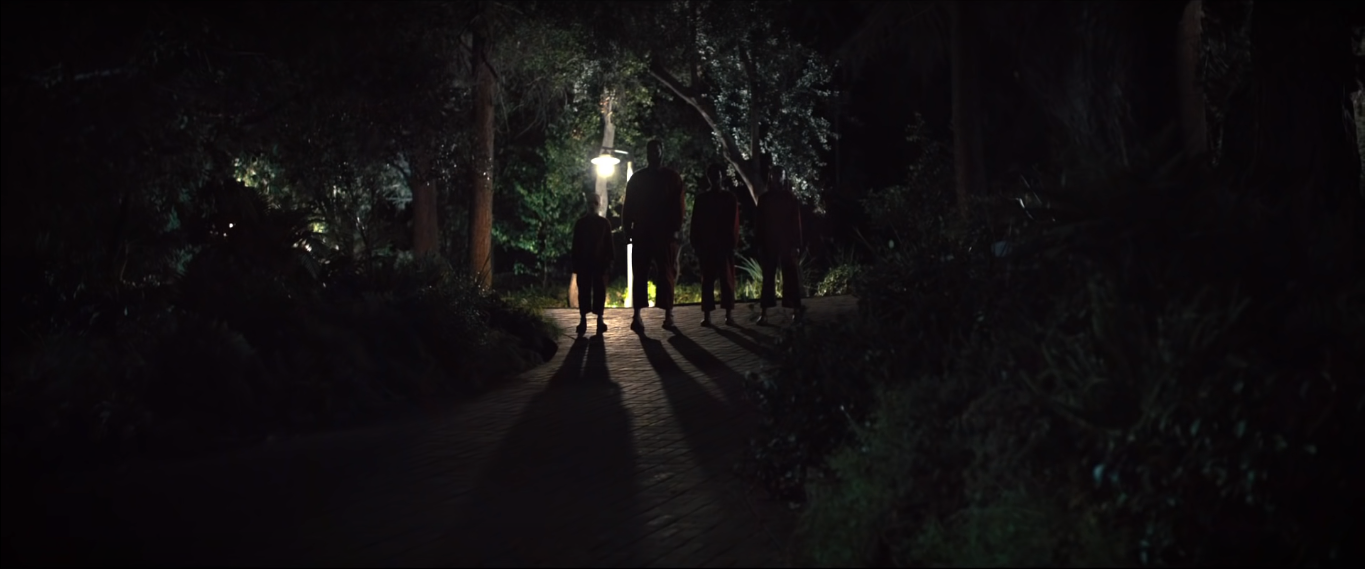
After the massive hit that was Get Out (2017), Jordan Peele kept showing his love for horror and a will to keep on writing new material in the genre. The subtexts and politics of Get Out (2017) were clear and well transformed into a more or less consistent concept. The value of the film was deposited in the dynamic of this transaction of racial politics into the horror film discourse, and by provoking the viewer with suggestive and anarchic ideas (similar to the one’s by Spike Lee). It was a film that worked as a genre piece but utilized its strengths to reach the public and confront them with realities that while terrifying are enlightening. Daniel Kaluuya presented us one great performance, backed by an incredible supporting cast. That is the main thing that mirrors and is enhanced in Us. The performances are well-above average and the film owes its cast a lot for its dynamic between horror and comedy (presented even more extremely than in Peele’s previous).

us 1.pngShadows and reflections are essential elements of the film
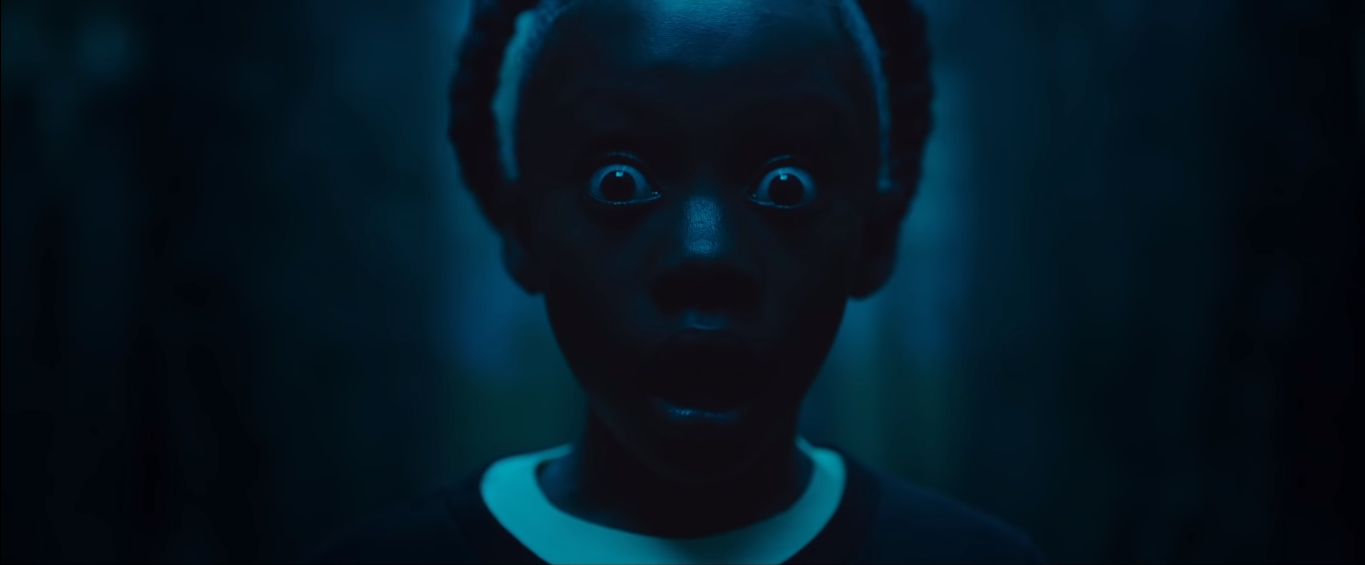
The game of mirrors presented in Us starts right of the bat with the name of the film. There is ‘Us’ and ‘US’, and with that information in mind we can expect the film to present certain political ideas. The problem with it is that most of the times the small scenes are full of certain meanings that contrast with the main concept of the film, creating a lot of room for interpretation, especially considering the film as an exercise in ideology. The best thing about the film (after Lupita Nyong’o’s mesmerizing performance) is arguably how vague its political readings can be. We are teased with the idea of it being a political film with the title alone, and yet the film challenges us to dig deeper to find any consistent concepts regarding its ideas. Despite touching on the subject of racism, Peele’s vision is now aiming at broader issues with Us.

Being a comercial film, it comes with its problems. Some of the scenes in the film are too predictable in its stereotypes. What helps the film to get over these scenes is its usage in an almost metalinguistic cinematic way. Peele knows his horror clichés and uses them in an ironic way briliantly, playing with our expectations and creating genuinely funny moments. As an European citizen it is hard to understand the realities of racism in America (mostly due to our racial prejudices being of a different nature and having a different expression), so probably these complaints at the end of the day are just conditioned by my personal life experience. Having this in mind, Us regards the subject of racism in a lighter way than what was expected, especially considering its main theme. This is not a negative criticism at all, because as I mentioned before, the vagueness of Us adds a lot to any reading of the film, including a reading inclined to the ideas of racism.”

Visually it is more interesting than Get Out (2017), despite being a completely different film. It is creative and intelligent in its visual style, enough to be noticeable when comparing it to other big horror blockbusters. However, it still ends up feeling a little bit flat, just like Peele’s previous did. The use of music is brilliantly funny, and the original soundtrack is really great as well, especially the anthemic track (that reminds me almost of The Omen‘s (1976) soundtrack). Technically it is satisfying enough, never being truly flabbergasting.

us 2.pngThe already iconic shot from Us

By what I’ve said so far one would assume that Us is a brilliant film. But it is not. It is too vague and too self-conscious to be just a commercial film to watch at the mall, and too predictable in its techniques and paralells to be a really serious and innovative picture. One of the things that troubles me the most is that its vagueness translates a lot into meaninglessness, even though it is clear that there was a care in creating a well-rounded plot (in a Hitchockian way) and complete concept. The second thing that annoys me is the necessity to overexplain everything in the end. The “plot-twist” was rather predictable and despite the film having a lot of interesting buried plot points, it leaves a more experienced viewer feeling that the film is being condescending.

This text took into consideration spoilers and I decided to not discuss any of the plot, as it is very fun to watch without knowing what it is about. Gather some friends and go watch it. Probably every person will come out of the theater with a different reading of the film (I read somewhere that a guy thinks that the film is somehow anti-socialist. I highly doubt that though) and it is an enjoyable time in the cinema. Don’t expect too much out of it, but face it with enough seriousness to consider it, as it is clear that a lot of work and dedication went into it. Jordan Peele seems like he will be the new horror genre director to look out for, though.


6 out of 10