LEFFEST – Lisboa & Sintra Film Festival 2019


leffest.jpg

We at Camera Coverage have been attending to the 2019 edition of the biggest film festival in Portugal and thought of speaking a little bit about the films we have been able to see. We got our heads around the whole section of the films in competition to the festival’s awards, and some of the new releases on other sections of the festival. Between all of these we thought of making our brief selection of films that are for us the highlights of the festival. Also, from Wednesday forth we are thinking of making more focused texts on what we think is our favourite of the festival, and the films that were awarded by the selected jury of the festival – that are to be announced in the 24th of November.

For our list we have picked three highlights from the festival selection in the competition.


Atlantis, by Valentyn Vasyanovych


atlantis 3.jpg

This year’s competition was packed with two films from the old Eastern Block that find themselves in somewhat the same category. These are The Criminal Man, by Dmitry Mamuliya and the afforementioned Atlantis, by Valentyn Vasyanovych. Both of these films are paced with care and drag the viewer into a very slow pacing, being easy to put them in what some call the “slow-cinema” category. However, while Atlantis presents consisted cathartic and poetic imagery, The Criminal Man seems to be a film in which there is a great central scene – arguably greater than any scene in Atlantis – and feeling a bit empty in comparison. Atlantis is a film that has its setting in a dystopic post-war Ukraine, following a main character suffering from PTSD. There are many scenes of despair, many moments where we may be led to think that Vasyanovych really has no hope for his country and his people after the consequences of the war. By the end though, we are faced with this flash of light, as poetically depicted as any of the shades of grey previously presented in the film, that remind us that the power of love and humanity  is strong enough, not only to be reborn from the remnants of such war, but I would even say taht there is here a suggestion that this light may even prevent us from falling into this dark utopia if we keep it close to us.


Beanpole [Dylda], by Kantemir Balagov

kinopoisk.ru


Arguably one of the most talked about films in the festival scene, Kantemir Balagov’s Beanpole deserves every bit of the attention it has received. The film deals with a plethora of complex themes, and presents them with, however extreme, 100% believable situations. The fluid sense we have – much of it provided by a sober set and art design – between all of these is impressive. From war trauma, to poverty, to complex romantic and motherhood dynamics, Beanpole seems to gather all of this seamlessly. It is a beautifully shot film, with a strong sense of colour and aesthetics, including a dynamic camera that switches from being handheld and really shaky to fluidity and steadiness at a pace that is hard to notice as we are mesmerized with everything that is being portrayed. The sense of pathos in Beanpole is the probably one of the strongest from the festival, and the performances are certainly the most convincing. A cinematic treat for the eyes, and an always important reminder of what extremes can the human soul deal with.


Fire Will Come [O Que Arde], by Oliver Laxe

fire will come

A personal favourite of ours, O Que Arde by Oliver Laxe is one of the most subtle and gentle depictions of the complex nature of human beings. Between the beautiful landscapes of Galicia and their absolute destruction there are humans and their complex, but nonetheless consequential, relationships. We follow Amador through his journey back home from being imprisoned for causing a massive forest fire in his region. He deals with his everyday chores in the countryside, next to his mother Benedita – a charming powerhouse of a 80 year old woman. There is a sense of silence and of the ephemeral throughout the whole of the film, despite the absolute chaos that is the nature of human existence. Even when filming the forest fire scenes there is a sense of calm, a sense of beauty and a sense of sobriety that gives opportunity to the viewer to mingle on the many subjects the film can extract from our lives. Family, ecology, social life, the rural world, decadence, destruction and limits. All of these and none of them at the same time. O Que Arde is without a doubt one of our 2019 favourites.


Other honourable mentions:

Tommaso, by Abel Ferrara
Balloon [Qi Qiu], by Pema Tseden
Atlantics [Atlantique] (out of competition), by Mati Diop


The Beach Bum (2019)

Directed by Harmony Korine
mv5bmty3mduzmtazov5bml5banbnxkftztgwndk3odqynzm40._v1_sy1000_cr006751000_al_-1

“He may be a jerk, but he’s a great man.”

Korine became known on the movie industry for writing the screenplay for the critically acclaimed Kids (1995), being only 19 years old at the time. Made his directorial debut with Gummo (1997), Korine started to implement his vision for cinema. Unlike traditional American cinema (that depends heavily on the power of narrative), he prefers an approach not so plot based. The film flows freely along the small events that occur, without a sense of a strict plotline that must be respected. In a way his vision of cinema is closer to a European one, in line of a Godard or a Cassavetes (in terms of artistic inspiration, as in quality he is a few steps below still).

It is not in any sense a figure praised by everybody. His films create a divide both among critics and overall public. For instance, in his previous film Spring Breakers (2012) he tried to make a social commentary of naiveté and the new” American dream” the younger generations, using Florida as background. The result had some interesting notes but is one of those films that tries way hard to be more profound than it really is. And that is usually the reason that leaves people often disappointed with his work.

In Beach Bum Korine returns once again to Florida but using a different approach. Florida still maintains the very saturated colours that were used in Spring Breakers, along with some great cinematography. It carefully translates the warmness and tropical aspect of the place with some gorgeous backgrounds. The difference lies on the overall tone of the film. Florida is depicted usually in film as this tropical paradise, but the reality is usually grimmer than that. The Florida Project (Sean S. Baker,2017) did a great job portraying the lives of lower classes in a cheap motel, showing a rather dark side to the stifling blissfulness.

There are no taboos in Korine’s films, either it be sexual, drug use or violence and Beach Bum continues to follow that line. As the protagonist we have Moondog (Matthew McConaughey), this hardcore stoner that lives this extremely hedonistic life without rules. McConaughey plays with great ease a role that its not that new to him (as for instance Linklater’s Dazed and Confused (1993) ). As the film progresses, we learn that he used to be a great writer but now lives of his multimillionaire wife Minnie’s (Isla Fisher) bank account. It´s a non-conventional and open relationship, noted by the multiple affair that they both have, something that don’t seem to bother them that much. It’s only the event of their daughter Heather´s (Stefania LaVie Owen) wedding that brings them together once again. The absurdity of the wedding brings along some great comedic scenes as well some interesting caracters such as Lingerie (Snoop Dogg). Despite having an obvious affair with his wife, Moondog is still very fond of him. The film then takes an tragic turn that leaves Moondog completely broke and homeless. The only way of getting the money back if he writes a new book, something that he is avoiding for a long time.

These two events come without notice a shape the flow of the film. Throughout his ramblings he encounters some eccentric characters like Flicker (Zac Efron), an sociopath pyromaniac with an spiritual side, or Captain Wack (Martin Lawrence), with his fixation with dolphins. Everywhere he goes positivity follows him. There are no dirty places or bad people, everything is glowing in Beach Bum. His life seems completely chaotic and without any shape of planning. He is a free spirit, loved by everybody, and always with an unshakable positivity. It’s almost discomfortable his level of happiness, almost childlike and completely unaware of his surroundings. But it always works out well for him in the end, even when all could go wrong. The cathartic ending shows his views about money were purely utilitarian. He needed the money to continue his lifestyle, not for shows of grandeur and opulence. It can be seen as a critic to the money culture that rules over us and distracts us from the most important things in life.

Overall its an interesting experience that tries to convey a more positive outlook to the problems of the world. On a more profound level Moondog is a troubled soul showed by his alcoholism, drug abuse or his womanizer ways. Despite that he still has an inspiring way of guiding himself towards happiness as his main goal to life. It´s not a life changing film or his message is new by any chance but in the end, it makes up for a different and thought-provoking film experience.

6 out of 10

3 Faces (2019)

(original title: Se rokh)

Directed by Jafar Panahi

3 faces

“So you came for her and not for us.”

Jafar Panahi is a Iranian director famous for his continuous quarrel with censorship and his consequent imprisonment in 2010. His 2015 masterpiece Taxi gave him worldwide recognition, but he was already one of the highest praised Asian directors from the last twenty years by film critics and a staple of the big film festivals. His work follows the lead of his master Abbas Kiarostami, especially after being imprisoned, where he approached a fluid style between documentary and fiction to develop his already highly realist filmography. 3 Faces is a film that won the award for Best Screenplay at the Cannes Film Festival, and is since being released all over the globe.

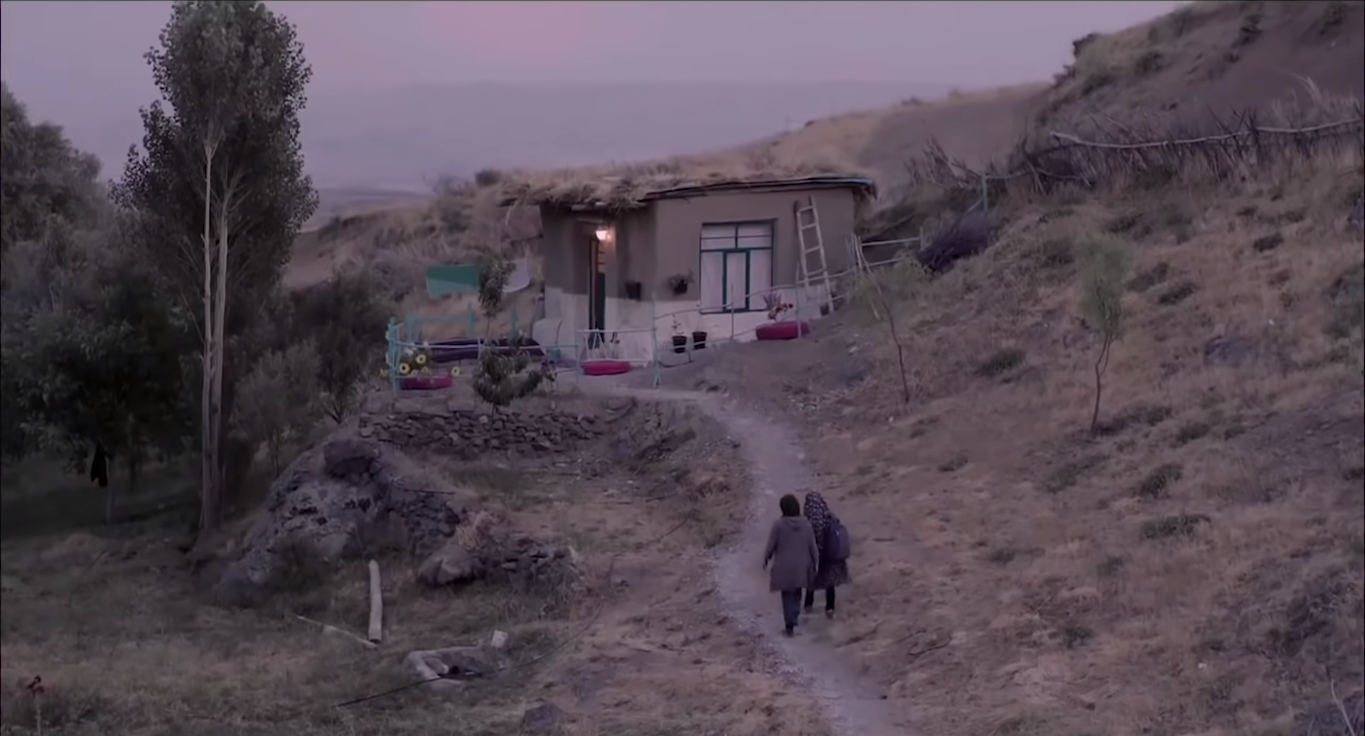
The film follows the director himself and the actress Behnaz Jafari. They received a video message of a young girl commiting suicide in an attempt to get the actress’ attention and help with the consequences of her somewhat progressive lifestyle (she studies in college and is an actress) in her traditionalist village. The three faces that gave the film its title are meant to be the faces of the three actresses in the film. The young girl that sent the message, the middle aged Behnaz Jafari and an old lady that they meet somewhere in the middle of their journey into the village. It is shot at the same location that many of Kiarostami’s films were shot, and has a lot of direct references to some of his most famous work, including the devastating ending of Taste of Cherry (1997) mirrored in the somewhat crazy old actress’ actions.

3 faces 1.pngBehnaz Jafari

As are the other films of the director since 2010, 3 Faces is a politically charged work. Panahi seems to extend his views on femininity, generational issues and religious catharsis from his other films. In this aspect, Panahi’s work seems to resemble another Iranian director that seems to be forgotten when talking about Panahi, that is Mohsen Makhmalbaf. In some of his films, of course considering Kiarostami’s influence on them as well, Makhmalbaf utilized too the fluidity between documentary paradigms and preconceived narratives to approach certain political issues – see for instance Kandahar (2001) and how it deals with the uprising war, or A Moment of Innocence (1996) and how it works with morality issues inside small communities. In the same way Taxi or This is Not a Film (2011) worked, this new film utilizes its meta elements to the fullest in order to reach the level of realism it does. It does not even shy away from going further into many other debates, much like Kiarostami’s Close-Up (1990) when it comes to the debate about the power of film and the influence of art in an oppressed society.

Despite not being as original as a film like Taxi was, Panahi seems to make a proper tribute to his masters. The debate topics of Makhmalbaf in 2001 or Kiarostami in 1990 are not the same the ones being discussed in Panahi’s contemporary cinema. Even if going as far as utilizing diegetic elements of the voyage or other direct elements of these other director, the final product is still original and relevant. There is a blend of a seemingly ascetic scenario with traditional but poetic use of framing and editing, and with a real sense of pathos that transcends the otherworldly level of cinema into real life (with a knowledge of technology and modernity that remembered us of other directors that utilized modern elements to their most real, like Michael Haneke in Happy End (2017) ). This mixture of techniques combined with the poignancy of Panahi’s assertions is hard to criticise and all of it definitely works.

3 faces 3.png

One of the most important things to take from a fictional film like 3 Faces is its sense of realism. Despite working will milions of elements and influences that are somewhat hard to keep track of, the film puts them together in a way that every frame drools a sense of what’s reality like in Iran, but even goes further in globalizing Iran’s problems. How do we deal with our professional lives, how do we deal with deceit, how do we deal with time and how do we deal with rules. What is the role of God, and does godliness ends when humanity starts to fade. These are some of the things that are hard not to think of when we see a film like Panahi’s. Much like the main idea from his 2011 film we are once faced with the fact that a film is a representation of life. Not only that, but the final product of this representation is alarming, not only because of what’s happening in some Middle Eastern countries, but because of the true universality of these problems.

7 out of 10

Cat People (1942)

Directed by Jacques Tourneur

cat-people

“Let no one say, and say it to your shame / That all was beauty here, until you came.”

This week on Camera Coverage, after an unfortunate but necessary hiatus, we take a chance at yet another Horror Classic. This time we discuss one of RKO’s ultimate, but sadly forgotten classics, Jacques Tourneur’s Cat People. We often associate suspense films of this era with Alfred Hitchcock, and rightly so, but Tourneur is a French director that utilized the techniques of the afforementioned director to a new height in his Hollywood career. Despite being associated with B-movie fair, Cat People presents classic horror cinema at its best. There is a creature, there is melodrama, there is symbolism and there is masterful use of archaic techniques in order to portray (or not) all these cathartic elements.

The film plays with the character of Irena Dubrovna (Simone Simon), a Serbian fashion designer working in New York. Right from the beginning of the film we are introduced to her future husband Oliver Reed (Kent Smith), who’s relationship with will be the main focus of the whole film. Irena has a unsettling past and is afraid that some legends from her village in Serbia are true and inside her. Stories of witches, kings, witchhunters and, of course, cat people, live within her as she expresses her anxieties of the possibility of all of it being true. This will lead to a troubled marriage, in which physical contact is inexistant, and the insistence of another woman inside the relationship dynamic will be the key factor for Irena to release the panther within her.

the other woman cat people.pngAlice as, in a genre bending role, The Other Woman, a New Yorker intruding a troubled marriage between a Serbian (Irena) and an American (Oliver).

All of this is quite literal. Irena seems to really release, or rather transform into, a panther by the third act of the film. So what makes the film so fascinating despite its somewhat cheesy premise? Well, what could have turned into a really awkward puppet and silicone fest is dealt with incredible subtilty. Tourneur’s cinema uses shadows as one of its foundational elements. This is essential to a film working with metamorphosis as is Cat People. The idea of transformation is never portrayed directly onto the screen, but suggested. I believe, as many others do, that Tourneur utilized heavy indexicality mainly because of the somewhat low budget of the film. That said, when working with abductive imagery he manages to elevate the film not only in terms of ambiguity, but also in relation to films that utilize top-notch special effects but sadly do not hold so well nowadays. It must be noted and observed that this technique is not reduced to editing and cutting the scene when transformations are due, but there is a work of suggestive imagery throughout the whole of the film. From images of Irena with paintings of menacing cats in the background, to juxstaposition of her body and a reproduction of a statue of Anubis, to the crossing of Irena’s figure and the shadow of an armchair giving her some sort of cat ears. One of the key scenes works with Irena’s footsteps quickly silencing as she is chasing Alice (Jane Randolph), as we must only assume that her feet transmorphed into the silent, deadly paws of a black panther. This film represents the use of cinema’s rhethorical means at its best, using not only the resource of image and visual representation, but going as far as utilizing sound to its most effective.

game of shadows cat people.pngAnother example of suggestion – in this case premonition – of a scene through shadows and objects. If you look closely you can observe the shadow of the bird and its cage projected onto the black panther image, predicting what would later happen in that scene regarding the bird’s death.

One can love a film by its technical prowess, but what does it all really mean? Well, Cat People does not shy away from ambiguity. This is not only due to the decisions behind the technical aspects of the film, but also due to the broad themes that the film is dealing with. Probably the most clear readings of the film lay on the problem of sexuality, femininity and relationships as a whole. There is a clear suggestion throughout the whole film of Irena’s fear of touch, even though she is already married and social or even religious judgements are not an issue. This woman is dynamic in the film, as she can transform into a menacing beast that is awaken by the overextension of male activity in the world that is her own – this is, sexual intercourse regarding her own body. But what about her Serbian identity? The reading of the film as a cultural collision is another interesting perspective by which we can approach Cat People.

Despite all these possible perspectives on the film, its ambiguity and blank spaces should be respected and perceived as such. This is a film that is simultaneously meant to be enjoyed and discussed, but never reduced to x or y perspective. By trying to limit the film’s readings (there is an immense focus by critics in accessing the film with the perspective on sexual anxieties), we tend to leave its essential element of identity that it is dealing with. More than a woman or a Serbian, Irene is an individual trying to defend her individuality when in necessity of interacting with other individuals. Whether Irene is a cat person or not we will never get to really see, but what we get to see is that Irene is as human as she can as she tries to survive in our inherently intrusive world.

Ruben Brandt, Collector (2019)

Directed by Milorad Krstic

rub

“Art is the key to the troubles of the mind”

This week, for the first time on Camera Coverage, we’ll be taking a look at an animated feature. Coming from Hungary, Ruben Brandt, Collector is the first feature film of Milorad Krstic. A fairly unknown figure with only short movie credit (My Baby Left Me (1995) ), Krstic makes up a strong impression at the age of 66 years old. Regardless of its country of origin, the film is dubbed originally in English.

At the centre we have as the main character Ruben Brandt (voiced by Ivan Kamaras), a world-famous psychologist haunted by these weird and absurd dreams all connected with famous art pieces. The story advances between real life and dream sequences where famous paintings try to harm and kill Ruben. It is an extremely bizarre but captivating scenario to see; for instance, Velázquez’s Infanta Margarita Teresa in a Blue Dress (1659) trying to bite off his arm in a speeding train; or even a pistol duel against Andy Warhol’s Double Elvis (1963). These wonderful usages of famous art pieces from the western world redefine their meanings beautifully and with great taste.

vlcsnap-2019-05-11-15h46m58s874The duel with Elvis

Ruben Brandt is himself an art lover. His methods for helping his patients all connect with art, as he is a true believer of self-artistic expression to exorcise one’s ghosts of the past. Asking for help dealing with her problem with kleptomania is Mimi (Gabriella Hamori), an art robber escaping from detective Mike Kowalski (Csaba “Kor” Márton). She and the other patients in Brandt’s luxurious clinic discover his problems related to his dreams and agree they all must help him. The problems that made them enter the clinic are all related to crime and stealing so teaming up to rob to steal Manet’s Olympia (1863) is not that big of a deal. When they show this painting stolen from the Musée d’Orsay in Paris to Brandt, his nightmares with the woman portrayed suddenly disappeared. He then joins the group to steal the rest of the paintings that still haunted his dreams. The gang raids numerous museums all around the world like the Louvre, MoMa, the Uffizi Gallery or the Art Institute of Chicago, ending up getting the attention of both authorities and gang members alike.The above-mentioned detective Kowalski tries to catch Mimi and the rest of the group before other criminals get to them, attracted by the huge bounty on their heads.

The storyline ends up emulating the classic Hollywood spy and cop movies genre, being a somewhat disappointing experience especially in the last third of the film. This is a film that is to be appreciated more by the originality of the embedded details rather than the narrative itself. There are plenty of heist films clichés, and the personality of the characters is not that deep or original, maybe except for the protagonist. Regarding the plot, points go certainly to the importance given to art and its relation to the well being of an individual. The connection between psychology and art is an interesting and refreshing one, especially in a world dominated by scientific thought.

vlcsnap-2019-05-11-15h45m34s690Velazquez’s Infanta Margarida attack

Aesthetically this film leaves the viewer in awe by the gorgeous detail to both the characters and the world around them. People are portrayed as these cubistic with surrealistic undertones like a Picasso met Dali kind of style. Some have three eyes, others two heads, and, in a brilliant play with perspectives, there is a character that is bidimensional like a sheet of paper. It is an astonishing world completely filled with subtle references to all kinds of art, that goes from Soviet propaganda to American Realism painting. Besides that, a brilliant homage is also given to cinema, portrayed in the home collection of detective Kowalski. Filled with film memorabilia from Weneger’s Der Student von Prag (1913) poster to the small detail of ice cubes in the shape of Alfred Hitchcock, there´s a lot for any movie buff to enjoy in these small quirks.

Overall it was a pleasant surprise, and an animation like any other I’ve ever watched. The focus on the holistic aspect of art in the human mind is definably a positive aspect. In the end Ruben Brandt, Collector gives both an approachable introduction to art history and something that art enthusiasts can take also.

6 out of 10

Knife+Heart (2019)

(original title: Un couteau dans le cœur)

Directed by Yann Gonzalez

knife+heart poster

“She saw so many gay flicks, she thought she was a fag.”

Yann Gonzalez is a French director known for his feature film You And The Night (2013) but mostly because of his many other short films. He is especially well regarded in the LGBTQ+ community for his preference on themes regarding sexuality and gender politics. Having won many prizes and nominations in important festivals like Cannes Film Festival, he is one of those directors to be watching out for if you are interested in art-house films of the new era. However, we feel on Camera Coverage that this new feature from Gonzalez is pretty much a mess, it is not without some singular scenes that are incredible, but it is indeed a bit of a mess.

The film follows Anne (Vanessa Paradis), a gay pornography film director, in her quest of filming her new feature that seems to be more bold and adventurous than her previous. This brings us close to the character and her relationship dynamics with her film editor Löis (Kate Moran) and her dealing with alcohol addiction. From the start we know that the film has as a main plot a giallo-esque story, with a serial killer that seems to be targeting the actors from Anne’s films. The connecion between the killer and the actors is left uknown until the end of the film, where we are bombarded with a traditional plot-twist from the great classics of the genre.

print heart+knife 1Vanessa Paradis as Anne

The film plays along the lines of what we may consider the supernatural giallo, especially in its first two acts. The relationship between Anne’s vision of her new picture and the killings is meant to be perceived, but sadly, with its ending, we are left hanging in the understanding of this relationship. Throughout her journey we are faced with many surrealist images that are traditional in these giallo films and Italian horror films of the 1960s and 1970s, but they seem to add little to the unravel of our characters quest. It is clear that there are many diagetic layers on Knife+Heart, but after seeing it and thought of it for a week I still feel that they are not only disconnected, but they are sadly disconnected, as most of them are individually incredible and contain a lot of contrasting and formally complex ideas working on a deep semiotic level. The insistence on creating a traditional giallo in structure does not work in the film as much as it does visually, and it lefts the viewer confused, frustrated and cheated.

Vanessa Paradis is one of the actors in later years that we feel, as lovers of photography in general, that has one of the most unique faces. The characterization of every character in the film, especially her’s, is incredibly stylized and works well comparing to the other aspects of the film. The whole visual aspect of the film is undeniably great. It works as a cool throwback to the films of the genre, but it works as a singular piece as well, despite its insistence on weird black and white thermal images when depicting dream sequences. However, even at the technical level (image and sound) Knife+Heart is not the best throwback to the giallo, particularly if we consider the incredible films that made reference to the genre we have seen in the last few years (like Berberian Sound Studio (2012) and Amer (2009) ).

black and white dreams equencesOne of the dream sequences

Falling short on others to describe the film, it feels disapointing. The director has achieved greatness with some of his short films (notably Les îles (2017) ), but this time he completely misses the target. Despite arguably being one of the films that are a throwback to the afforementioned genres that more truly incorporates not only the visual aesthetics but the structure of the giallo, it fails on creating a compelling experience by being too overwhelming and obtuse with its symbols and parallels. I feel that some of this may be due to how random some of the events in the film are, and the discrepancy of vibes in it. The play of the director regarding the meta aspect of the film (the films inside the film; the dreams inside the film; the dreams that are the film; the relationship between director and editor, etc) is interesting, as are the mirror images it tries to make with its individual scenes. Sadly it does not keep up with its promises (especially its depiction of the theme of obsessive and corrosive love) and mostly is an insatisfying experience, that while being really extreme and poignant in the depiction of a community and a genre of filmmaking that is really underapreciated and not valued as it should, it leaves the spectator feeling that it is a mere exercise in shock value and pretentiousness.


3.5 out of 10

Bibi Andersson || Persona (1966)

[Directed by Ingmar Bergman]

1.jpg

Earlier this week we have been braced with the devastating news of the death of the legendary actress Bibi Andersson. She is best known for her long collaboration with director Ingmar Bergman with whom she had made approximately twelve films. Andersson is responsible to the introduction of Liv Ullmann to Bergman, and therefore responsible for what is one of the most legendary collaborations in the history of cinema. Even though the spotlight is often on Ullmann, Bibi Andersson is the original muse of the director, and works as a strong homogenous figure in Bergman’s early work, only later her figure being noticeable as a “lighthearted” contrast to what was the “severity” of Liv Ullmann, especially on the masterpiece that is Persona.

Every film lover knows Persona. But it is also true that no one can truly deconstruct and interpret the film in what may be considered a “right way”. This is a film that is meant to work on a level that differs from our usual cinematic experiences. Most of this is due to the way both characters interact and the work of metamorphosis between the two. While, as mentioned before, Liv Ullmann plays the patient, an actress that is both austere and troubled, Bibi Andersson plays a deeply humane but also troubled nurse. While both performances are incredibly layered and dynamic, we are mostly guided by the eyes of nurse Alma in her quest to heal Elizabeth Vogler, that quickly turns into a therapy for her own troubles. The humanity and sincerity of Andersson’s performance brings to the film something for the viewer to relate to, something that is essential for Bergman’s work to function correctly in order to not transform into something completely obtuse and abstract. She is the perfect counterpart that bridges the complex states of mind and the complex artistic pretensions of the film into our everyday lives, creating in the end one of the most unheimlich experiences one can have with a film.

Bibi Andersson is the light of our everyday lives fading in the world of Bergman’s cinema. She brought reality and sensibility to films that would feel too cold and distant to be as relevant as they are today. This week we lost one of the big faces of Swedish cinema, and she will surely be remembered as one of the absolute icons of the history of film. We leave a list below of our favourite films she made part of. Bibi Andersson will not be forgotten.

The List:

Sommarnattens leende [Smiles of a Summer Night] (1955)
Det sjunde inseglet [The Seventh Seal] (1957)
Smultronstället [Wild Strawberries] (1957)
Djävulens öga [The Devil's Eye] (1960)
Syskonbädd 1782 [My Sister, My Love] (1966)
Persona (1966)
Flickorna [The Girls] (1968)
En passion [A Passion] (1969)
Scener ur ett äktenskap [Scenes from a Marriage] (1974)
An Enemy of the People (1978)
Quintet (1979)

The Fire Within (1963)

(original title: Le Feu Follett)

Directed by Louis Malle

qL6ZEBtqgDUf0j76xJ6GFEpaGQYXl3_large

“One day I realised I’d spent my life waiting. For women. Money. Action. So I drank myself stupid.”

Louis Malle is a French director that started his career amidst the Nouvelle Vague movement. Despite not being a full front figure like Jean Luc Godard, Alain Resnais or the recently late Agnes Varda, he has a personal style and sensibility that make him, in my opinion, an underrated director in the French scene. His first full feature is Ascenseur pour l’échafaud (1958), a noir masterpiece, displaying a suffocating and almost despairing feel with the brilliance of his night Paris shots. This in alliance with a stellar original soundtrack by the jazz great Miles Davis make for an almost perfect debut as a director. Throughout his career he would tackle difficult and polemic themes like Nazi collaboration (Lacombe Lucien (1974) ) or incestuous relationships (Le souffle au cœur (1971) ). His own World War II experience would serve as the theme for Au revoir les enfants (1987), a powerful film about a catholic school that hides Jewish children from Nazi persecution.

With Le Feu Follett, Malle focuses once again in very sensitive topics, like depression, addiction and especially on suicide. The story follows Alain Leroy (Maurice Ronet), a 30-year-old writer with alcoholic problems as he leaves the rehabilitation clinic in Paris. This service was played by his ex-wife, who now lives away from him in New York. To verify the success of the treatment, she sends one of Alain’s old female acquaintances Lydia (Léna Skerla) to check up on him. His doctor (Jean-Paul Moulinot) assures him that he is completely cured, and all is good now. Despite all the positive feedback from the outside Alain cannot help but feel disenchanted with the prospects of his future. Though the film we see him visit some old friends and catching up with their current lives in the present. For instance, as his comrade Dubourg (Bernard Noël) now dedicates his life to Egyptology and marriage, Eva (Jeanne Moreau) wastes her time with drug users. In another scene we see Alain dine with Solange (Alexandra Stewart) and her wealthy and reactionary friends. There is a feeling of resentment by Alain against his friends as if they are no longer the same as they were in their youth. As if in some way, their juvenile ideals were betrayed and transformed exactly on what was promised to fight against.

vlcsnap-2019-04-17-13h41m27s823.png“It’s not feelings of anxiety, it’s a single feeling of constant anxiety”

Despite the constant presence of friends and acquaintances, Alain feels more alone than ever. Deep inside he feels truly displaced in this world and questions the bourgeois life that his friends live. In his small room questions the meaning of his existence and if he should just end it. The addiction leaves him with constant questioning of his abilities as a writer and even his notions of manhood, mainly because of the power and dependence that his ex-wife still has on him.

Maurice Ronet, who worked with Malle before in Ascenseur pour l’échafaud (1958) does an astonishing job in this film. With a profound sense of calmness, he wanders through Paris narrating his thoughts in an eloquent manner. Malle use of handheld cameras give a more personal and closer feel as we feel as if we walk along with Alain. Along with the minimalistic notes of piano composed by Erik Satie there is a bittersweet tone to the relation between the viewer and the protagonist. In his head he made up his mind and he is tired of waiting for something that gives meaning to his life. Despite that, what may feel as a self-imposed fatalism is something very hard to understand to those not experienced with depression or addition problems. Alain seems like the kind of men that has nothing against him. With a good figure, intelligent and well-dressed what does he needs more? He has lots of friends and women that want to spend the night with him but regardless of that he is extremely unhappy with his life.

vlcsnap-2019-04-17-13h42m10s094.png

Malle, born into a wealthy industrialist family surely took a lot of his own thoughts and experiences into this work. Inspired by the writter Pierre Drieu la Rochelle (who ended up committing suicide) and his novel Will O’ the Wisp (1931), Malle gives an honest and well needed take on both mental issues and the problematics of contemporary society. Alain is in short, a profoundly alone person mainly because people lack the understanding of his real problems. Depression works not only on sadness and poor mood but especially the lack or misplacement of feelings. The true sadness of the film lies on not the decisions made by Alain but how poorly the others could view his problems. Maybe it was shame or pure hopelessness, but Alain seemed to others like a functional human being. If the viewer did not have access to his thoughts would them also view him as a man in the brink of suicide?

Agnès Varda || Les plages d’Agnès (2008)

[Directed by Agnès Varda]

2

The past 29th of March braced us with the sour news of Agnès Varda passing away. A woman that changed the world of cinema so much should not go away dismissed by Camera Coverage. With that in mind I decided to write a small text on how much she meant to us cinema lovers and art lovers based on her autobiographical film The Beaches of Agnès.

In this documentary we see exposed the soul and will behind an incredible individual in the world of the French New Wave, something which we hope to find a lot more in her upcoming picture Varda par Agnès. By going through some of her past films and experiences in the world of art, we are able to go a step deeper in understanding the artist behind them, and never forget that the power moving those pictures was coming from a deep love for the emotions of art. Despite it being an autobiographical film, it is surely full with nods at experimentation. Any fan identifies the personal touches of the director and her whimsical idiosyncrasies. Varda is as expressionistic as ever, with her infamous atittude of being intoxicated with the mere act of living, with poetry and with the romantism in everyday life is as strong as in any of her later films. It is not necessarly the best film to start if you are not familiar with the director and the French New Wave movement, but it is tear inducing if you are an experienced viewer and lover of the excentricities of the its directors.

Varda is the joy of French cinema impersonated. Her last films had the incredible quality of the first, leaving the viewer enchanted by a woman full of life and full of will to live. A truly inspiring artist. In a world where the severity of Goddard and the ‘filmism’ of Truffaut are (wrongly) on top, she finds a perfect spot in the heart and soul of men. Innovative, magical and artsy in the best way possible, all of us want to be a little bit like Agnès, and are grateful to be blessed with so much work from her. The cinema and photography of her work shine bright enough in our world for her to never really fade away. We leave a list below of Camera Coverage’s favourite’s from this great director. May she rest her joyous soul.

The List:

Cléo de cinq à sept [Cléo from 5 to 7] (1962)
Le Bonheur (1965)
Oncle Yanco [Uncle Yanco] (1967)
Documenteur (1981)
Sans toit ni loi [Vagabond] (1985)
Les cent et une nuits de Simon Cinéma [One Hundred and One Nights] (1995)
Les Glaneurs et la Glaneuse [The Gleaners & I] (2000)
Les plages d'Agnès [The Beaches of Agnès] (2008)
Visages, villages [Faces Places] (2017)