
3 Faces (2019)

(original title: Se rokh)

Directed by Jafar Panahi

3 faces

“So you came for her and not for us.”

Jafar Panahi is a Iranian director famous for his continuous quarrel with censorship and his consequent imprisonment in 2010. His 2015 masterpiece Taxi gave him worldwide recognition, but he was already one of the highest praised Asian directors from the last twenty years by film critics and a staple of the big film festivals. His work follows the lead of his master Abbas Kiarostami, especially after being imprisoned, where he approached a fluid style between documentary and fiction to develop his already highly realist filmography. 3 Faces is a film that won the award for Best Screenplay at the Cannes Film Festival, and is since being released all over the globe.

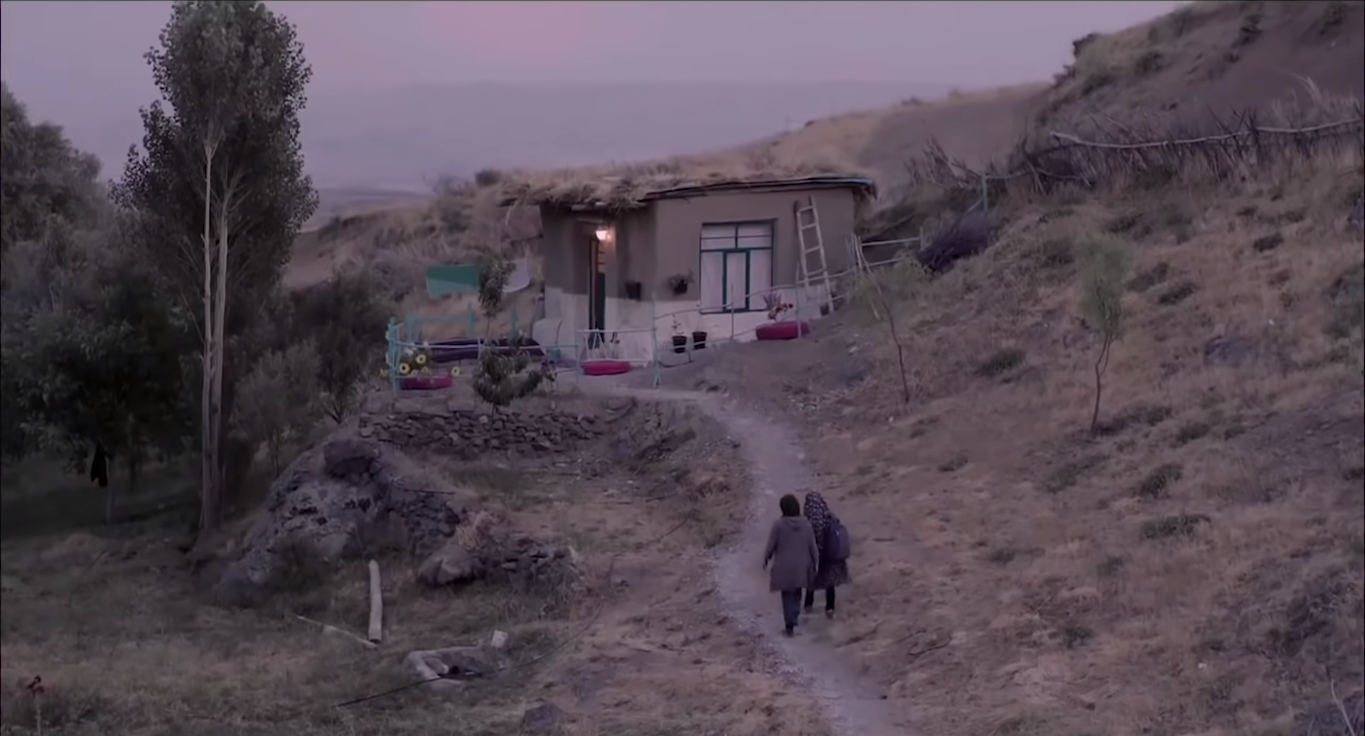
The film follows the director himself and the actress Behnaz Jafari. They received a video message of a young girl commiting suicide in an attempt to get the actress’ attention and help with the consequences of her somewhat progressive lifestyle (she studies in college and is an actress) in her traditionalist village. The three faces that gave the film its title are meant to be the faces of the three actresses in the film. The young girl that sent the message, the middle aged Behnaz Jafari and an old lady that they meet somewhere in the middle of their journey into the village. It is shot at the same location that many of Kiarostami’s films were shot, and has a lot of direct references to some of his most famous work, including the devastating ending of Taste of Cherry (1997) mirrored in the somewhat crazy old actress’ actions.
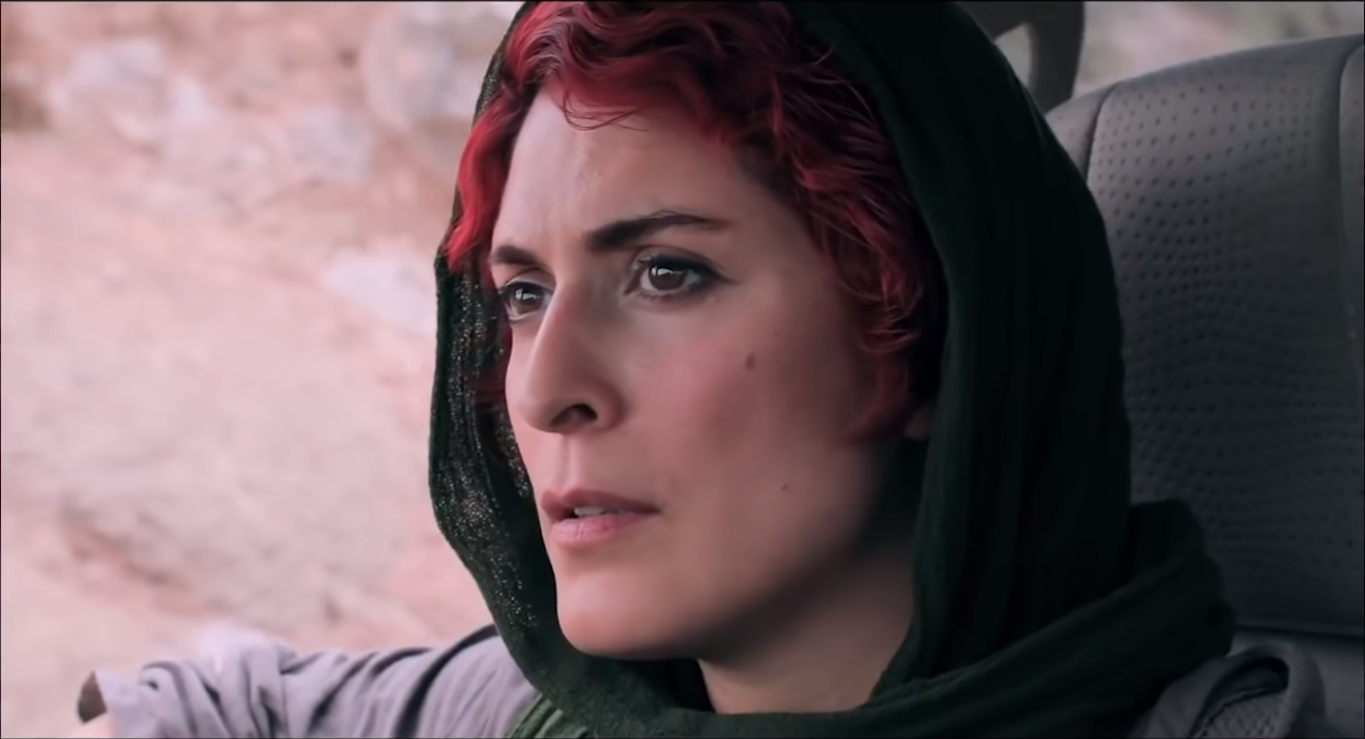
3 faces 1.pngBehnaz Jafari

As are the other films of the director since 2010, 3 Faces is a politically charged work. Panahi seems to extend his views on femininity, generational issues and religious catharsis from his other films. In this aspect, Panahi’s work seems to resemble another Iranian director that seems to be forgotten when talking about Panahi, that is Mohsen Makhmalbaf. In some of his films, of course considering Kiarostami’s influence on them as well, Makhmalbaf utilized too the fluidity between documentary paradigms and preconceived narratives to approach certain political issues – see for instance Kandahar (2001) and how it deals with the uprising war, or A Moment of Innocence (1996) and how it works with morality issues inside small communities. In the same way Taxi or This is Not a Film (2011) worked, this new film utilizes its meta elements to the fullest in order to reach the level of realism it does. It does not even shy away from going further into many other debates, much like Kiarostami’s Close-Up (1990) when it comes to the debate about the power of film and the influence of art in an oppressed society.

Despite not being as original as a film like Taxi was, Panahi seems to make a proper tribute to his masters. The debate topics of Makhmalbaf in 2001 or Kiarostami in 1990 are not the same the ones being discussed in Panahi’s contemporary cinema. Even if going as far as utilizing diegetic elements of the voyage or other direct elements of these other director, the final product is still original and relevant. There is a blend of a seemingly ascetic scenario with traditional but poetic use of framing and editing, and with a real sense of pathos that transcends the otherworldly level of cinema into real life (with a knowledge of technology and modernity that remembered us of other directors that utilized modern elements to their most real, like Michael Haneke in Happy End (2017) ). This mixture of techniques combined with the poignancy of Panahi’s assertions is hard to criticise and all of it definitely works.
3 faces 3.png

One of the most important things to take from a fictional film like 3 Faces is its sense of realism. Despite working will milions of elements and influences that are somewhat hard to keep track of, the film puts them together in a way that every frame drools a sense of what’s reality like in Iran, but even goes further in globalizing Iran’s problems. How do we deal with our professional lives, how do we deal with deceit, how do we deal with time and how do we deal with rules. What is the role of God, and does godliness ends when humanity starts to fade. These are some of the things that are hard not to think of when we see a film like Panahi’s. Much like the main idea from his 2011 film we are once faced with the fact that a film is a representation of life. Not only that, but the final product of this representation is alarming, not only because of what’s happening in some Middle Eastern countries, but because of the true universality of these problems.

7 out of 10

Ruben Brandt, Collector (2019)

Directed by Milorad Krstic

rub

“Art is the key to the troubles of the mind”

This week, for the first time on Camera Coverage, we’ll be taking a look at an animated feature. Coming from Hungary, Ruben Brandt, Collector is the first feature film of Milorad Krstic. A fairly unknown figure with only short movie credit (My Baby Left Me (1995) ), Krstic makes up a strong impression at the age of 66 years old. Regardless of its country of origin, the film is dubbed originally in English.

At the centre we have as the main character Ruben Brandt (voiced by Ivan Kamaras), a world-famous psychologist haunted by these weird and absurd dreams all connected with famous art pieces. The story advances between real life and dream sequences where famous paintings try to harm and kill Ruben. It is an extremely bizarre but captivating scenario to see; for instance, Velázquez’s Infanta Margarita Teresa in a Blue Dress (1659) trying to bite off his arm in a speeding train; or even a pistol duel against Andy Warhol’s Double Elvis (1963). These wonderful usages of famous art pieces from the western world redefine their meanings beautifully and with great taste.

vlcsnap-2019-05-11-15h46m58s874The duel with Elvis

Ruben Brandt is himself an art lover. His methods for helping his patients all connect with art, as he is a true believer of self-artistic expression to exorcise one’s ghosts of the past. Asking for help dealing with her problem with kleptomania is Mimi (Gabriella Hamori), an art robber escaping from detective Mike Kowalski (Csaba “Kor” Márton). She and the other patients in Brandt’s luxurious clinic discover his problems related to his dreams and agree they all must help him. The problems that made them enter the clinic are all related to crime and stealing so teaming up to rob to steal Manet’s Olympia (1863) is not that big of a deal. When they show this painting stolen from the Musée d’Orsay in Paris to Brandt, his nightmares with the woman portrayed suddenly disappeared. He then joins the group to steal the rest of the paintings that still haunted his dreams. The gang raids numerous museums all around the world like the Louvre, MoMa, the Uffizi Gallery or the Art Institute of Chicago, ending up getting the attention of both authorities and gang members alike.The above-mentioned detective Kowalski tries to catch Mimi and the rest of the group before other criminals get to them, attracted by the huge bounty on their heads.

The storyline ends up emulating the classic Hollywood spy and cop movies genre, being a somewhat disappointing experience especially in the last third of the film. This is a film that is to be appreciated more by the originality of the embedded details rather than the narrative itself. There are plenty of heist films clichés, and the personality of the characters is not that deep or original, maybe except for the protagonist. Regarding the plot, points go certainly to the importance given to art and its relation to the well being of an individual. The connection between psychology and art is an interesting and refreshing one, especially in a world dominated by scientific thought.

vlcsnap-2019-05-11-15h45m34s690Velazquez’s Infanta Margarida attack

Aesthetically this film leaves the viewer in awe by the gorgeous detail to both the characters and the world around them. People are portrayed as these cubistic with surrealistic undertones like a Picasso met Dali kind of style. Some have three eyes, others two heads, and, in a brilliant play with perspectives, there is a character that is bidimensional like a sheet of paper. It is an astonishing world completely filled with subtle references to all kinds of art, that goes from Soviet propaganda to American Realism painting. Besides that, a brilliant homage is also given to cinema, portrayed in the home collection of detective Kowalski. Filled with film memorabilia from Weneger’s Der Student von Prag (1913) poster to the small detail of ice cubes in the shape of Alfred Hitchcock, there´s a lot for any movie buff to enjoy in these small quirks.

Overall it was a pleasant surprise, and an animation like any other I’ve ever watched. The focus on the holistic aspect of art in the human mind is definably a positive aspect. In the end Ruben Brandt, Collector gives both an approachable introduction to art history and something that art enthusiasts can take also.

6 out of 10

The Spirit of the Beehive (1973)

(original title: El espíritu de la colmena)

Directed by Victor Erice

MV5BMTIzNjYwMTUzMl5BMl5BanBnXkFtZTcwNTE4MDQzMQ@@._V1_

“Why did he kill her?

Children in film are often used as a powerful tool to portray an array of heavy and dark sentiments through the eyes of naivety and without preconceptions. If we take, for instance, the experience of war, this innocence shattering event makes up for a potent art statement. For example, in a film like Elem Klimov’s Come and See (1985) the sheer expressions of horror in the face of the young Florya, during the Nazi’s invasion of the Soviet Union makes up for an image far more lasting than if it was an adult. There is something about the loss of innocence combined with a sense of escapism in a child’s mind to deal with that shocking reality. But it doesn’t need to be as eerie and explicit like that to make a deep impression. In a film like Children of Heaven (Majid Majidi, 1997) the journey for a poor child to get a new pair of shoes for his sister makes up for a simple but not less beautiful and warm experience.

The Spirit of the Beehive is not in anyway as a traumatic experience as the Klimov film mentioned above. The plot takes during the early years of Francisco Franco’s fascist regime in Spain. It is interesting to point out that this film was released during the last years of this dictatorship, marking perhaps, by the themes portrayed in the film, a pending weakness in the regime. The main characters are two young sisters, Ana (Ana Torrent) and Isabel (Isabel Telleria). Their father has a myriad of occupations that go from bookkeeper to beekeeper and poet.  Taking place in a small Castillian village in the Spanish Meseta, cinema is a motive for great excitement in this quiet town. The projector is set on an old barn and all the inhabitants, including the small girls watch a dubbed version of James Whale’s Frankenstein (1931). The impact is immense on the younger one Ana, who leaves the cinema traumatized by the famous drowning scene. Obsessed with the monster, she looks for any sign of the monster close to home. The search ends up leading her to an isolated old shed on a large and desolate piece of flat land. Inside there’s a wounded republican soldier, trying to escape death at the hands of the Francoist forces. The small girl, naïve to all the political struggles, steals food from home to feed the desperate soldier. The Republican partisan is found and shot by the Nationalists which leads to the suspicion that Ana’s father was the one helping him. The pressure for the daughter ends up being too much and she escapes next to a lake, making a clear parallel with the Frankenstein plot.

captura-de-ecracc83-2019-05-01-acc80s-17.04.18.png
The impact of the film reflected in her eyes

Portraying a Republican this way, like a wounded horse waiting for its demise, is an obvious example of a critique against the then fascist Spanish regime. In the seventies, dictatorships in Europe suffered an enormous amount of pressure by the rest of the western powers that already lived in democracy. Regimes like the Spanish (and as well the Portuguese one) grew more and more isolated. That could explain why films like this one or Viridiana (Buñuel, 1961, a ferocious critique of the catholic church, usual theme in Buñuel) passed the censors, despite the bad image they made of the regime. With general Franco’s death in 1975, Spain would finally make its transition to a democratic regime. Despite this obvious message, this film is much more than a political statement. It deals with the pureness of a child’s imagination, and how the make believes sometimes juxtaposes the sense of what is real. The innocence of Ana makes her completely unaware of the possible troubles she may be getting into by helping the soldier. Ana Torrent (that would end up working also with Carlos Saura in Cría Cuervos (1976)) makes up for an extremely sincere and sweet innocent child, in one of the more perfect roles played by a child that young. Merit has to be given to Erice for being able to blossom such a talent in a little child.

captura-de-ecracc83-2019-05-01-acc80s-16.55.38.png
The vastness of the Spanish “Meseta”

On top of the terrific performances, the cinematography is clearly an astonishing feat. The stellar work of Luis Cuadrado (who ironically was losing eyesight during the shoot) is found in creating this sense of emptiness both inside the buildings and in the vast Spanish flat lands. The house where the children live feels old and uninhabited and the small village is surrounded by immense of dry fields to lose sight on. The emptiness feels like a colossal canvas for a young child’s imagination. Together with the somewhat eerie but at the same time comforting soundtrack by Spanish composer Luis de Pablo, The Spirit of the Beehive is a cinematographic experience like any other.