LEFFEST – Lisboa & Sintra Film Festival 2019


leffest.jpg

We at Camera Coverage have been attending to the 2019 edition of the biggest film festival in Portugal and thought of speaking a little bit about the films we have been able to see. We got our heads around the whole section of the films in competition to the festival’s awards, and some of the new releases on other sections of the festival. Between all of these we thought of making our brief selection of films that are for us the highlights of the festival. Also, from Wednesday forth we are thinking of making more focused texts on what we think is our favourite of the festival, and the films that were awarded by the selected jury of the festival – that are to be announced in the 24th of November.

For our list we have picked three highlights from the festival selection in the competition.


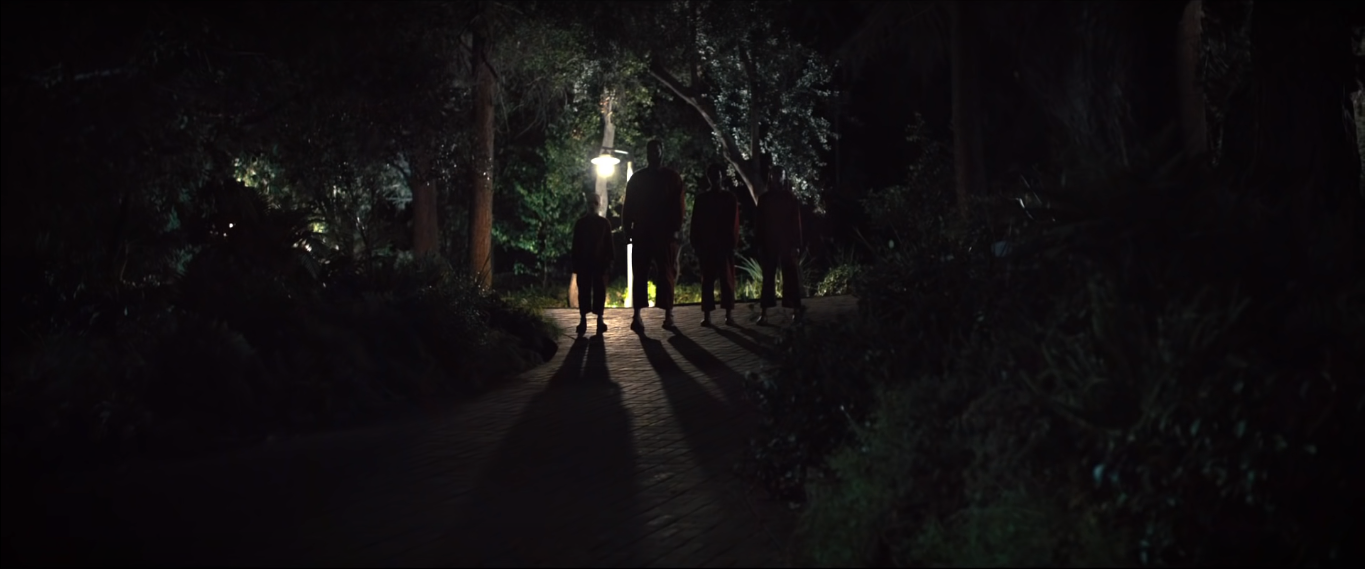
Atlantis, by Valentyn Vasyanovych


atlantis 3.jpg

This year’s competition was packed with two films from the old Eastern Block that find themselves in somewhat the same category. These are The Criminal Man, by Dmitry Mamuliya and the afforementioned Atlantis, by Valentyn Vasyanovych. Both of these films are paced with care and drag the viewer into a very slow pacing, being easy to put them in what some call the “slow-cinema” category. However, while Atlantis presents consisted cathartic and poetic imagery, The Criminal Man seems to be a film in which there is a great central scene – arguably greater than any scene in Atlantis – and feeling a bit empty in comparison. Atlantis is a film that has its setting in a dystopic post-war Ukraine, following a main character suffering from PTSD. There are many scenes of despair, many moments where we may be led to think that Vasyanovych really has no hope for his country and his people after the consequences of the war. By the end though, we are faced with this flash of light, as poetically depicted as any of the shades of grey previously presented in the film, that remind us that the power of love and humanity  is strong enough, not only to be reborn from the remnants of such war, but I would even say taht there is here a suggestion that this light may even prevent us from falling into this dark utopia if we keep it close to us.


Beanpole [Dylda], by Kantemir Balagov

kinopoisk.ru


Arguably one of the most talked about films in the festival scene, Kantemir Balagov’s Beanpole deserves every bit of the attention it has received. The film deals with a plethora of complex themes, and presents them with, however extreme, 100% believable situations. The fluid sense we have – much of it provided by a sober set and art design – between all of these is impressive. From war trauma, to poverty, to complex romantic and motherhood dynamics, Beanpole seems to gather all of this seamlessly. It is a beautifully shot film, with a strong sense of colour and aesthetics, including a dynamic camera that switches from being handheld and really shaky to fluidity and steadiness at a pace that is hard to notice as we are mesmerized with everything that is being portrayed. The sense of pathos in Beanpole is the probably one of the strongest from the festival, and the performances are certainly the most convincing. A cinematic treat for the eyes, and an always important reminder of what extremes can the human soul deal with.


Fire Will Come [O Que Arde], by Oliver Laxe

fire will come

A personal favourite of ours, O Que Arde by Oliver Laxe is one of the most subtle and gentle depictions of the complex nature of human beings. Between the beautiful landscapes of Galicia and their absolute destruction there are humans and their complex, but nonetheless consequential, relationships. We follow Amador through his journey back home from being imprisoned for causing a massive forest fire in his region. He deals with his everyday chores in the countryside, next to his mother Benedita – a charming powerhouse of a 80 year old woman. There is a sense of silence and of the ephemeral throughout the whole of the film, despite the absolute chaos that is the nature of human existence. Even when filming the forest fire scenes there is a sense of calm, a sense of beauty and a sense of sobriety that gives opportunity to the viewer to mingle on the many subjects the film can extract from our lives. Family, ecology, social life, the rural world, decadence, destruction and limits. All of these and none of them at the same time. O Que Arde is without a doubt one of our 2019 favourites.


Other honourable mentions:

Tommaso, by Abel Ferrara
Balloon [Qi Qiu], by Pema Tseden
Atlantics [Atlantique] (out of competition), by Mati Diop


The Beach Bum (2019)

Directed by Harmony Korine
mv5bmty3mduzmtazov5bml5banbnxkftztgwndk3odqynzm40._v1_sy1000_cr006751000_al_-1

“He may be a jerk, but he’s a great man.”

Korine became known on the movie industry for writing the screenplay for the critically acclaimed Kids (1995), being only 19 years old at the time. Made his directorial debut with Gummo (1997), Korine started to implement his vision for cinema. Unlike traditional American cinema (that depends heavily on the power of narrative), he prefers an approach not so plot based. The film flows freely along the small events that occur, without a sense of a strict plotline that must be respected. In a way his vision of cinema is closer to a European one, in line of a Godard or a Cassavetes (in terms of artistic inspiration, as in quality he is a few steps below still).

It is not in any sense a figure praised by everybody. His films create a divide both among critics and overall public. For instance, in his previous film Spring Breakers (2012) he tried to make a social commentary of naiveté and the new” American dream” the younger generations, using Florida as background. The result had some interesting notes but is one of those films that tries way hard to be more profound than it really is. And that is usually the reason that leaves people often disappointed with his work.

In Beach Bum Korine returns once again to Florida but using a different approach. Florida still maintains the very saturated colours that were used in Spring Breakers, along with some great cinematography. It carefully translates the warmness and tropical aspect of the place with some gorgeous backgrounds. The difference lies on the overall tone of the film. Florida is depicted usually in film as this tropical paradise, but the reality is usually grimmer than that. The Florida Project (Sean S. Baker,2017) did a great job portraying the lives of lower classes in a cheap motel, showing a rather dark side to the stifling blissfulness.

There are no taboos in Korine’s films, either it be sexual, drug use or violence and Beach Bum continues to follow that line. As the protagonist we have Moondog (Matthew McConaughey), this hardcore stoner that lives this extremely hedonistic life without rules. McConaughey plays with great ease a role that its not that new to him (as for instance Linklater’s Dazed and Confused (1993) ). As the film progresses, we learn that he used to be a great writer but now lives of his multimillionaire wife Minnie’s (Isla Fisher) bank account. It´s a non-conventional and open relationship, noted by the multiple affair that they both have, something that don’t seem to bother them that much. It’s only the event of their daughter Heather´s (Stefania LaVie Owen) wedding that brings them together once again. The absurdity of the wedding brings along some great comedic scenes as well some interesting caracters such as Lingerie (Snoop Dogg). Despite having an obvious affair with his wife, Moondog is still very fond of him. The film then takes an tragic turn that leaves Moondog completely broke and homeless. The only way of getting the money back if he writes a new book, something that he is avoiding for a long time.

These two events come without notice a shape the flow of the film. Throughout his ramblings he encounters some eccentric characters like Flicker (Zac Efron), an sociopath pyromaniac with an spiritual side, or Captain Wack (Martin Lawrence), with his fixation with dolphins. Everywhere he goes positivity follows him. There are no dirty places or bad people, everything is glowing in Beach Bum. His life seems completely chaotic and without any shape of planning. He is a free spirit, loved by everybody, and always with an unshakable positivity. It’s almost discomfortable his level of happiness, almost childlike and completely unaware of his surroundings. But it always works out well for him in the end, even when all could go wrong. The cathartic ending shows his views about money were purely utilitarian. He needed the money to continue his lifestyle, not for shows of grandeur and opulence. It can be seen as a critic to the money culture that rules over us and distracts us from the most important things in life.

Overall its an interesting experience that tries to convey a more positive outlook to the problems of the world. On a more profound level Moondog is a troubled soul showed by his alcoholism, drug abuse or his womanizer ways. Despite that he still has an inspiring way of guiding himself towards happiness as his main goal to life. It´s not a life changing film or his message is new by any chance but in the end, it makes up for a different and thought-provoking film experience.

6 out of 10

Us (2019)

Directed by Jordan Peele

1

“We’re Americans.”

After the massive hit that was Get Out (2017), Jordan Peele kept showing his love for horror and a will to keep on writing new material in the genre. The subtexts and politics of Get Out (2017) were clear and well transformed into a more or less consistent concept. The value of the film was deposited in the dynamic of this transaction of racial politics into the horror film discourse, and by provoking the viewer with suggestive and anarchic ideas (similar to the one’s by Spike Lee). It was a film that worked as a genre piece but utilized its strengths to reach the public and confront them with realities that while terrifying are enlightening. Daniel Kaluuya presented us one great performance, backed by an incredible supporting cast. That is the main thing that mirrors and is enhanced in Us. The performances are well-above average and the film owes its cast a lot for its dynamic between horror and comedy (presented even more extremely than in Peele’s previous).

us 1.pngShadows and reflections are essential elements of the film
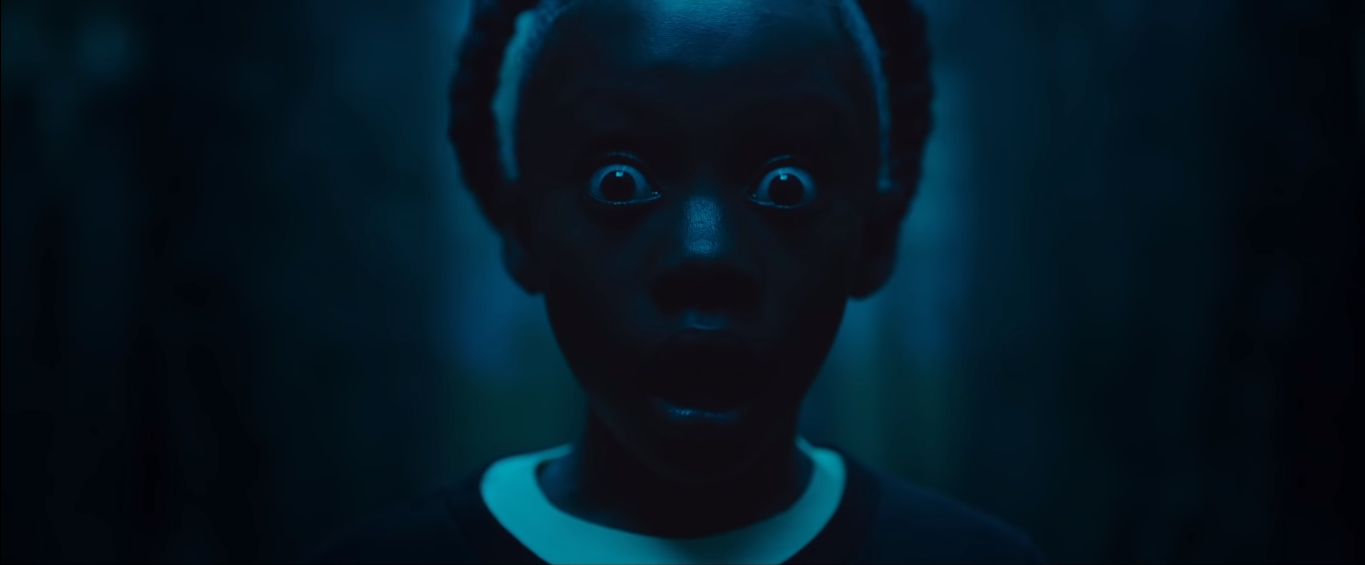
The game of mirrors presented in Us starts right of the bat with the name of the film. There is ‘Us’ and ‘US’, and with that information in mind we can expect the film to present certain political ideas. The problem with it is that most of the times the small scenes are full of certain meanings that contrast with the main concept of the film, creating a lot of room for interpretation, especially considering the film as an exercise in ideology. The best thing about the film (after Lupita Nyong’o’s mesmerizing performance) is arguably how vague its political readings can be. We are teased with the idea of it being a political film with the title alone, and yet the film challenges us to dig deeper to find any consistent concepts regarding its ideas. Despite touching on the subject of racism, Peele’s vision is now aiming at broader issues with Us.

Being a comercial film, it comes with its problems. Some of the scenes in the film are too predictable in its stereotypes. What helps the film to get over these scenes is its usage in an almost metalinguistic cinematic way. Peele knows his horror clichés and uses them in an ironic way briliantly, playing with our expectations and creating genuinely funny moments. As an European citizen it is hard to understand the realities of racism in America (mostly due to our racial prejudices being of a different nature and having a different expression), so probably these complaints at the end of the day are just conditioned by my personal life experience. Having this in mind, Us regards the subject of racism in a lighter way than what was expected, especially considering its main theme. This is not a negative criticism at all, because as I mentioned before, the vagueness of Us adds a lot to any reading of the film, including a reading inclined to the ideas of racism.”

Visually it is more interesting than Get Out (2017), despite being a completely different film. It is creative and intelligent in its visual style, enough to be noticeable when comparing it to other big horror blockbusters. However, it still ends up feeling a little bit flat, just like Peele’s previous did. The use of music is brilliantly funny, and the original soundtrack is really great as well, especially the anthemic track (that reminds me almost of The Omen‘s (1976) soundtrack). Technically it is satisfying enough, never being truly flabbergasting.

us 2.pngThe already iconic shot from Us

By what I’ve said so far one would assume that Us is a brilliant film. But it is not. It is too vague and too self-conscious to be just a commercial film to watch at the mall, and too predictable in its techniques and paralells to be a really serious and innovative picture. One of the things that troubles me the most is that its vagueness translates a lot into meaninglessness, even though it is clear that there was a care in creating a well-rounded plot (in a Hitchockian way) and complete concept. The second thing that annoys me is the necessity to overexplain everything in the end. The “plot-twist” was rather predictable and despite the film having a lot of interesting buried plot points, it leaves a more experienced viewer feeling that the film is being condescending.

This text took into consideration spoilers and I decided to not discuss any of the plot, as it is very fun to watch without knowing what it is about. Gather some friends and go watch it. Probably every person will come out of the theater with a different reading of the film (I read somewhere that a guy thinks that the film is somehow anti-socialist. I highly doubt that though) and it is an enjoyable time in the cinema. Don’t expect too much out of it, but face it with enough seriousness to consider it, as it is clear that a lot of work and dedication went into it. Jordan Peele seems like he will be the new horror genre director to look out for, though.


6 out of 10

The Sisters Brothers (2019)

Directed by Jacques Audiard

MV5BOTZmNTI1MzMtMGY0ZS00YTRlLWI4OTktYzE3YzZjZjJkNDVlXkEyXkFqcGdeQXVyMjM4NTM5NDY@._V1_SY1000_SX675_AL_

“I had to help him. He is my brother.”

The western genre has been a staple of the American cinema since its early beginnings in  the turn of the twentieth century. It helped to create a romanticised image of USA’s growth as a powerful nation, from the lawless open deserts filled with bandits, to the fights against the native Americans. Sometimes problematic by today’s standards of justice and ethics (mainly because of unjust representations of non-whites) the western were a very successful category mainly until the end of the sixties when the Vietnam war and the civil rights movements shifted the attention to other more pending issues at hand.

The Sisters Brothers is the last main western release in line with the many that came out in the last years. This western revival has a different paradigm to what it was the purpose of old-time ones. It focuses on unusual themes for the genre (like the African-American struggle in Django Unchained (2012) or portrays the characters in a rather much more crude and realistic tone compared to the idealistic and clean aspect of the old westerns (for instance The Revenant (2015) or True Grit (2010)). The film we´re focusing on today takes a similar stand and pretends to use some of the western typical tropes to depict a deeper story than it appears on the first hand. As the two main protagonists we have Eli Sisters (John C. Reilly) and Charlie Sisters (Joaquin Phoenix). The two brothers and outlaws serve as hired guns of a mysterious wealthy man known only as the Commodore and accept a contract to kill a a man named Hermann Warm (Riz Ahmed), a chemist rumoured to have found a formula that makes the gold glow underwater.  The film is set during the gold rush in the western part of the United States. It takes into thoughtful consideration the creation of a truthful atmosphere, displaying a effervescent growth of towns made up by people fascinated by this “easy” way to get rich. Another character named John Morris (Jake Gyllenhaal), also an employ of this Commodore, tries to find the same man as the Sisters. He is the first to encounter Warm, who after some initial struggle convinces him to join him in a partnership. Warm is an idealist kind of man, dreaming that the money raised with his invention could make way for an commune in Texas, where every man was equal and without social classes. The film takes place in 1851, three years after  Marx and Engels’s Communist Manifesto was published and it sure had made a deep impression on Warm. Despite this hopefulness in his mind, his invention, as we can see in the end of the film, is of terrible physical harm to humans. Almost as if there is somewhere a metaphor associating creation of wealth and the suffering of millions of low-class citizens.

vlcsnap-2019-03-23-19h34m47s543“You never thought about stopping?”

The focus of the film is primarily the relationship between the two brothers. Eli acts as the more responsible of the two, almost as a father figure to Charlie, always trying to protect him. Charlie, on the other hand, is a drunkard, with a somewhat nihilistic posture to life. In a scene we see the two discussion a future without being hired killers, with Charlie being deeply against any possible career change. Despite all the harsh times and difficulties, we can experience an honest brotherly love between the two. They only have each other and shared a severe childhood, mainly because of a drunk and violent father figure, something that can explain most of Charlie’s attitude towards alcohol and violence.

Director Jacques Audiard (responsible for films such as Un prophète (2009) or De rouille et d’os (2012)), makes its first English speaking feature with The Sisters Brothers. Like Sergio Leone and all the “Spaghetti western” genre, not being an American truly brings a fresh new approach to such a classic and almost a creator of an American identity. Despite being a violent film, with the protagonists being cold hard killers without remorse, the viewer cannot help but to empathize with them. The “Wild West” was truly a rough time to life and that is well represented in the film. In a scene we see a spider entering Eli’s mouth, making him very sick in the following day, in one of the most gruesome moments in the film.  Everything surrounding the brothers seems to want to eliminate them, from other outlaws to Mother Nature itself. Despite all the euphoric feeling towards a growing economy, there is a deep loneliness in the men, completely tired of this extremely competitive world. The ending of the film truly reflects that, not obsessing, like old time westerns, in a sense of true justice, but in internal peace and fulfilment.

The Sister Brothers is a good film, with superb performances and a great care for the film’s ambience. It is not a perfect film, mainly because some of the sudden changes, from slapstick comedy to the more dramatic moments feel somewhat odd. It may also feel to more impatient viewers as if nothing much is going on many if the scenes. Despite that, is an different approach to the genre and definitely not to be missed.

7 out of 10

Gräns (2019)

(eng: Border)

Directed by Ali Abbasi

grans 1

“I don’t see the point of evil.”

Inspired on a novel by John Ajvide Lindqvist (better known for Let The Right One In), Border is one of the films to have a lot of controversy and high regard last year. To it was awarded the Un Certain Regard award at Cannes, and it even managed to swiftly get a nomination to the Oscar for Best Achievement in Makeup and Hairstyling. The controversy is mainly due to the sexual nature of its themes. It is an undeniably shocking film. The usage its shock value is, however, very pertinent. As Let The Right One In (2008), the transformation of Lindqvist’s story into film works brilliantly, combining the already poignant themes present in the words and visually expanding them, something that is even more noticeable in Border, mainly due to the irreverence and shamelessness of the film’s imagery.

The film follows Tina (Eva Melander), a security officer working on border control, and he daily routine. She is not blessed by standards of Western beauty and has a menacing look that works well with her magical power of being able to smell people’s feelings. She lives an unhappy marriage and has no friends other than her mentally-ill father. There are two big changes in her life when she smells a memory card on a passenger’s phone that is full of snuff films and child pornography and on another scene sees a guy that is oddly similar to her and confuses her special sensibilities. These changes lead to two inner plots in the film that consist on one side a detective thriller-like film and on the other a romantic story that leads to Tina’s discovery of her true identity.

border 2.png

Border is a story of fluid bodies and souls trapped in an ordered world. Tina and Vore (Eero Milonoff) are figurations of chaos inside an organized Western society. However, if we consider the sexual nature of the film we quickly understand that there is a political edge to this chaos. Combined with the ideas of social isolation, foreignness and family issues we understand that the new dynamic presented by these two special characters is an amalgamation of every otherness that exists in our contemporary world. So far so great. The problem with the film is that while presenting brilliant ideas, it overly complicates them and by the end it leaves an undesirable odd feeling to the viewer. Of course this ending can be read as an anarchic solution to the aforementioned themes, or even as a following to the mythology presented half-way into the story, but never does it feel as smooth as expected. Comparing it to something like the ending of Do The Right Thing (1989), for instance, it feels really off considering the way the plot devices work beforehand.

Technically it is a decent film. It never does something that is not expected from an ultra-realist style film. Sometimes the camera seems to be too shaky, and even nauseating at times. In other scenes, the fast movements of the camera and all the shakiness contribute greatly to the inner beauty of the film. The original soundtrack is very enchanting and is really on the same page with the tone of the film. The make-up effects are pristine, as is Melander’s performance. I would say Eero Milonoff’s performance is never up to par with Melander’s, and sometimes is not even really good at all. But then again, that is never a big problem (even if combined with the shaky camera aspect of the film) if we face it with the originality and boldness of all the other decisions surrounding it.

border 4.pngOne of the great visual moments in Gräns

The reason I was not a big fan of Let The Right One In (2008) is probably the reason I am actually a big fan of Border. It is a consciously awkward film, one that is aiming specifically at shocking the viewer in order to get its ideas out there. Most of the times this technique does not work, but with Border it does, as it is probably the perfect figurative film of the many lost souls in our monotonous society. Even though it is not perfect, particularly the thrilleresque subplot, Border works a lot better than expected. This review tried to say as little as possible about the singular elements of the film because in order for it to work it is mandatory to watch it with little knowledge about what is so special about it. It released in Portugal last week despite having been distributed in the rest of the world earlier this year. Still, try and watch it on stream or DVD, because if you don’t, you will be missing what is probably the most excruciatingly, cringeworthy and at the same time beautiful sex scene of the last few years (and for that alone it deserves ½ a point).

6.5 out of 10

Green Book (2019)

Directed by Peter Farrelly

green book 2.png“So if I’m not black enough and if I’m not white enough, then tell me, Tony, what am I?” – Don Shirley

Green Book is a film directed by Peter Farrelly, who has mostly a bunch of major successful comedies on his record like Dumb and Dumber (1994) and There’s Something About Mary (1998). This comedy past is clearly an influence on this production, which provides a more light-hearted mood to an otherwise dark themed film.

The story follows Tony Lip (Viggo Mortensen), a rough Italian-American bouncer in a upper class night club during the 1960’s. Suddenly out of work after the club closes for renovations, he is compelled to get a new job fast to pay for his bills. An old acquaintance gives him the contact of a “doctor” who is in the need for a new chauffer. This “doctor” ends up not being a medical one, but a stage name for pianist Dr. Donald Shirley (Mahershala Ali), who is planning a concert tour in the south of the USA. As an African American Don is clearly anticipating problems relating his skin colour on the deep American south, so he is counting on Tony to not only drive him around but also be a kind of bodyguard. After some reluctance, he accepts the job. His hesitation is mainly due  to racism: having a black person in charge felt humiliating for Tony.

The film does a good job portraying the mob mentality of racism inside the Italian-American community, who suffered discrimination from the other white ethnicities. John M. Parker, a American Democratic politician from Louisiana (ironically one of the places where Don Shirley stopped in his tour) described the Italians as “just a little worse than the Negro, being if anything filthier in their habits, lawless, and treacherous”. Despite that, they hold on to their white ethnicity very strongly as in a way to feel superior. This power relationship was explored in a powerful manner by Spike Lee´s work Do The Right Thing (1989). There we see that despite similar economic backgrounds of low-income status, racism is still a powerful tool for compensating internalized shame, as in a way as saying, “at least I’m not black”.

vlcsnap-2019-03-09-15h06m25s979The first meeting in Don Shirley’s house

But in this film the power dynamic is different, because of the economical status of the two main characters. Shirley is a rich and highly refined pianist, familliar with the best things in life. Tony on the other hand comes from a low-income family and must work hard just to make ends meet. He tries to show throughout the film how he is closer to the African-American culture than Shirley, by showing him things that he has not experienced in his life such as listening to black music and eating fried chicken (which was apparently false in real life, accordingly to Shirley’s family). The film tries to get across the image that the racism that Tony displays is completely unjustified because he is closer to black culture than Don. But what Tony fails to understand is that despite not being connoisseur of the typical black culture, he stills suffers discrimination from the fact that he is black. More than that, it sure has racist undertones, especially in the correlation between being black and enjoying the stereotypical black culture, especially when made by a white man.

vlcsnap-2019-03-09-15h05m51s415“Thats why you drivin’ him around. You´re half N- yourself”

As the film goes by the relationship between the two grows stronger, with Tony Lip saving the pianist from many problems derived from the blatant racism in the south. This is another problem that the film ends up creating. The protagonist of the film is clearly Viggo Mortensen’s character and not Don. It is a movie trope present in a lot of Hollywood films (such as a classic like To Kill a Mockingbird (1962) or more recently The Blind Side (2009) that shifts the focus of the film from the narrative of suffering of the minority to the act of saving by the white character. Worse than that, it almost creates the image that the non-white person is incapable of saving him/herself from all their problems, many of them ironically created by the whites themselves. Despite this drawback, there are some funny and engaging moments portrayed by Viggo Mortensen, and a stellar performance by Mahershala Ali, which ended up earning him the Oscar.

The film ends on a cosy Christmas dinner with Tony Lip’s family where Don Shirley ends up joining them. The resentment against black people suddenly disappears and everybody accepts the black man at the table. This Christmas setting (despite not clearly being the director’s decision to make this statement) is the perfect analogy for racism amongst the white society. We all remember the messages of forgiveness and solidarity that go around in text messages, and suddenly everybody recognizes the need to help the homeless and foster care children. The warm and fuzzy ending to this film encapsulates precisely that feeling. It feels more like holiday spirit than a real change of attitude. Giving this film the Best Picture award at the Oscars – especially when a more poignant movie like BlacKkKlansman (2018) is also nominated – feels like Hollywood only wants to scrape the surface of the problem, without creating much fuss and controversy.

5 out of 10

A Portuguesa (2019)

a portuguesa

Sempre a guerra. Agora já leva crianças pobres com ele. Para morrerem.

[It’s always the war. Now he takes the children of the poor with him. To their deaths.]

The new Rita Azevedo Gomes film may seem meaningless to people outside Portugal, but as a Portuguese Cinema fan it is exciting to know that a director with such a small but critically acclaimed filmography just released new work. As a director, she has claimed her main influences, and this time she did not even needed to talk about them, as they are clear to anyone that goes through the film. She is working with an old-school film festival favourite actress, Ingrid Caven, and her performance is probably the highlight of the picture. Despite being an interesting homage to many visionary directors and containing great shot compositions (with the help of what is arguably the greatest Portuguese cinematographer, Acácio de Almeida) and a hypnotic soundtrack by José Mário Branco, The Portuguese Woman falls short in its delivery.

The film adapts a story from the 1924 novella by Robert Musil with the same name, with dialogues adapted by Agustina Bessa-Luís, a favourite of Manoel de Oliveira. It follows the story of a Portuguese woman (weird hun?) when she marries a German lord and lives in a castle in Germany while his husband is busy leading a war. It trails their romantic lives while he is in war, and what changes in their relationship when he comes back from it.

a portuguesa 1.pngThe ever beautiful Ingrid Caven in the beginning of the film.

Before I present the reasons I think why this film does not fall into the category of being great at all, let me first point out what holds the film up. There is a clear sense of cinematic conceptualization. A balance between the images and the sound and the music that is absolutely mesmerizing and engaging enough to create hope in the viewer for something great. The incredible care with framing reminds me of, of course, Oliveira’s work (as the director herself has mentioned the film as being a follow up tribute to Oliveira’s body of work), but mainly reminds me of Dreyer and, oddly enough, Peter Greenaway. There is an insistence in The Portuguese Woman of transforming beautiful roccoco painting archetypes into film, working almost like tableaux vivants. Rita works with the tools of camera movement and actor movement to lead us through these living paintings in a way that is diegetic enough to counterpart the hardship you will have in deconstructing the dialogues themselves (especially if you are a casual Portuguese citizen watching the film without subtitles). The soundtrack complements beautifully the rhythm of the scenes, even though that sometimes you feel the sound design of the film (especially regarding dialogue) to sound a little strange in the overall composition of the scenes (at least odd enough for me to notice).

The main problem with the film, and comparing it with some of Oliveira’s films for instance (and I know comparing is not the right way to analyse a new film), is that despite having some brilliant scenes, as a whole, it leaves the viewer feeling like the film is an exercise in futility. There are singular moments that are brilliant, and most of them are visual moments. I have no disdain for Agustina Bessa-Luís’ work (especially considering her words in Vale Abraão (1993) and her novels), but I truly feel that her script combined with the less-amazing and unoriginal scenes create a feeling of decadence that hasn’t the right to be in a tribute film. It is frustrating to deconstruct a film that is as beautiful and competent as this to only find banal and tired ideas that were already messed with a million times, and no overarching concept to hold its existence. And this is where the comparison with Peter Greenaway disappears, because there is no breaking of the narrative conventions in The Portuguese Woman that compensate for the extensive use of the aforementioned indulgent filmmaking decisions. I know that the screenplay is supposed to sound theatrical and poetic (just as it was in, again, Vale Abraão or Francisca (1981) ), but there is something in this particular picture that is profoundly distasteful and tiring.

a portuguesa 2.pngAn example of the mentioned idea of tableaux vivants.

It is a frustrating film for the potential it had to be great. The faces, the costumes, the voices, the colours, all of the small elements are meticulously chosen to compose every scene. The presence of Ingrid Caven brings a mesmerizing element of a Greek Chorus-like nature to the film, another ingredient added to what could have been a great cinematic work. The themes of womanhood, lethargy and class-relations are there though, even if disappointing in their scope. The lighting is great and magnetic. The music – enchanting. Even Bessa-Luís’ words are beautiful, but feel misplaced, and even misspoken at times. The film itself… it really has nothing new to say, and while it is presenting nothing new, and in spite of its cinematic beauty and being a noticeable tribute, it is remarkably unsatisfying and inconsequential.

5 out of 10

Vice (2019)

Directed by Adam McKay

0190456.jpg-r_1280_720-f_jpg-q_x-xxyxx

‘If you have power, people will always try to take it from you. Always’ – Lynne Cheney

Adam Mckay gives another try on directing a political commentary film with Vice, three years after his last production. His career is filled with comedy directing credits, from SNL sketches to Hollywood hits like Anchorman: The Legend of Ron Burgundy (2004) or Step Brothers (2008). In The Big Short (2015), McKay tried to ally the seriousness of the 2007’s mortgage housing crisis in the US with a combination of humorous characters that work as a comic relief on such a severe topic. On Vice, the recipe is taken up a notch with an even more extreme approach to the theme of the film.

Vice works, on a primary level, as a biopic of the Vice President of the USA during the George W. Bush era (2001-2009), Dick Cheney (Christian Bale). From his troubled Yale years to the personal ascension inside the power dynamics of the White House, the film is never clear on what are his real goals. A scene on the first half if the movie shows his wife Lynne Cheney (Amy Adams) giving him an ultimatum implying she would abandon him in case he didn’t amend his behaviour. In all the motion picture, the figure of Lynne is a potent influence on the action of Cheney. Throughout the film, a clear connection between Cheney and his family is shown, as a way of not only trying to give an alternative and more positive view of him, but also serve as a motivation as to why he is acting as the way he is. The family is painted as a close clan whose protection and ascension are the primary goal for him.

McKay tries to paint an image of a man whose obsession for power makes him look like an introverted sociopath without any ethics, except for his own personal gain, with the leverage of a kind family man to balance it all out. But even his close ones suffer from the thirst for power, especially his daughter Mary (Alison Pill). Although he always accepted her choices, her sexuality is the appointed reason by Cheney for not running for President, as it is something that would diminish his chances. Later when his other daughter Liz (Lily Rabe) decides to run for Senate, he approves her decision to not support gay marriage, as it would hurt her chances with the more conservative Republican voters. After the crumbling of his political career, the family cohesion is also shattered, leaving the viewer confused on what were his real motivations after all.

Christian Bale, who also worked with McKay on The Big Short (2015), goes again to extreme measures in an effort to give the closest portrayal of Cheney. His method acting made him gain almost 20 kilos and shave his hair. Besides the work on physical aspect, the voice and mannerisms are also not missed, making Bale a strong contender for the Best Actor award on the upcoming Academy Awards. The rest of the cast also delivers strong performances. Amy Adams incarnates a strong wife that, in a way, feels that she is the one truly in charge. Sam Rockwell does what he is best at: after winning the Oscar for best supporting actor last year, he displays here an eerie similarity with George W. Bush, especially with both the accent and tone of his voice. Despite this, the viewer cannot help but feel that he is spared of much of the guilt, by displaying Bush one sided only as an ignorant fool. Steve Carrell (playing Donald Rumsfeld) distances himself even more from the comedy actor typecast, showing once again that he is capable of doing more serious types of characters.

Despite the powerful performances, it feels somewhat exaggerated at times, mainly because of McKay’s editing quirks and misplaced satire. It works, for instance, on the Macbeth reenactment by the Cheney couple, establishing, like the original Shakespeare work, the importance of the wife in the way the lead behavior. But on the other hand, the constant uses of documentary footage make the film lose focus as on what it is trying to be. The “credit roll” on the middle of the film doesn’t really work and appears a little bit forced, especially because the second half doesn’t fit that narrative (and being the second fake ending I watched recently after Gaspar Noe’s Climax (2018), let’s hope it doesn’t become a trend). The narrator (Jesse Plemons) is also a character that shows up in the film without much reason and the plot twist feels a tad forced (especially on the light of the trope of Cheney’s almost humorous heart attacks).

03-vice.w1200.h630“I believe we can make this work.”

It’s a film of the Trump era, clearly making a lot of connections between Cheney and the current US President. The rage that McKay tries to impulse on the viewer by Cheney’s actions serve as a warning for the present American administration. After the final credits roll there’s an extra scene that disperses any doubt that this is a movie for the current times. One of the mechanisms used by the Bush administration were the creation of focus groups which helped justify the war to the American people. But in this after credit scene it is the movie itself that is being discussed. The same focus group reappears where a stereotypical white Trump supporter denounces a liberal bias throughout the film, starting a fiery discussion in the room. As it erupts, one disinterested member remarks that she is looking forward to the new installment of the Fast and Furious franchise. It’s a cheap shot to audience as it tries to tell them that the fault is also theirs. Nonetheless, despite the lack of interest in politics which usually results in abuses in power, it’s not impossible to enjoy popular culture and take political stands. A populist conclusion on a movie that supposedly criticizes the same evil.

6 out of 10

The Favourite (2019)

Directed by Yorgos Lanthimos

the favourite 1

“I must take control of my circumstance. I’m on my side, always. As it turns out I’m capable of much unpleasantness.”

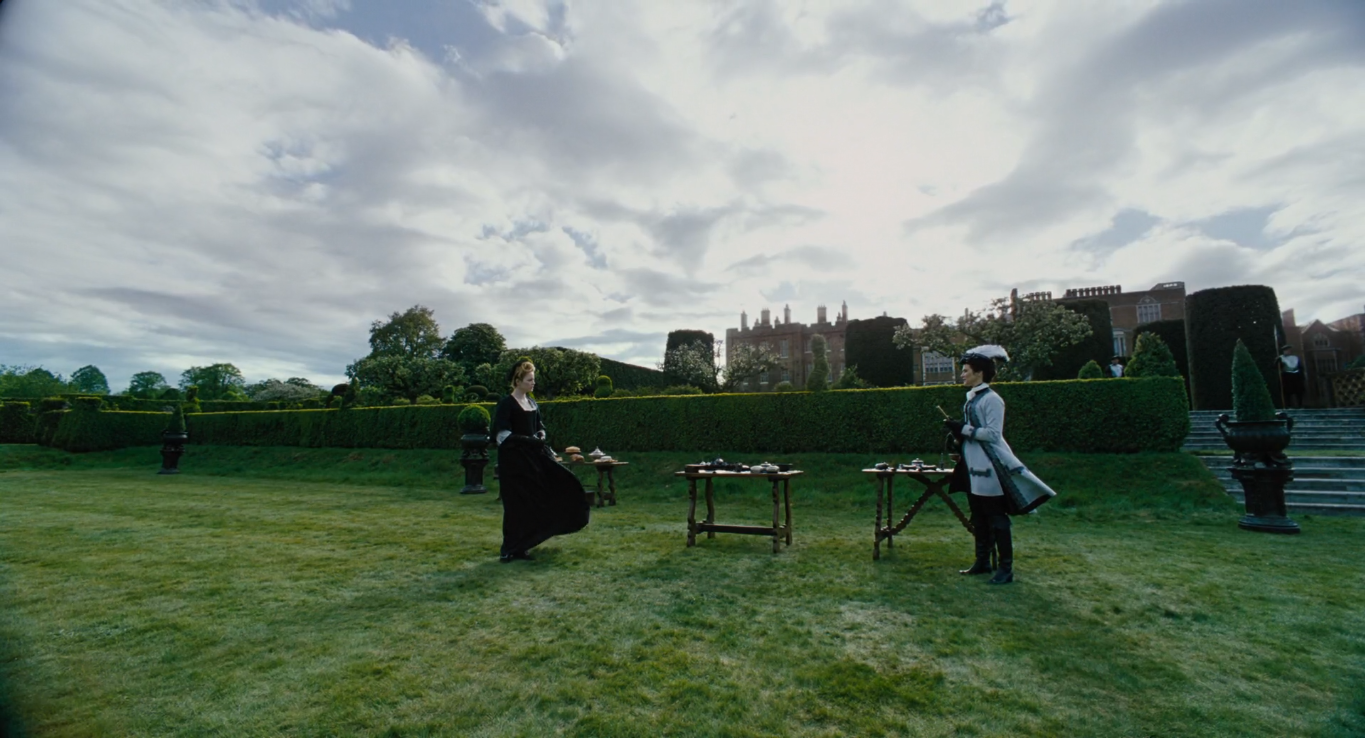
Yorgos Lanthimos is a Greek director that has first gathered international attention in the big film festivals with Dogtooth (2009) and has since then gradually gained public attention. Despite the many quirks and particularities of his previous projects, one of the big changes going into The Favourite is that it is the first film in which he worked not having written the screenplay with his associate Efthymis Filippou. This will be a big shift of style and pace from the unusually paced dialogues characteristic of his previous films. Despite this significant transformation in the dialogue, visually Lanthimos is working with some of the most unusual camera placing and most dynamic camera movement in all of his filmography, this being even more noticeable if we consider that The Favourite is at its heart a British costume drama.

This film revolves around the somewhat unknown historical figure of Queen Anne, and plays with the relationships between her majesty, her main advisor Lady Sarah Churchill and the newcomer servant Abigail. The whole piece revolves around the power struggle between these three characters in a way that has been compared to All About Eve (1950), being that it mainly focuses on the scuffle between Lady Sarah and Abigail for the Queen’s attention, love and their privileged position in royal affairs. If we try to deconstruct the film we will quickly realize that beneath all of the witty, sharp and corrosive dialogue there are layers upon layers of different motivations that lead our characters through this love triangle.

favourite 3 “Sometimes it’s hard to remember whether you’ve loaded a pellet or not.”
What we gather from The Favourite is actually a really kaleidoscopic combination of themes in a story that could be dismissed as mostly politics. In the background we have the grand scale of the war with the French and in the forefront we have all the personal intrigue surrounding our three main characters. The dynamics between these two levels of politics are presented in a much more interesting and creative way than what is expected considering the film’s plot. But again, while this may seem like the core to the film (and is the core to many other films), The Favourite goes beyond and above, constructing all this political talk in a much more important and universal foundation that combines the matter of relationships with the matter of personal emancipation, all bound together by a sense of real tragedy and pathos revolving the central character of Queen Anne. This allows the viewer to be challenged and agitated, but especially helps in engaging the viewer, by never creating distance between both the film’s main ideas and its undertones, avoiding what could be either a wearisome and bland political allegory or an incomprehensible pretentious mess.

The dialogues and acting are witty and poignant and they never reduce the film into a predictable period drama. This is not necessarily due to the fact that they deal with unashamed and violent sexual language and cathartic situations, but instead in it allowing the viewer to engage with its complicated web of themes, something that in previous Lanthimos films was made really differently if not even in a slightly faultier way. The presence of the absurd, particularly the visual absurd, is still a big part of The Favourite, even if it takes a smaller and different role than in films like The Lobster (2015). As mentioned before, the camera is frenetic in The Favourite.

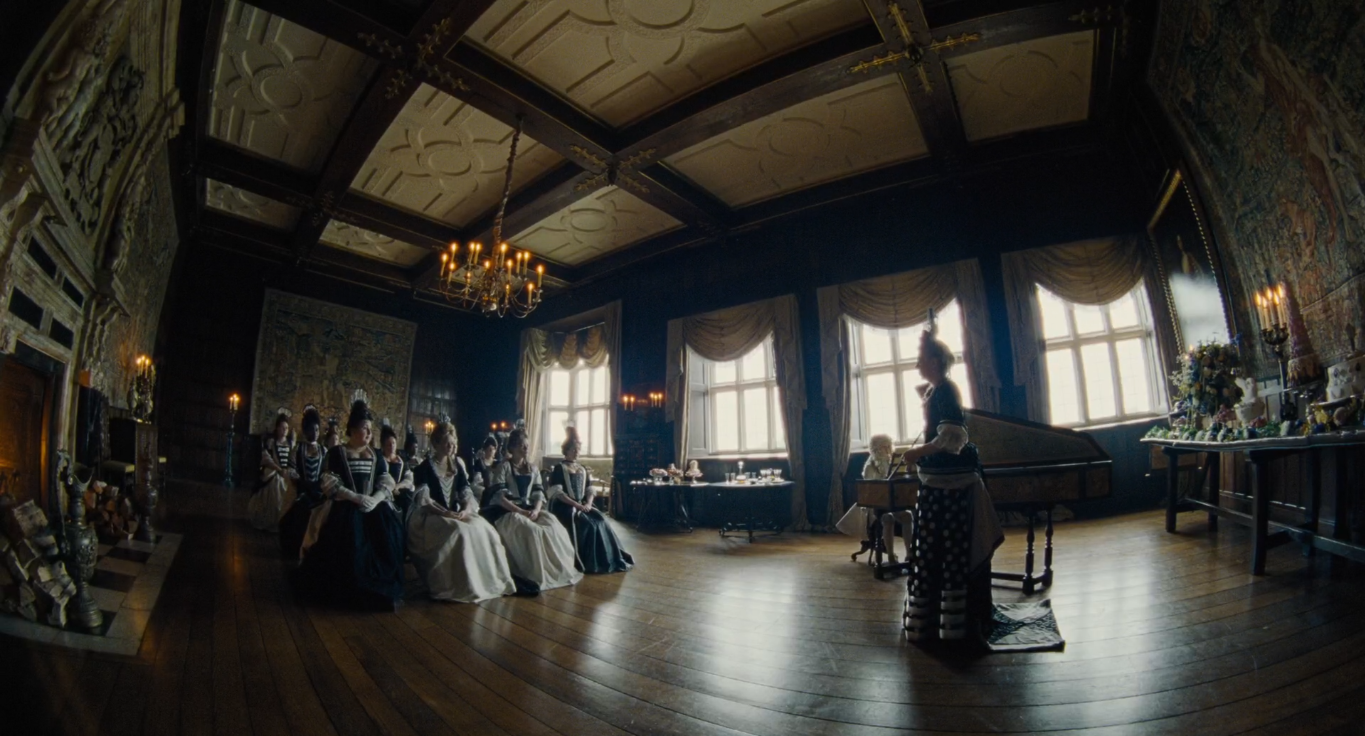
Despite some critics making visual comparisons with films like Barry Lyndon (1975) or The Draughtsman’s Contract (1982) (and rightly so to some extent), Lanthimos’ take on the period drama ditches the expected formality of the genre. The camera is on the ground, on the corner of the room, by the window, it follows the corridors at the oddest angles. This combined with the heavy use of the fisheye lens give the film an edge that elevates the already combination of the oblique motley of themes in the picture, giving it a sense of a nightmare, a weird historical hallucination that seems to play on your subconscious. All of this put together with a truly eclectic soundtrack that goes from the expected baroque music of the time, to deeply sentimental slower paced string tunes, descending gradually into being experimental and dissonant, creates a dynamic that accompanies the visual queues of the film in a no-less than brilliant way.

favourite 2An example of the use of fisheye lens and the odd camera placement in what could otherwise been a regular scene in court.

Complete with what is probably Olivia Colman’s best performance, together with the work of an incredible supporting cast, The Favourite is the most well-rounded of Lanthimos’ film. This sense of completion and unity does not mean that it is a linear and simple film, and not being a straightforward film does not mean that it is not accessible to pretty much anyone. The themes and subjects I mentioned are just a personal selection, but things like the exploration of the gender roles, that the film could be a possible exercise of pastiche and parody, or the viable but more complex psychoanalytical readings of The Favourite are all ideas that are easily interrogated by anyone that watches it. It is one of my favourite films of 2018 and I would say it is up there with The Killing of a Sacred Deer (2017) for Yorgos Lanthimos’ best.

8 out of 10

At Eternity’s Gate (2019)

Directed by Julian Schnabel


MV5BOTRmZGJiZjUtMGJjYi00MzZhLTkzYjUtODE1Yjk5ZDRiODhlXkEyXkFqcGdeQXVyODAzODU1NDQ@._V1_SY1000_SX675_AL_.jpg


“Maybe God made me a painter for people who aren’t born yet”


On At Eternity’s Gate Julian Schnabel, director of the critically acclaimed Le scaphandre et le papillon (2007) turns again to the art world for inspiration. 23 years after Basquiat (1996), inspired by the troubled life of street artist Jean Michel Basquiat, it’s now time for an exploration of the later days of Vincent van Gogh. Despite the many decades that separate the life and death of the two artists, both were misinterpreted visionaries whose works came to be known as revolutionary after their deaths.

Biopics and homages of van Gogh are too many to describe in this review. From Vincent Minelli´s Lust for Life (1956), to the Akira Kurosawa´s marvellous tribute in Dreams (1990) where the painting Wheatfield with Crows (1890) is referenced in one of the shots. In 2017 came out Loving Vincent, an animation film using 65,000 frames of oil painting on canvas, inspired by the painting technique of van Gogh.

This film focuses approximately on the last 2 and half years of the Dutch artist. It begins with van Gogh (William Dafoe) meeting the also acclaimed French painter Paul Gauguin (Oscar Isaac) and their stay in the French small town of Arles. All the known episodes about the artists life, from the breaking apart with Gauguin, the cutting of his own ear as well his stay in a mental asylum and controversial death are represented in this film.

One of the great things about At Eternity’s Gate is the great performance of William Dafoe in this picture. Although having almost twice the age of van Gogh at the time of his death, Dafoe establishes a believable portrayal of the anguish and pure joy the painter experienced during this period of his life. The director focused with great care at the expressions in the faces of the actors, with the constant use of close-ups. Like Dreyer in The Passion of Joan of Arc (1928), the close-up on someone’s face does an astonishing job of making the spectator feel the pain as well the joy the character must be feeling at the time. The scenes where van Gogh paints, the switch between the focus on the quick brushstrokes and the emotions manifested by his face truly transports the viewer to the pure bliss of painting. These few scenes are when the film really outshines itself, together with a warm but at the same time gloomy solo piano soundtrack.

Schnabel experiments a lot with the camera work. Besides the above-mentioned close ups, which work quite well and give texture to the film experience, the overemphasis on a half-blurred lens in some scenes starts to get a little bit tiring after a while. The sound experimentation works better. In the church scene, where Gauguin announces his departure to Paris, leaving van Gogh completely shattered inside is a great example of this. The lines spoken by Gauguin repeat in van Gogh’s head at the same time he is hearing more information from the French painter. It helps to represent better the pure exasperation that van Gogh was surely feeling at the time.


The echoes of Gauguin’s voice inside van Gogh’s head

Van Gogh is represented as a fragile man where the only person who appears to comprehend him is his own brother. A powerful bond which is well represented in this film, especially in a scene where the two lie down in an hospital bed, after one of van Gogh’s breakdowns. He feels that the world doesn’t comprehend him, and laments when he says, “I have a menacing spirit around me.” The connection between mental illness and acts of pure genius is sometimes hailed as logic and unavoidable. As if madness is the only way of achieving greatness and that every genius has a little bit of a madman inside him. This image of a deranged gift is unjust, and a lot of times given to artists like van Gogh. In one of his many marvellous letters to his brother Theo he refers that a “grain of madness that is the best of art”. He knows his limitations and how deeply they affect him. The film tries to explain, with all its flaws, that the mental problems were an issue that incapacitated him to do even more, and not the source of all his brilliance.

The painting where the title was drawn from represents a figure of an old man with his elbows on his knees and his head in his hands, in a clear sense of despair. In a way, Schnabel tries to make van Gogh a martyr of his own geniality. The last scenes of the film almost try to glue the image of saint-like to the painter. The forgiveness of his alleged killers (his suicide it’s still an unsolved mystery to this day) give him a Christ in the cross kind of aura.

Sorrowing Old Man (At Eternity’s Gate)  (1890) by Vincent Van Gogh; oil in canvas; Kröller-Müller Museum,Otterlo

  At Eternity’s Gate tries to transport the viewer closer to the experience of the Dutch painter using every tool possible. It’s not a perfect film but tries to give a fair representation of van Gogh away from the mad genius stereotype. It shows all his brilliance as a painter and his difficulties as a man. The experience of painting on cinema at its best.


7 out of 10