Divorce Italian Style (1961)

(original title: Divorzio all’italiana)
Directed by Pietro Germi
mv5bmjm3njqxmze3nl5bml5banbnxkftztgwnzmzotq1mze40._v1_sy1000_cr007071000_al_

“Have you really got another headache?”

This week we’re heading out to Italy with this film by Sicilian director Pietro Germi. His early work is characterized by a neorealist tone in the likes of Rosselini or Vittorio De Sica (in films such as Il ferroviere (1956). In the sixties his line of work shifted towards the satirical comedy in the likes of Dino Risi or Mario Monicelli. This Italian style of comedy, the so-called commedia all’italiana (comedy Italian style) is characterized by a profound sense of social criticism beside the curtain of apparent lightness of laughter. The film ended up giving Germi the Oscar for Best Story and Screenplay Written Directly for the Screen at the 35th Academy Awards in 1962 and as well the Best Comedy award at the Cannes festival.  

In Divorce Italian Style (1961), Germi plays a masterful take on the Sicilian machismo, only possible through an acute sense of comedy. Baron Ferdinando Cefalù (Marcello Mastroianni) is a disgraced nobleman married to Rosalia (Daniela Rocca). He has grown out of love with her and wants desperately to dissolve the marriage. The problem resides in the fact that at the time divorce was prohibited by law, leaving him “trapped” with Rosalia for the rest of his life. The illegality of divorce had its deep roots on the influence that the Catholic Church still had on life in Italy, especially the south. Fefè, as his wife affectionately calls him, draws a devious plan in order to get rid of Rosalia. By bringing her close to affection to another man, making him the cuckold, he could then kill then both, invoking that crime of passion and get away with murder. After this, he could finally make his move on to Angela (Stefania Sandrelli), his 16 years old cousin who he was infatuated with.

“Angela, what an unexpected pleasure”

The comic aspect of the film starts with the contrasts between the physical appearance of the couple. The baron is a cool figure, with a cigarette on the corner of his mouth, dark shades and a stylish moustache. A bon vivant and in a way a figure out of his time. But that is only a cover, shown by the preoccupations with his body (in a funny scene at the mirror where Mastroianni reflects about his belly size), and the way he presents himself at home, with the hair unkempt and rumpled clothes. In a way Mastroianni is creating a satire of the perfect and charming Italian lover, which includes himself in the lot (like in Fellini´s La Dolce Vita (1960). Despite all his flaws, Fefè is still convinced that he´s on top of his game and deserves a better looking and younger wife.

His wife Rosalia is characterized physically by the excessive body hair, especially in her face, with the subtle moustache and unibrow. Fefè is clearly repulsed by her and her constant shows of love make him rather disconformable. To add up, Rosalia has this very high-pitched voice and extravagant poses. The audience, despite knowing that is wrong, almost ends up in a devious way to agree with him. Germi makes the viewer enter in a conflict with themselves and therefore make him in Mastroianni´s shoes. If we analyse deeper though, Rosalia is a naïve kind of person, completely unaware of his husband unhappiness with the relationship.

Through the film we see him fantasizing about how he would kill his wife. Either by stabbing her in the back and throwing her into a soap caldron; or later in the beach by imagining her being swallowed up in quicksand. He finally finds Carmelo (Leopoldo Trieste), a World War II veteran who was deeply in love with Rosalia. The designing of plan was now completed, and when the two finally met again and fell in love, Fefè was now the cuckold. The shame was not only onto him but the entire family, ending a part of it being the reason for his father´s death or the actions against Rosalia and Carmelo.

Baron Ferdinando “Fefè” Cefalù and his wife Rosalia

The end shatters completely with the double standard of the male chauvinism. Now with a clear path to chase and marry the young Angela, she ends up behaving a lot like him. The irony displaced in the final scenes maybe tries to show that the problem is more a societal one than only the mischievous character of the baron. This is not an excuse for the husband´s actions, which are evidentially reprovable. But in the end, it feels like is easier to kill the partner than to lawfully divorce him. In addiction to this, the reaction of his family and the deep sense of shame all around the village display the problems that a post war and now democratic Italy had with machismo and the authority of the old institutions. 

Raise The Red Lantern (1991)

(original title: Da hong deng long gao gao gua)

Directed by Zhang Yimou

raise the red lantern

“Isn’t that the fate of a woman?”

This week on Camera Coverage we turn back to Asia, more specifically, to China. Zhang Yimou is one of the most prolific Chinese directors of the last twenty years. Before estabilishing himself as one of the masters of the modern wuxia film with works like Hero (2002) or Curse of the Golden Flower (2006) he made a bunch of diferent films related to either Chinese history or your regular to-go drama picture. That said, his first three feature films, consisting of an unconnected trilogy, are to this day some of his best, especially the one we selected to elaborate upon. Raise the Red Lantern is a period film based on a novel by Su Tong, Wives and Concubines, that managed to do the impossible task of balancing pure cinema aesthetics and important statements on many political, social and cultural problems that are relevant to this very day.

The film follows Songlian (Li Gong), a young woman in 1920’s China. She appears to have been an university student that had some sort of conflict with her family. In a revenge act towards her family she decides to marry an old, powerful rich man in northern China. All of it happens really quickly, and Yimou puts the viewer straight into the complicated relationships between all of the four wives inside the mansion. Each of them have their own house/room that will be lit up with red lanterns if the master of the house (his name is never mentioned in the film) chooses to stay with that wife for the night or not.

raise the red lantern 1Saifei Ha as Meishan, the second wife, an opera singer.

Right off the bat we are faced with the aesthetic beauty of the film. Yes, the visuals are incredibly, but even the soundtrack works briliantly well with the images. There is a real sense of composition and structure in the film that contrasts well with its cathartic and dynamic ideas. More than just pure aesthetics the film manages to utilize many ingredients from the very beginning that make even the casual viewer to question some of the meanings and possible themes that the film will develop. Not only is the use of colour obviously important – hence the title of the film – but framing is key in the film, as is the decision of what to show and what not to show.

Raise the Red Lantern is not a sympathetic film when it comes to its protagonist, nor it is sympathetic to its viewer. The film has a claustrophobic feeling to it. There are rooms inside houses inside a village, and the four depicted woman are most of the time depicted inside these rooms like prisoners. The cold hand of the director when it comes to the depiction of these problems is felt in aspects like these, even if when picturing the master of the house there is never a shot of his face or, like we mentioned before, the mentioning of his very name. This decision would supposedly work in a way that would make us connect with the women inside, but quickly we realize that, yes, the man is a villain, but there is a bigger problem inside this world that dictates all these feelings of oppression. We must think that from the very beginning we are shown that Songlian’s decision was her own, and if she is a prisoner it is because of her doings. Despite the focus on the relationship between the women regarding their marriage, the film’s decision to avoid direct picturing of the husband puts us far away from any of his personal responsability we could have thought of.

raise the red lantern 2The quest for power of these wome led to lies such as fake illness, and even fake pregnancy.

All of this combined with the cruelty and evil depicted in these four women (being it at the same time a characteristic of each of them and a consequence of their situation), Raise the Red Lantern quickly goes from what could be a go-to bland feminist statement to a complex proposition of an overarching structure that is responsible for such issues. It is a controversial reading of the film, yes, but the catharsis we take from such a film is relevant enough to question these problems further and create a reaction in the viewer that, while mesmerized by the beauty of it, it is shocked by how contrasting it is with its ideas. Zhang Yimou made a beautiful film that manages to embellish and strengthen these women’s cages with the purpose of breaking their own metal bars.

Gräns (2019)

(eng: Border)

Directed by Ali Abbasi

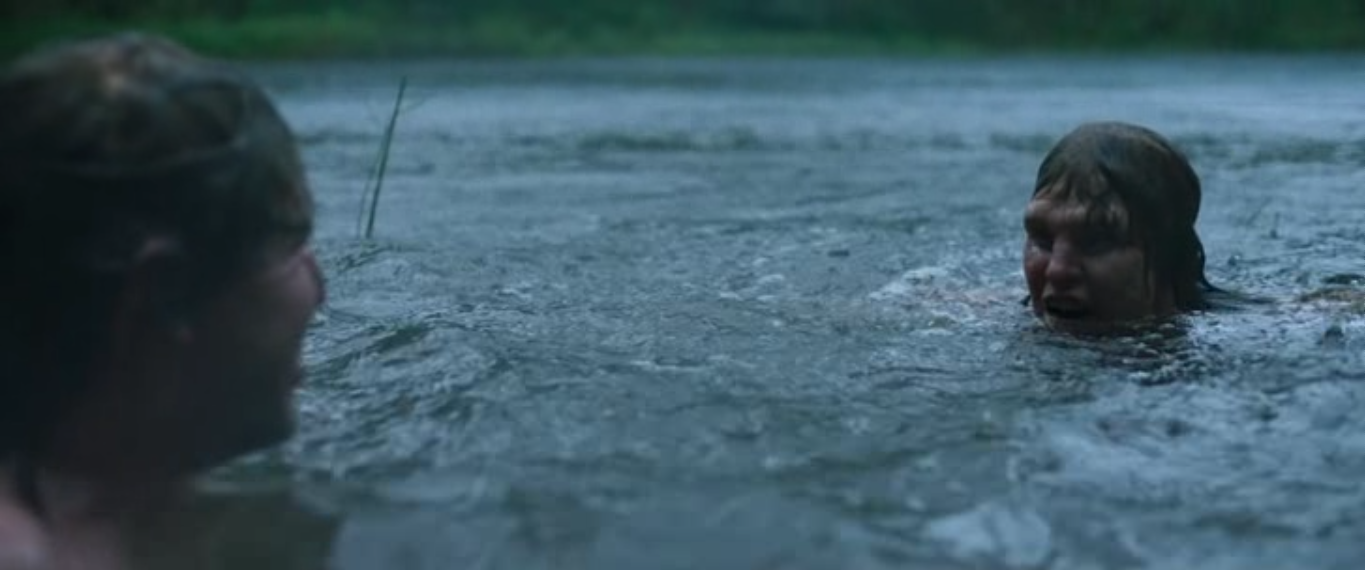
grans 1

“I don’t see the point of evil.”

Inspired on a novel by John Ajvide Lindqvist (better known for Let The Right One In), Border is one of the films to have a lot of controversy and high regard last year. To it was awarded the Un Certain Regard award at Cannes, and it even managed to swiftly get a nomination to the Oscar for Best Achievement in Makeup and Hairstyling. The controversy is mainly due to the sexual nature of its themes. It is an undeniably shocking film. The usage its shock value is, however, very pertinent. As Let The Right One In (2008), the transformation of Lindqvist’s story into film works brilliantly, combining the already poignant themes present in the words and visually expanding them, something that is even more noticeable in Border, mainly due to the irreverence and shamelessness of the film’s imagery.

The film follows Tina (Eva Melander), a security officer working on border control, and he daily routine. She is not blessed by standards of Western beauty and has a menacing look that works well with her magical power of being able to smell people’s feelings. She lives an unhappy marriage and has no friends other than her mentally-ill father. There are two big changes in her life when she smells a memory card on a passenger’s phone that is full of snuff films and child pornography and on another scene sees a guy that is oddly similar to her and confuses her special sensibilities. These changes lead to two inner plots in the film that consist on one side a detective thriller-like film and on the other a romantic story that leads to Tina’s discovery of her true identity.

border 2.png

Border is a story of fluid bodies and souls trapped in an ordered world. Tina and Vore (Eero Milonoff) are figurations of chaos inside an organized Western society. However, if we consider the sexual nature of the film we quickly understand that there is a political edge to this chaos. Combined with the ideas of social isolation, foreignness and family issues we understand that the new dynamic presented by these two special characters is an amalgamation of every otherness that exists in our contemporary world. So far so great. The problem with the film is that while presenting brilliant ideas, it overly complicates them and by the end it leaves an undesirable odd feeling to the viewer. Of course this ending can be read as an anarchic solution to the aforementioned themes, or even as a following to the mythology presented half-way into the story, but never does it feel as smooth as expected. Comparing it to something like the ending of Do The Right Thing (1989), for instance, it feels really off considering the way the plot devices work beforehand.

Technically it is a decent film. It never does something that is not expected from an ultra-realist style film. Sometimes the camera seems to be too shaky, and even nauseating at times. In other scenes, the fast movements of the camera and all the shakiness contribute greatly to the inner beauty of the film. The original soundtrack is very enchanting and is really on the same page with the tone of the film. The make-up effects are pristine, as is Melander’s performance. I would say Eero Milonoff’s performance is never up to par with Melander’s, and sometimes is not even really good at all. But then again, that is never a big problem (even if combined with the shaky camera aspect of the film) if we face it with the originality and boldness of all the other decisions surrounding it.

border 4.pngOne of the great visual moments in Gräns

The reason I was not a big fan of Let The Right One In (2008) is probably the reason I am actually a big fan of Border. It is a consciously awkward film, one that is aiming specifically at shocking the viewer in order to get its ideas out there. Most of the times this technique does not work, but with Border it does, as it is probably the perfect figurative film of the many lost souls in our monotonous society. Even though it is not perfect, particularly the thrilleresque subplot, Border works a lot better than expected. This review tried to say as little as possible about the singular elements of the film because in order for it to work it is mandatory to watch it with little knowledge about what is so special about it. It released in Portugal last week despite having been distributed in the rest of the world earlier this year. Still, try and watch it on stream or DVD, because if you don’t, you will be missing what is probably the most excruciatingly, cringeworthy and at the same time beautiful sex scene of the last few years (and for that alone it deserves ½ a point).

6.5 out of 10

Green Book (2019)

Directed by Peter Farrelly

green book 2.png“So if I’m not black enough and if I’m not white enough, then tell me, Tony, what am I?” – Don Shirley

Green Book is a film directed by Peter Farrelly, who has mostly a bunch of major successful comedies on his record like Dumb and Dumber (1994) and There’s Something About Mary (1998). This comedy past is clearly an influence on this production, which provides a more light-hearted mood to an otherwise dark themed film.

The story follows Tony Lip (Viggo Mortensen), a rough Italian-American bouncer in a upper class night club during the 1960’s. Suddenly out of work after the club closes for renovations, he is compelled to get a new job fast to pay for his bills. An old acquaintance gives him the contact of a “doctor” who is in the need for a new chauffer. This “doctor” ends up not being a medical one, but a stage name for pianist Dr. Donald Shirley (Mahershala Ali), who is planning a concert tour in the south of the USA. As an African American Don is clearly anticipating problems relating his skin colour on the deep American south, so he is counting on Tony to not only drive him around but also be a kind of bodyguard. After some reluctance, he accepts the job. His hesitation is mainly due  to racism: having a black person in charge felt humiliating for Tony.

The film does a good job portraying the mob mentality of racism inside the Italian-American community, who suffered discrimination from the other white ethnicities. John M. Parker, a American Democratic politician from Louisiana (ironically one of the places where Don Shirley stopped in his tour) described the Italians as “just a little worse than the Negro, being if anything filthier in their habits, lawless, and treacherous”. Despite that, they hold on to their white ethnicity very strongly as in a way to feel superior. This power relationship was explored in a powerful manner by Spike Lee´s work Do The Right Thing (1989). There we see that despite similar economic backgrounds of low-income status, racism is still a powerful tool for compensating internalized shame, as in a way as saying, “at least I’m not black”.

vlcsnap-2019-03-09-15h06m25s979The first meeting in Don Shirley’s house

But in this film the power dynamic is different, because of the economical status of the two main characters. Shirley is a rich and highly refined pianist, familliar with the best things in life. Tony on the other hand comes from a low-income family and must work hard just to make ends meet. He tries to show throughout the film how he is closer to the African-American culture than Shirley, by showing him things that he has not experienced in his life such as listening to black music and eating fried chicken (which was apparently false in real life, accordingly to Shirley’s family). The film tries to get across the image that the racism that Tony displays is completely unjustified because he is closer to black culture than Don. But what Tony fails to understand is that despite not being connoisseur of the typical black culture, he stills suffers discrimination from the fact that he is black. More than that, it sure has racist undertones, especially in the correlation between being black and enjoying the stereotypical black culture, especially when made by a white man.

vlcsnap-2019-03-09-15h05m51s415“Thats why you drivin’ him around. You´re half N- yourself”

As the film goes by the relationship between the two grows stronger, with Tony Lip saving the pianist from many problems derived from the blatant racism in the south. This is another problem that the film ends up creating. The protagonist of the film is clearly Viggo Mortensen’s character and not Don. It is a movie trope present in a lot of Hollywood films (such as a classic like To Kill a Mockingbird (1962) or more recently The Blind Side (2009) that shifts the focus of the film from the narrative of suffering of the minority to the act of saving by the white character. Worse than that, it almost creates the image that the non-white person is incapable of saving him/herself from all their problems, many of them ironically created by the whites themselves. Despite this drawback, there are some funny and engaging moments portrayed by Viggo Mortensen, and a stellar performance by Mahershala Ali, which ended up earning him the Oscar.

The film ends on a cosy Christmas dinner with Tony Lip’s family where Don Shirley ends up joining them. The resentment against black people suddenly disappears and everybody accepts the black man at the table. This Christmas setting (despite not clearly being the director’s decision to make this statement) is the perfect analogy for racism amongst the white society. We all remember the messages of forgiveness and solidarity that go around in text messages, and suddenly everybody recognizes the need to help the homeless and foster care children. The warm and fuzzy ending to this film encapsulates precisely that feeling. It feels more like holiday spirit than a real change of attitude. Giving this film the Best Picture award at the Oscars – especially when a more poignant movie like BlacKkKlansman (2018) is also nominated – feels like Hollywood only wants to scrape the surface of the problem, without creating much fuss and controversy.

5 out of 10