LEFFEST – Lisboa & Sintra Film Festival 2019


leffest.jpg

We at Camera Coverage have been attending to the 2019 edition of the biggest film festival in Portugal and thought of speaking a little bit about the films we have been able to see. We got our heads around the whole section of the films in competition to the festival’s awards, and some of the new releases on other sections of the festival. Between all of these we thought of making our brief selection of films that are for us the highlights of the festival. Also, from Wednesday forth we are thinking of making more focused texts on what we think is our favourite of the festival, and the films that were awarded by the selected jury of the festival – that are to be announced in the 24th of November.

For our list we have picked three highlights from the festival selection in the competition.


Atlantis, by Valentyn Vasyanovych


atlantis 3.jpg

This year’s competition was packed with two films from the old Eastern Block that find themselves in somewhat the same category. These are The Criminal Man, by Dmitry Mamuliya and the afforementioned Atlantis, by Valentyn Vasyanovych. Both of these films are paced with care and drag the viewer into a very slow pacing, being easy to put them in what some call the “slow-cinema” category. However, while Atlantis presents consisted cathartic and poetic imagery, The Criminal Man seems to be a film in which there is a great central scene – arguably greater than any scene in Atlantis – and feeling a bit empty in comparison. Atlantis is a film that has its setting in a dystopic post-war Ukraine, following a main character suffering from PTSD. There are many scenes of despair, many moments where we may be led to think that Vasyanovych really has no hope for his country and his people after the consequences of the war. By the end though, we are faced with this flash of light, as poetically depicted as any of the shades of grey previously presented in the film, that remind us that the power of love and humanity  is strong enough, not only to be reborn from the remnants of such war, but I would even say taht there is here a suggestion that this light may even prevent us from falling into this dark utopia if we keep it close to us.


Beanpole [Dylda], by Kantemir Balagov

kinopoisk.ru


Arguably one of the most talked about films in the festival scene, Kantemir Balagov’s Beanpole deserves every bit of the attention it has received. The film deals with a plethora of complex themes, and presents them with, however extreme, 100% believable situations. The fluid sense we have – much of it provided by a sober set and art design – between all of these is impressive. From war trauma, to poverty, to complex romantic and motherhood dynamics, Beanpole seems to gather all of this seamlessly. It is a beautifully shot film, with a strong sense of colour and aesthetics, including a dynamic camera that switches from being handheld and really shaky to fluidity and steadiness at a pace that is hard to notice as we are mesmerized with everything that is being portrayed. The sense of pathos in Beanpole is the probably one of the strongest from the festival, and the performances are certainly the most convincing. A cinematic treat for the eyes, and an always important reminder of what extremes can the human soul deal with.


Fire Will Come [O Que Arde], by Oliver Laxe

fire will come

A personal favourite of ours, O Que Arde by Oliver Laxe is one of the most subtle and gentle depictions of the complex nature of human beings. Between the beautiful landscapes of Galicia and their absolute destruction there are humans and their complex, but nonetheless consequential, relationships. We follow Amador through his journey back home from being imprisoned for causing a massive forest fire in his region. He deals with his everyday chores in the countryside, next to his mother Benedita – a charming powerhouse of a 80 year old woman. There is a sense of silence and of the ephemeral throughout the whole of the film, despite the absolute chaos that is the nature of human existence. Even when filming the forest fire scenes there is a sense of calm, a sense of beauty and a sense of sobriety that gives opportunity to the viewer to mingle on the many subjects the film can extract from our lives. Family, ecology, social life, the rural world, decadence, destruction and limits. All of these and none of them at the same time. O Que Arde is without a doubt one of our 2019 favourites.


Other honourable mentions:

Tommaso, by Abel Ferrara
Balloon [Qi Qiu], by Pema Tseden
Atlantics [Atlantique] (out of competition), by Mati Diop


Vitalina Varela (2019)

Directed by Pedro Costa

vitalina

It’s poison!”

[“É veneno!“]

Pedro Costa is in 2019 already a well-established auteur. His work since Casa de Lava (1994) has been consistent theme-wise, and at the same time its progress is clear throughout. With Vitalina Varela the director still manages to stay true to the work he has been developing since Ossos (1997), on elevating the everyday lives of impoverished and endangered people into the realm of cinema. At the same time, there is a sense of evolution, and character development in a way, in this new feature. It is a film about Vitalina Varela, the main actress of the film, and her mostly true story of coming to meet her husband in Portugal after a 40 year waiting call for a ticket, arriving too late, as his funeral had taken place three days before her arrival.

vitalina 3.pngA film well worth noticing for its dark environments, captured as pristine as possible by Costa and his usual collaborator Leonardo Simões

As a standalone feature it is a great new way to introduce a new viewer to the director’s other films. In a way it’s one of the most linear narrative structures of the director, especially if we consider his last film Horse Money (2014) as comparison. In another hand, it is easily the most slow-paced of all of his films, making it the biggest chore to the casual moviegoer that wants to get in touch with his whole filmography. Nonetheless, Vitalina Varela has what is the most positive look towards the future of those depicted Cape Verdeans. It is at the same time, with the help of heavy stylization and immense technical care, a film that is as elevated and astray from reality as it is grounded, by its individual elements (real setting, non-actors, real stories, etc), on the truth surrounding these people’s social and economic lives.

vitalina 1.pngVentura

If we try and manage to contextualize Vitalina Varela in Costa’s full body of work, we can easily state as a fact that this is, as per usual when there is a new film by the director, the zenith of his career. If we consider the balance stated in the last paragraph, it is nothing new to the director’s other films. What is impressive is the development of the actor Ventura, the main character of his two last films Colossal Youth (2006) and Horse Money. It is the first time Ventura is not playing as himself, this is, as the character of Ventura. He plays a priest. This is the absolute next step on what we can consider as the big politics of Costa’s films. Ventura has now reached a new height, as a normal person being an actor playing himself, and now as a normal person being an actor playing a third-party character. The idea of cinema as proof of human potential in art, and of human potential in something that is transcendental, even transcendental of what may appear only as ethical, economical or political statements. This something is what makes these people worth much more than what the world gives to them, as every single person that suffers from similar conditions. This final goal is beautifully achieved in Vitalina Varela, and it presents us the in-depth story of a character that appeared briefly in Horse Money, a story that is tragic, but essentially true. The real truth, though, is not in these stories, it is not in these real people. The truth is their ability to make something great, a film, to be stars, even though that they were born in the dark side of Jesus’ face.

10 out of 10

3 Faces (2019)

(original title: Se rokh)

Directed by Jafar Panahi

3 faces

“So you came for her and not for us.”

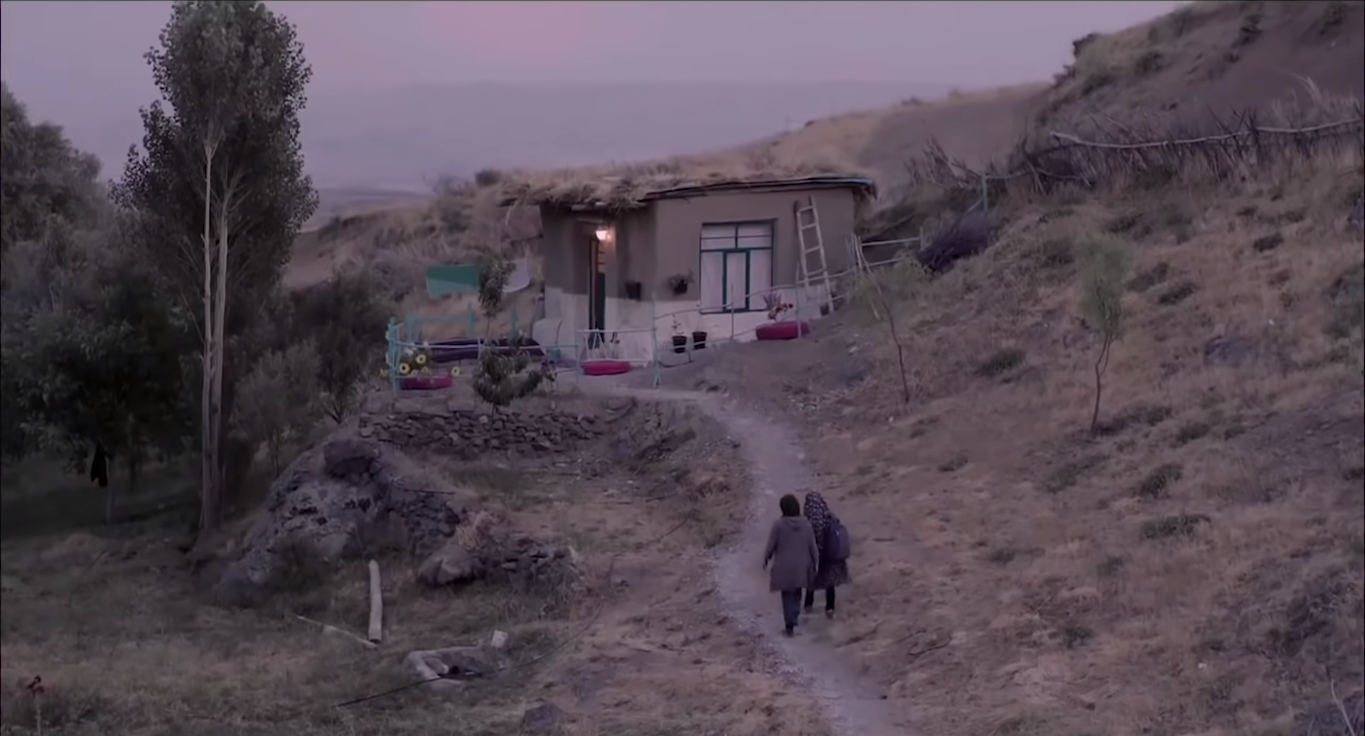
Jafar Panahi is a Iranian director famous for his continuous quarrel with censorship and his consequent imprisonment in 2010. His 2015 masterpiece Taxi gave him worldwide recognition, but he was already one of the highest praised Asian directors from the last twenty years by film critics and a staple of the big film festivals. His work follows the lead of his master Abbas Kiarostami, especially after being imprisoned, where he approached a fluid style between documentary and fiction to develop his already highly realist filmography. 3 Faces is a film that won the award for Best Screenplay at the Cannes Film Festival, and is since being released all over the globe.

The film follows the director himself and the actress Behnaz Jafari. They received a video message of a young girl commiting suicide in an attempt to get the actress’ attention and help with the consequences of her somewhat progressive lifestyle (she studies in college and is an actress) in her traditionalist village. The three faces that gave the film its title are meant to be the faces of the three actresses in the film. The young girl that sent the message, the middle aged Behnaz Jafari and an old lady that they meet somewhere in the middle of their journey into the village. It is shot at the same location that many of Kiarostami’s films were shot, and has a lot of direct references to some of his most famous work, including the devastating ending of Taste of Cherry (1997) mirrored in the somewhat crazy old actress’ actions.

3 faces 1.pngBehnaz Jafari

As are the other films of the director since 2010, 3 Faces is a politically charged work. Panahi seems to extend his views on femininity, generational issues and religious catharsis from his other films. In this aspect, Panahi’s work seems to resemble another Iranian director that seems to be forgotten when talking about Panahi, that is Mohsen Makhmalbaf. In some of his films, of course considering Kiarostami’s influence on them as well, Makhmalbaf utilized too the fluidity between documentary paradigms and preconceived narratives to approach certain political issues – see for instance Kandahar (2001) and how it deals with the uprising war, or A Moment of Innocence (1996) and how it works with morality issues inside small communities. In the same way Taxi or This is Not a Film (2011) worked, this new film utilizes its meta elements to the fullest in order to reach the level of realism it does. It does not even shy away from going further into many other debates, much like Kiarostami’s Close-Up (1990) when it comes to the debate about the power of film and the influence of art in an oppressed society.

Despite not being as original as a film like Taxi was, Panahi seems to make a proper tribute to his masters. The debate topics of Makhmalbaf in 2001 or Kiarostami in 1990 are not the same the ones being discussed in Panahi’s contemporary cinema. Even if going as far as utilizing diegetic elements of the voyage or other direct elements of these other director, the final product is still original and relevant. There is a blend of a seemingly ascetic scenario with traditional but poetic use of framing and editing, and with a real sense of pathos that transcends the otherworldly level of cinema into real life (with a knowledge of technology and modernity that remembered us of other directors that utilized modern elements to their most real, like Michael Haneke in Happy End (2017) ). This mixture of techniques combined with the poignancy of Panahi’s assertions is hard to criticise and all of it definitely works.

3 faces 3.png

One of the most important things to take from a fictional film like 3 Faces is its sense of realism. Despite working will milions of elements and influences that are somewhat hard to keep track of, the film puts them together in a way that every frame drools a sense of what’s reality like in Iran, but even goes further in globalizing Iran’s problems. How do we deal with our professional lives, how do we deal with deceit, how do we deal with time and how do we deal with rules. What is the role of God, and does godliness ends when humanity starts to fade. These are some of the things that are hard not to think of when we see a film like Panahi’s. Much like the main idea from his 2011 film we are once faced with the fact that a film is a representation of life. Not only that, but the final product of this representation is alarming, not only because of what’s happening in some Middle Eastern countries, but because of the true universality of these problems.

7 out of 10

The Spirit of the Beehive (1973)

(original title: El espíritu de la colmena)

Directed by Victor Erice

MV5BMTIzNjYwMTUzMl5BMl5BanBnXkFtZTcwNTE4MDQzMQ@@._V1_

“Why did he kill her?

Children in film are often used as a powerful tool to portray an array of heavy and dark sentiments through the eyes of naivety and without preconceptions. If we take, for instance, the experience of war, this innocence shattering event makes up for a potent art statement. For example, in a film like Elem Klimov’s Come and See (1985) the sheer expressions of horror in the face of the young Florya, during the Nazi’s invasion of the Soviet Union makes up for an image far more lasting than if it was an adult. There is something about the loss of innocence combined with a sense of escapism in a child’s mind to deal with that shocking reality. But it doesn’t need to be as eerie and explicit like that to make a deep impression. In a film like Children of Heaven (Majid Majidi, 1997) the journey for a poor child to get a new pair of shoes for his sister makes up for a simple but not less beautiful and warm experience.

The Spirit of the Beehive is not in anyway as a traumatic experience as the Klimov film mentioned above. The plot takes during the early years of Francisco Franco’s fascist regime in Spain. It is interesting to point out that this film was released during the last years of this dictatorship, marking perhaps, by the themes portrayed in the film, a pending weakness in the regime. The main characters are two young sisters, Ana (Ana Torrent) and Isabel (Isabel Telleria). Their father has a myriad of occupations that go from bookkeeper to beekeeper and poet.  Taking place in a small Castillian village in the Spanish Meseta, cinema is a motive for great excitement in this quiet town. The projector is set on an old barn and all the inhabitants, including the small girls watch a dubbed version of James Whale’s Frankenstein (1931). The impact is immense on the younger one Ana, who leaves the cinema traumatized by the famous drowning scene. Obsessed with the monster, she looks for any sign of the monster close to home. The search ends up leading her to an isolated old shed on a large and desolate piece of flat land. Inside there’s a wounded republican soldier, trying to escape death at the hands of the Francoist forces. The small girl, naïve to all the political struggles, steals food from home to feed the desperate soldier. The Republican partisan is found and shot by the Nationalists which leads to the suspicion that Ana’s father was the one helping him. The pressure for the daughter ends up being too much and she escapes next to a lake, making a clear parallel with the Frankenstein plot.

captura-de-ecracc83-2019-05-01-acc80s-17.04.18.png
The impact of the film reflected in her eyes

Portraying a Republican this way, like a wounded horse waiting for its demise, is an obvious example of a critique against the then fascist Spanish regime. In the seventies, dictatorships in Europe suffered an enormous amount of pressure by the rest of the western powers that already lived in democracy. Regimes like the Spanish (and as well the Portuguese one) grew more and more isolated. That could explain why films like this one or Viridiana (Buñuel, 1961, a ferocious critique of the catholic church, usual theme in Buñuel) passed the censors, despite the bad image they made of the regime. With general Franco’s death in 1975, Spain would finally make its transition to a democratic regime. Despite this obvious message, this film is much more than a political statement. It deals with the pureness of a child’s imagination, and how the make believes sometimes juxtaposes the sense of what is real. The innocence of Ana makes her completely unaware of the possible troubles she may be getting into by helping the soldier. Ana Torrent (that would end up working also with Carlos Saura in Cría Cuervos (1976)) makes up for an extremely sincere and sweet innocent child, in one of the more perfect roles played by a child that young. Merit has to be given to Erice for being able to blossom such a talent in a little child.

captura-de-ecracc83-2019-05-01-acc80s-16.55.38.png
The vastness of the Spanish “Meseta”

On top of the terrific performances, the cinematography is clearly an astonishing feat. The stellar work of Luis Cuadrado (who ironically was losing eyesight during the shoot) is found in creating this sense of emptiness both inside the buildings and in the vast Spanish flat lands. The house where the children live feels old and uninhabited and the small village is surrounded by immense of dry fields to lose sight on. The emptiness feels like a colossal canvas for a young child’s imagination. Together with the somewhat eerie but at the same time comforting soundtrack by Spanish composer Luis de Pablo, The Spirit of the Beehive is a cinematographic experience like any other.

Bibi Andersson || Persona (1966)

[Directed by Ingmar Bergman]

1.jpg

Earlier this week we have been braced with the devastating news of the death of the legendary actress Bibi Andersson. She is best known for her long collaboration with director Ingmar Bergman with whom she had made approximately twelve films. Andersson is responsible to the introduction of Liv Ullmann to Bergman, and therefore responsible for what is one of the most legendary collaborations in the history of cinema. Even though the spotlight is often on Ullmann, Bibi Andersson is the original muse of the director, and works as a strong homogenous figure in Bergman’s early work, only later her figure being noticeable as a “lighthearted” contrast to what was the “severity” of Liv Ullmann, especially on the masterpiece that is Persona.

Every film lover knows Persona. But it is also true that no one can truly deconstruct and interpret the film in what may be considered a “right way”. This is a film that is meant to work on a level that differs from our usual cinematic experiences. Most of this is due to the way both characters interact and the work of metamorphosis between the two. While, as mentioned before, Liv Ullmann plays the patient, an actress that is both austere and troubled, Bibi Andersson plays a deeply humane but also troubled nurse. While both performances are incredibly layered and dynamic, we are mostly guided by the eyes of nurse Alma in her quest to heal Elizabeth Vogler, that quickly turns into a therapy for her own troubles. The humanity and sincerity of Andersson’s performance brings to the film something for the viewer to relate to, something that is essential for Bergman’s work to function correctly in order to not transform into something completely obtuse and abstract. She is the perfect counterpart that bridges the complex states of mind and the complex artistic pretensions of the film into our everyday lives, creating in the end one of the most unheimlich experiences one can have with a film.

Bibi Andersson is the light of our everyday lives fading in the world of Bergman’s cinema. She brought reality and sensibility to films that would feel too cold and distant to be as relevant as they are today. This week we lost one of the big faces of Swedish cinema, and she will surely be remembered as one of the absolute icons of the history of film. We leave a list below of our favourite films she made part of. Bibi Andersson will not be forgotten.

The List:

Sommarnattens leende [Smiles of a Summer Night] (1955)
Det sjunde inseglet [The Seventh Seal] (1957)
Smultronstället [Wild Strawberries] (1957)
Djävulens öga [The Devil's Eye] (1960)
Syskonbädd 1782 [My Sister, My Love] (1966)
Persona (1966)
Flickorna [The Girls] (1968)
En passion [A Passion] (1969)
Scener ur ett äktenskap [Scenes from a Marriage] (1974)
An Enemy of the People (1978)
Quintet (1979)