
Vice (2019)

Directed by Adam McKay

0190456.jpg-r_1280_720-f_jpg-q_x-xxyxx

‘If you have power, people will always try to take it from you. Always’ – Lynne Cheney

Adam Mckay gives another try on directing a political commentary film with Vice, three years after his last production. His career is filled with comedy directing credits, from SNL sketches to Hollywood hits like Anchorman: The Legend of Ron Burgundy (2004) or Step Brothers (2008). In The Big Short (2015), McKay tried to ally the seriousness of the 2007’s mortgage housing crisis in the US with a combination of humorous characters that work as a comic relief on such a severe topic. On Vice, the recipe is taken up a notch with an even more extreme approach to the theme of the film.

Vice works, on a primary level, as a biopic of the Vice President of the USA during the George W. Bush era (2001-2009), Dick Cheney (Christian Bale). From his troubled Yale years to the personal ascension inside the power dynamics of the White House, the film is never clear on what are his real goals. A scene on the first half if the movie shows his wife Lynne Cheney (Amy Adams) giving him an ultimatum implying she would abandon him in case he didn’t amend his behaviour. In all the motion picture, the figure of Lynne is a potent influence on the action of Cheney. Throughout the film, a clear connection between Cheney and his family is shown, as a way of not only trying to give an alternative and more positive view of him, but also serve as a motivation as to why he is acting as the way he is. The family is painted as a close clan whose protection and ascension are the primary goal for him.

McKay tries to paint an image of a man whose obsession for power makes him look like an introverted sociopath without any ethics, except for his own personal gain, with the leverage of a kind family man to balance it all out. But even his close ones suffer from the thirst for power, especially his daughter Mary (Alison Pill). Although he always accepted her choices, her sexuality is the appointed reason by Cheney for not running for President, as it is something that would diminish his chances. Later when his other daughter Liz (Lily Rabe) decides to run for Senate, he approves her decision to not support gay marriage, as it would hurt her chances with the more conservative Republican voters. After the crumbling of his political career, the family cohesion is also shattered, leaving the viewer confused on what were his real motivations after all.

Christian Bale, who also worked with McKay on The Big Short (2015), goes again to extreme measures in an effort to give the closest portrayal of Cheney. His method acting made him gain almost 20 kilos and shave his hair. Besides the work on physical aspect, the voice and mannerisms are also not missed, making Bale a strong contender for the Best Actor award on the upcoming Academy Awards. The rest of the cast also delivers strong performances. Amy Adams incarnates a strong wife that, in a way, feels that she is the one truly in charge. Sam Rockwell does what he is best at: after winning the Oscar for best supporting actor last year, he displays here an eerie similarity with George W. Bush, especially with both the accent and tone of his voice. Despite this, the viewer cannot help but feel that he is spared of much of the guilt, by displaying Bush one sided only as an ignorant fool. Steve Carrell (playing Donald Rumsfeld) distances himself even more from the comedy actor typecast, showing once again that he is capable of doing more serious types of characters.

Despite the powerful performances, it feels somewhat exaggerated at times, mainly because of McKay’s editing quirks and misplaced satire. It works, for instance, on the Macbeth reenactment by the Cheney couple, establishing, like the original Shakespeare work, the importance of the wife in the way the lead behavior. But on the other hand, the constant uses of documentary footage make the film lose focus as on what it is trying to be. The “credit roll” on the middle of the film doesn’t really work and appears a little bit forced, especially because the second half doesn’t fit that narrative (and being the second fake ending I watched recently after Gaspar Noe’s Climax (2018), let’s hope it doesn’t become a trend). The narrator (Jesse Plemons) is also a character that shows up in the film without much reason and the plot twist feels a tad forced (especially on the light of the trope of Cheney’s almost humorous heart attacks).

03-vice.w1200.h630“I believe we can make this work.”

It’s a film of the Trump era, clearly making a lot of connections between Cheney and the current US President. The rage that McKay tries to impulse on the viewer by Cheney’s actions serve as a warning for the present American administration. After the final credits roll there’s an extra scene that disperses any doubt that this is a movie for the current times. One of the mechanisms used by the Bush administration were the creation of focus groups which helped justify the war to the American people. But in this after credit scene it is the movie itself that is being discussed. The same focus group reappears where a stereotypical white Trump supporter denounces a liberal bias throughout the film, starting a fiery discussion in the room. As it erupts, one disinterested member remarks that she is looking forward to the new installment of the Fast and Furious franchise. It’s a cheap shot to audience as it tries to tell them that the fault is also theirs. Nonetheless, despite the lack of interest in politics which usually results in abuses in power, it’s not impossible to enjoy popular culture and take political stands. A populist conclusion on a movie that supposedly criticizes the same evil.

6 out of 10

Le Silence de la Mer (1949)

(eng: The Silence of the Sea)

Directed by Jean-Pierre Melville

MV5BMWJjM2ZkZTEtZDM0My00YzU2LWEzNTMtMWExNDY3OWNmYjlmXkEyXkFqcGdeQXVyMTQxNzMzNDI@._V1_SY1000_CR0,0,708,1000_AL_

Filmed in 1947 and released two years after, Le Silence de la Mer was the answer of Jean-Pierre Melville to the dark period of Nazi Germany’s occupation of France. The script is inspired on the book by the same name written by the French author Jean Bruller. This novel, published secretly in France during the first year of the Nazi invasion, became a beacon of inspiration to the Resistance. Melville himself joined the French Resistance and fought for the liberation of his country. He established a deep connection with the book, noting later that it was the logic choice of inspiration for the script of his first feature film.

The narrative of the film follows a young German officer, Werner von Ebrennac (Howard Vernon), in a recently occupied French town. There he takes hold of a room in a house belonging to an old Frenchman (Jean-Marie Robain) and his niece (Nicole Stéphane). The new occupant is given a complete silence treatment by the French, despite the constant attempts of conversation by the German. A self-proclaimed Francophone, von Ebrennac speaks fluently the French language. With a gentle and warm posture, he shows his love for music and talks about his youth. But above all he talks constantly of the greatness of both countries, France and Germany, and the need for a closer relationship. This is the way he justifies the war, affirming that both the nations will gain tremendously with the new alliance. This vision is shattered though, in a scene where von Ebrennac meet with his fellow officers in Paris. Here he discovers that the rest of the army does not share his ideas of union between the two nations, but the total annihilation of the French spirit. He decides then to leave France and volunteers to the feared Eastern front to fight the soviet forces. It feels like he abandons all its hope described by his words through the film and embarks on a suicide mission, disenchanted by the ideals on his uniform and to the deserved punishment.

vlcsnap-2019-02-19-11h48m33s494“Then he knocked on our door/ Was it to spare us from the sight of an enemy’s uniform, or to make us forget and get used to him?”

The setting of the film is mainly the small living room of the house occupied by the young German officer. Except for a flashback to von Ebrennec’s nostalgic youth and the trip to Paris near the end of the film, all the scenes take place in the old Frenchman’s house. But it doesn’t feel claustrophobic at all, but rather cosy. It’s an austere film marked by minimalistic camera work and very few outside shots. Despite this, the viewer can’t help but feel but sympathetic to the German officer. In his “monologues” transpires a feeling of hope that almost grabs the other two occupants of the house, shattered by the fall of France and the enormous shame of defeat to Germany, its old rival. We get the perception that the old uncle, sitting on his chair silently smoking his pipe, has almost a inner urge to try and answer to von Ebrennec. His niece sits stoically knitting and completely evades the gaze of the intruder in her own house. Only at the last moment with his departure to the East we see this close up of the niece’s eyes glowing with light, as in final approval of the officer, giving him a kind of redemption and exceptionality against his German peers.

vlcsnap-2019-02-19-11h52m51s930“Do you think we’re so stupid as to allow France ever to rise again?”
The character of the german officer has its similarities with the captain von Rauffenstein (Erich von Stroheim) in Jean Renoir’s La grande illusion (1937). Both carry a deep sympathy for the enemy’s culture and feel the war is needed for the greater good of both nations. The difference lies primarily on age and grades of naivety. Von Rauffenstein is an old officer living with chivalric notions displaced from a period like World War I, marked by the mechanization of war and massification of the killings. On the other hand, the star of this film is completely fooled by the Nazi party real intentions for invading France. The conception of this heroic and chivalrous nineteenth-century times (where the dispute between the German Empire and France mainly started) is long gone, replaced by vindictiveness and the total annihilation of the enemy. The film starts with this homage to the bravery of the people who smuggled prohibited books. A man carrying a briefcase with books by authors like Camus or the above mentioned Bruller. A message after this scene transmits that this the wounds are too fresh, and the intention is not to solve the problem between the two nations.

Melville, like most of France is still in shock resulting from the German aggression and this film results as the possible answer at the time. He would return to similar themes in his movies, specifically Léon Morin, Priest (1961) or L’armée des ombres (1969). But these were movies made on the sixties, where much of the wounds were healed. It feels strange that Mellville, even more being jewish himself, decides to make a film where a German officer is portrayed in a civil and flattering way, a couple of years after the war ended. Perhaps it’s his way of showing, like the officer in the film, his admiration for the other side, and that a sense of reprisal must be refrained.

The Favourite (2019)

Directed by Yorgos Lanthimos

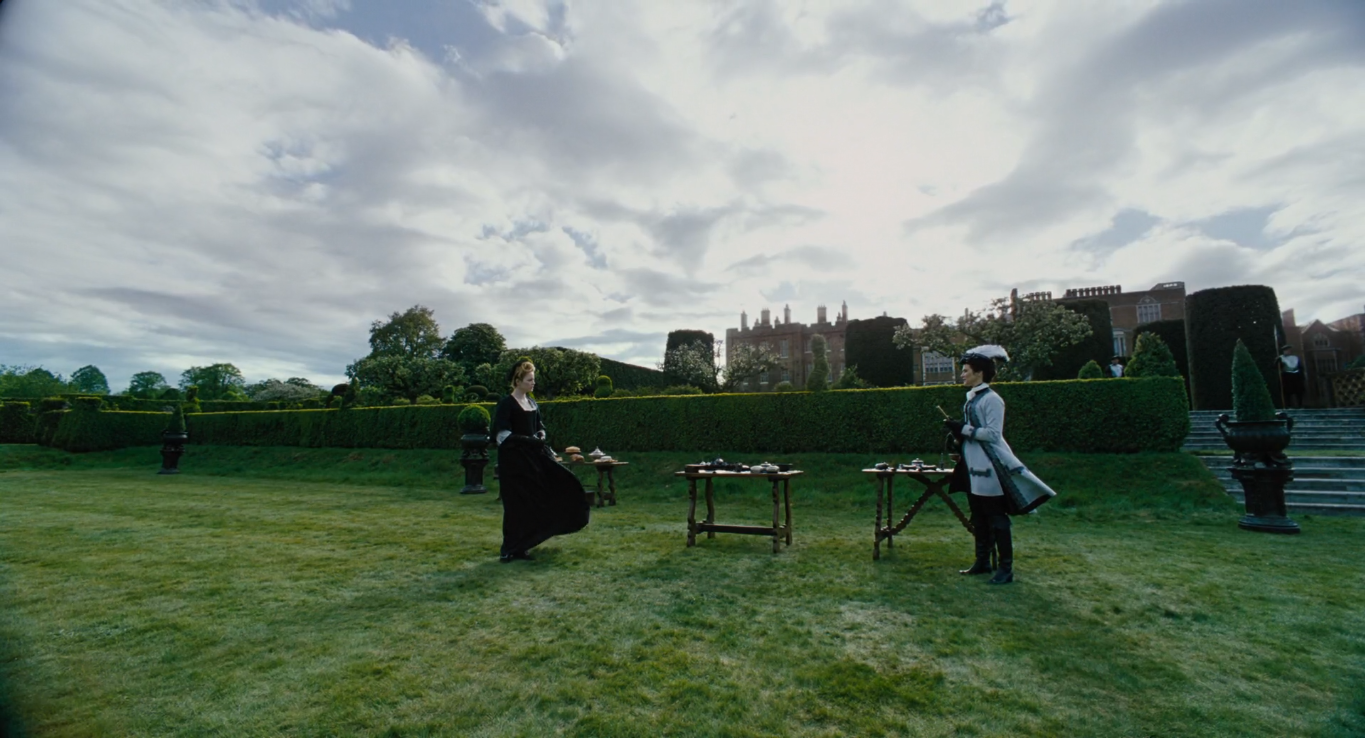
the favourite 1

“I must take control of my circumstance. I’m on my side, always. As it turns out I’m capable of much unpleasantness.”

Yorgos Lanthimos is a Greek director that has first gathered international attention in the big film festivals with Dogtooth (2009) and has since then gradually gained public attention. Despite the many quirks and particularities of his previous projects, one of the big changes going into The Favourite is that it is the first film in which he worked not having written the screenplay with his associate Efthymis Filippou. This will be a big shift of style and pace from the unusually paced dialogues characteristic of his previous films. Despite this significant transformation in the dialogue, visually Lanthimos is working with some of the most unusual camera placing and most dynamic camera movement in all of his filmography, this being even more noticeable if we consider that The Favourite is at its heart a British costume drama.

This film revolves around the somewhat unknown historical figure of Queen Anne, and plays with the relationships between her majesty, her main advisor Lady Sarah Churchill and the newcomer servant Abigail. The whole piece revolves around the power struggle between these three characters in a way that has been compared to All About Eve (1950), being that it mainly focuses on the scuffle between Lady Sarah and Abigail for the Queen’s attention, love and their privileged position in royal affairs. If we try to deconstruct the film we will quickly realize that beneath all of the witty, sharp and corrosive dialogue there are layers upon layers of different motivations that lead our characters through this love triangle.

favourite 3 “Sometimes it’s hard to remember whether you’ve loaded a pellet or not.”
What we gather from The Favourite is actually a really kaleidoscopic combination of themes in a story that could be dismissed as mostly politics. In the background we have the grand scale of the war with the French and in the forefront we have all the personal intrigue surrounding our three main characters. The dynamics between these two levels of politics are presented in a much more interesting and creative way than what is expected considering the film’s plot. But again, while this may seem like the core to the film (and is the core to many other films), The Favourite goes beyond and above, constructing all this political talk in a much more important and universal foundation that combines the matter of relationships with the matter of personal emancipation, all bound together by a sense of real tragedy and pathos revolving the central character of Queen Anne. This allows the viewer to be challenged and agitated, but especially helps in engaging the viewer, by never creating distance between both the film’s main ideas and its undertones, avoiding what could be either a wearisome and bland political allegory or an incomprehensible pretentious mess.

The dialogues and acting are witty and poignant and they never reduce the film into a predictable period drama. This is not necessarily due to the fact that they deal with unashamed and violent sexual language and cathartic situations, but instead in it allowing the viewer to engage with its complicated web of themes, something that in previous Lanthimos films was made really differently if not even in a slightly faultier way. The presence of the absurd, particularly the visual absurd, is still a big part of The Favourite, even if it takes a smaller and different role than in films like The Lobster (2015). As mentioned before, the camera is frenetic in The Favourite.

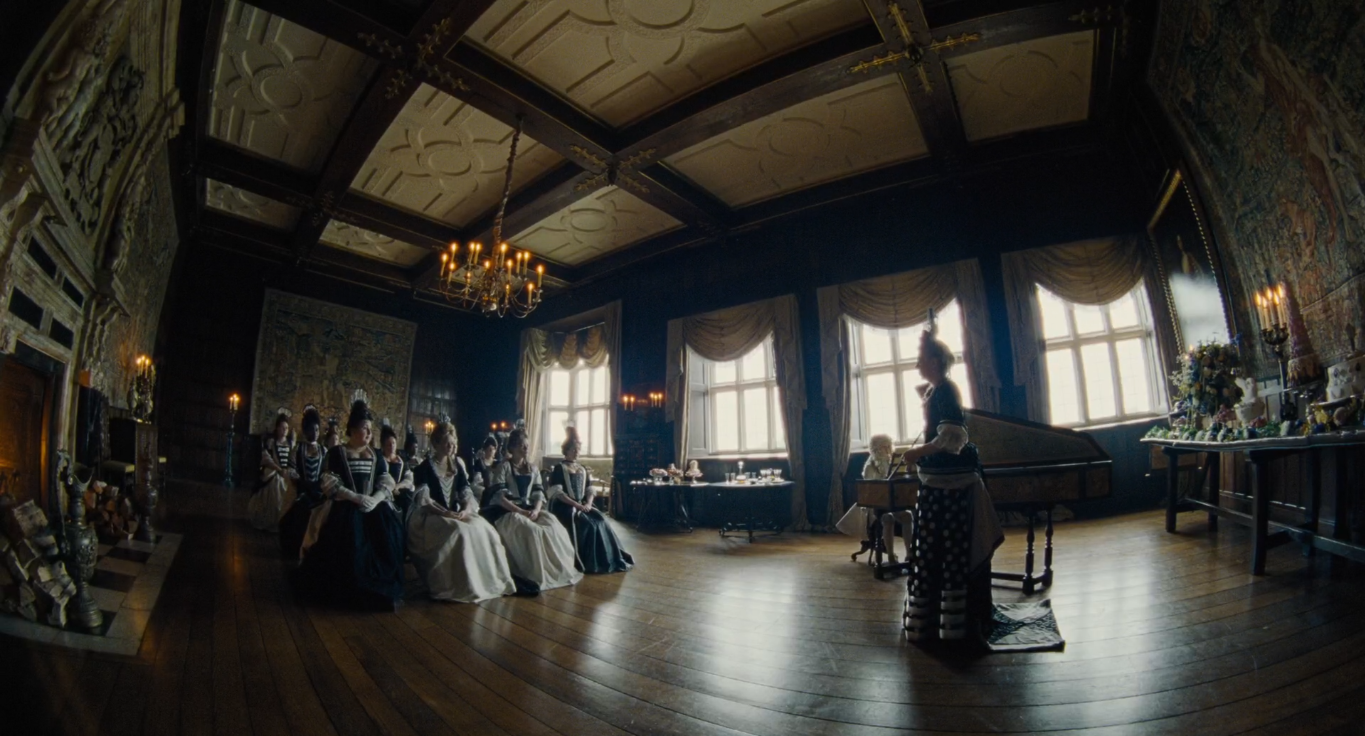
Despite some critics making visual comparisons with films like Barry Lyndon (1975) or The Draughtsman’s Contract (1982) (and rightly so to some extent), Lanthimos’ take on the period drama ditches the expected formality of the genre. The camera is on the ground, on the corner of the room, by the window, it follows the corridors at the oddest angles. This combined with the heavy use of the fisheye lens give the film an edge that elevates the already combination of the oblique motley of themes in the picture, giving it a sense of a nightmare, a weird historical hallucination that seems to play on your subconscious. All of this put together with a truly eclectic soundtrack that goes from the expected baroque music of the time, to deeply sentimental slower paced string tunes, descending gradually into being experimental and dissonant, creates a dynamic that accompanies the visual queues of the film in a no-less than brilliant way.

favourite 2An example of the use of fisheye lens and the odd camera placement in what could otherwise been a regular scene in court.

Complete with what is probably Olivia Colman’s best performance, together with the work of an incredible supporting cast, The Favourite is the most well-rounded of Lanthimos’ film. This sense of completion and unity does not mean that it is a linear and simple film, and not being a straightforward film does not mean that it is not accessible to pretty much anyone. The themes and subjects I mentioned are just a personal selection, but things like the exploration of the gender roles, that the film could be a possible exercise of pastiche and parody, or the viable but more complex psychoanalytical readings of The Favourite are all ideas that are easily interrogated by anyone that watches it. It is one of my favourite films of 2018 and I would say it is up there with The Killing of a Sacred Deer (2017) for Yorgos Lanthimos’ best.

8 out of 10

The Steel Helmet (1951)

Directed by Samuel Fuller

220px-TheSteelHelmet

“Told him I didn’t want any kid tagging along.”

Samuel Fuller is one of the most high-regarded filmmakers of the 20th century, being cited as an influence by many big names in American cinema such as Martin Scorsese or Richard Linklater. Today I am selecting one of his earlier works, and one that is not necessarily one of his most praised films, The Steel Helmet. Notorious for dwelling and transferring the pulp magazine aesthetic onto the big screen, being his most famous films Shock Corridor (1963) or The Naked Kiss (1964), Fuller always knew how to utilize the melodramatic and almost exploitative and sensational themes associated with the pulps to the fullest. In this early film, The Steel Helmet, he moves away from these archetypes and utilizes a reality well-known to him to deliver his poignant and spiky ideas of the war and of the politics of his time.

The film revolves around the Korean War, which was actually ongoing at the time of its release. However, despite propaganda for this war and the release of other films regarding this particular war, Fuller’s picture is arguably the less romanticized of the bunch. There is still a clear tragic pathos to the central plot of the film, but while other pictures focus on the glory and courage of the American soldiers, The Steel Helmet focuses on the soldier’s mindset, on the soldiers that are afraid, nervous and trying to survive in a war instead of soldiers gallantly marching towards their deaths.

The camera follows Gene Evans’ Sgt. Zack on the aftermath of a fatal confrontation of his platoon with North Korean troops, where he was the lucky one who survived, even though he was shot in his helmet. He finds a South Korean kid nearby which at first he dismisses, but eventually lets the kid follow him on his way out of the war. Again, it is not the first time we see children or teenagers in a war situation in American cinema, but what Fuller makes “Short Round” (the name given by the sergeant to the kid) go through is an unacceptably violent scenario, stepping on the joints of the viewer and creating an atmosphere of uneasiness that I can only imagine being almost unprecedented at the time of the film’s release, especially by the devastating emotional ending of this central plot.

steel helmet 2“Get yourself a pair of clodhoppers! No, no. Over there. Take Peewee Johnson’s.”

But arguably, the film shines most in its ideological ambiguities and in being genuinely humanizing. Even though this is a letter of hatred towards war, it depicts the communist side of the war in a really interesting way. It is Sgt. Zack’s war-prisoner that pushes some of the minorities in the squad at the Buddhist temple to reason with some of the social problems in America. He questions the African American soldier about him riding the back of the bus while he payed for the whole ticket, and faces the Japanese American soldier with the realities of the Japanese prisoners of war made by Americans in the World War II. Although the answers demonstrate an apparent loyalty to their flag, the insistence on the reaction of the soldiers by Fuller demonstrates that they recognize that there is something wrong with the American society .Unfortunately they must remain antagonistic and patriotic against the temptations of their communist enemy (even though they may be right on this one). There is, however, a complete disregard for the politics behind the war, and a distrust of Fuller’s on communist affairs, especially considering this situation of the prisoner that almost reminds us of the temptation of Eve, but also by the overall depiction of communist belief as betrayor of tradition and spirituality mirrored in the hiding and fighting in the Buddhist temple.

steel helmet 1“You pay for a ticket, but you even have to sit in the back of a public bus. Isn’t that so?”

There is also a subtlety in the interaction of the soldiers. Despite the angry, traumatized and cold Sgt. Zack being a result of warfare (despite that by the end of the picture he dives deeper in war trauma), the film emphasises the actual interaction of innocent and scared young men going through the actual process of trauma. There is an intimacy in The Steel Helmet that is absent in most American war films released at the time, and not in a romanticized way. The despair of war leads these young men to place hope and effort on small comforting gestures, most notably the bald soldier’s and the Japanese American soldier’s interaction regarding hair loss and their cooperation in such a personal matter, that is still important despite the dangers of a war background.

The film is an answer to pictures like A Walk in the Sun (1945), as it demonstrates that war is not romantic. It is a field where innocents meet their deaths, or even worse. Visually it is stunning, with great special effects and action set-pieces for such a small budget (around 103,000 US dollars) and full of small visual queues that are full of allegories and character building potential (small things like the North Korean soldier hiding behind the Buddha statue or Sgt. Zack playing with Buddhist artefacts in the temple). It is the combination of the outrageous situations with these subtleties that make Fuller’s work so enticing. The Steel Helmet is a relentless attack on war, but also an attack on racism and on the dismissal of spirituality. Complete with a shockingly tragic plot and definitely stepping the line with its themes by 1951’s standards, The Steel Helmet is my first pick for our Classics section of the blog, and despite it being often dismissed when competing with others from Samuel Fuller’s filmography, I have no problem in saying it is possibly my favourite from him.

At Eternity’s Gate (2019)

Directed by Julian Schnabel


MV5BOTRmZGJiZjUtMGJjYi00MzZhLTkzYjUtODE1Yjk5ZDRiODhlXkEyXkFqcGdeQXVyODAzODU1NDQ@._V1_SY1000_SX675_AL_.jpg


“Maybe God made me a painter for people who aren’t born yet”


On At Eternity’s Gate Julian Schnabel, director of the critically acclaimed Le scaphandre et le papillon (2007) turns again to the art world for inspiration. 23 years after Basquiat (1996), inspired by the troubled life of street artist Jean Michel Basquiat, it’s now time for an exploration of the later days of Vincent van Gogh. Despite the many decades that separate the life and death of the two artists, both were misinterpreted visionaries whose works came to be known as revolutionary after their deaths.

Biopics and homages of van Gogh are too many to describe in this review. From Vincent Minelli´s Lust for Life (1956), to the Akira Kurosawa´s marvellous tribute in Dreams (1990) where the painting Wheatfield with Crows (1890) is referenced in one of the shots. In 2017 came out Loving Vincent, an animation film using 65,000 frames of oil painting on canvas, inspired by the painting technique of van Gogh.

This film focuses approximately on the last 2 and half years of the Dutch artist. It begins with van Gogh (William Dafoe) meeting the also acclaimed French painter Paul Gauguin (Oscar Isaac) and their stay in the French small town of Arles. All the known episodes about the artists life, from the breaking apart with Gauguin, the cutting of his own ear as well his stay in a mental asylum and controversial death are represented in this film.

One of the great things about At Eternity’s Gate is the great performance of William Dafoe in this picture. Although having almost twice the age of van Gogh at the time of his death, Dafoe establishes a believable portrayal of the anguish and pure joy the painter experienced during this period of his life. The director focused with great care at the expressions in the faces of the actors, with the constant use of close-ups. Like Dreyer in The Passion of Joan of Arc (1928), the close-up on someone’s face does an astonishing job of making the spectator feel the pain as well the joy the character must be feeling at the time. The scenes where van Gogh paints, the switch between the focus on the quick brushstrokes and the emotions manifested by his face truly transports the viewer to the pure bliss of painting. These few scenes are when the film really outshines itself, together with a warm but at the same time gloomy solo piano soundtrack.

Schnabel experiments a lot with the camera work. Besides the above-mentioned close ups, which work quite well and give texture to the film experience, the overemphasis on a half-blurred lens in some scenes starts to get a little bit tiring after a while. The sound experimentation works better. In the church scene, where Gauguin announces his departure to Paris, leaving van Gogh completely shattered inside is a great example of this. The lines spoken by Gauguin repeat in van Gogh’s head at the same time he is hearing more information from the French painter. It helps to represent better the pure exasperation that van Gogh was surely feeling at the time.


The echoes of Gauguin’s voice inside van Gogh’s head

Van Gogh is represented as a fragile man where the only person who appears to comprehend him is his own brother. A powerful bond which is well represented in this film, especially in a scene where the two lie down in an hospital bed, after one of van Gogh’s breakdowns. He feels that the world doesn’t comprehend him, and laments when he says, “I have a menacing spirit around me.” The connection between mental illness and acts of pure genius is sometimes hailed as logic and unavoidable. As if madness is the only way of achieving greatness and that every genius has a little bit of a madman inside him. This image of a deranged gift is unjust, and a lot of times given to artists like van Gogh. In one of his many marvellous letters to his brother Theo he refers that a “grain of madness that is the best of art”. He knows his limitations and how deeply they affect him. The film tries to explain, with all its flaws, that the mental problems were an issue that incapacitated him to do even more, and not the source of all his brilliance.

The painting where the title was drawn from represents a figure of an old man with his elbows on his knees and his head in his hands, in a clear sense of despair. In a way, Schnabel tries to make van Gogh a martyr of his own geniality. The last scenes of the film almost try to glue the image of saint-like to the painter. The forgiveness of his alleged killers (his suicide it’s still an unsolved mystery to this day) give him a Christ in the cross kind of aura.

Sorrowing Old Man (At Eternity’s Gate)  (1890) by Vincent Van Gogh; oil in canvas; Kröller-Müller Museum,Otterlo

  At Eternity’s Gate tries to transport the viewer closer to the experience of the Dutch painter using every tool possible. It’s not a perfect film but tries to give a fair representation of van Gogh away from the mad genius stereotype. It shows all his brilliance as a painter and his difficulties as a man. The experience of painting on cinema at its best.


7 out of 10