Ruben Brandt, Collector (2019)

Directed by Milorad Krstic

rub

“Art is the key to the troubles of the mind”

This week, for the first time on Camera Coverage, we’ll be taking a look at an animated feature. Coming from Hungary, Ruben Brandt, Collector is the first feature film of Milorad Krstic. A fairly unknown figure with only short movie credit (My Baby Left Me (1995) ), Krstic makes up a strong impression at the age of 66 years old. Regardless of its country of origin, the film is dubbed originally in English.

At the centre we have as the main character Ruben Brandt (voiced by Ivan Kamaras), a world-famous psychologist haunted by these weird and absurd dreams all connected with famous art pieces. The story advances between real life and dream sequences where famous paintings try to harm and kill Ruben. It is an extremely bizarre but captivating scenario to see; for instance, Velázquez’s Infanta Margarita Teresa in a Blue Dress (1659) trying to bite off his arm in a speeding train; or even a pistol duel against Andy Warhol’s Double Elvis (1963). These wonderful usages of famous art pieces from the western world redefine their meanings beautifully and with great taste.

vlcsnap-2019-05-11-15h46m58s874The duel with Elvis

Ruben Brandt is himself an art lover. His methods for helping his patients all connect with art, as he is a true believer of self-artistic expression to exorcise one’s ghosts of the past. Asking for help dealing with her problem with kleptomania is Mimi (Gabriella Hamori), an art robber escaping from detective Mike Kowalski (Csaba “Kor” Márton). She and the other patients in Brandt’s luxurious clinic discover his problems related to his dreams and agree they all must help him. The problems that made them enter the clinic are all related to crime and stealing so teaming up to rob to steal Manet’s Olympia (1863) is not that big of a deal. When they show this painting stolen from the Musée d’Orsay in Paris to Brandt, his nightmares with the woman portrayed suddenly disappeared. He then joins the group to steal the rest of the paintings that still haunted his dreams. The gang raids numerous museums all around the world like the Louvre, MoMa, the Uffizi Gallery or the Art Institute of Chicago, ending up getting the attention of both authorities and gang members alike.The above-mentioned detective Kowalski tries to catch Mimi and the rest of the group before other criminals get to them, attracted by the huge bounty on their heads.

The storyline ends up emulating the classic Hollywood spy and cop movies genre, being a somewhat disappointing experience especially in the last third of the film. This is a film that is to be appreciated more by the originality of the embedded details rather than the narrative itself. There are plenty of heist films clichés, and the personality of the characters is not that deep or original, maybe except for the protagonist. Regarding the plot, points go certainly to the importance given to art and its relation to the well being of an individual. The connection between psychology and art is an interesting and refreshing one, especially in a world dominated by scientific thought.

vlcsnap-2019-05-11-15h45m34s690Velazquez’s Infanta Margarida attack

Aesthetically this film leaves the viewer in awe by the gorgeous detail to both the characters and the world around them. People are portrayed as these cubistic with surrealistic undertones like a Picasso met Dali kind of style. Some have three eyes, others two heads, and, in a brilliant play with perspectives, there is a character that is bidimensional like a sheet of paper. It is an astonishing world completely filled with subtle references to all kinds of art, that goes from Soviet propaganda to American Realism painting. Besides that, a brilliant homage is also given to cinema, portrayed in the home collection of detective Kowalski. Filled with film memorabilia from Weneger’s Der Student von Prag (1913) poster to the small detail of ice cubes in the shape of Alfred Hitchcock, there´s a lot for any movie buff to enjoy in these small quirks.

Overall it was a pleasant surprise, and an animation like any other I’ve ever watched. The focus on the holistic aspect of art in the human mind is definably a positive aspect. In the end Ruben Brandt, Collector gives both an approachable introduction to art history and something that art enthusiasts can take also.

6 out of 10

Alice (1988)

(original title: Něco z Alenky)

Directed by Jan Švankmajer

40000-alice-0-230-0-345-crop

“Alice thought to herself: ‘Now you will see a film made for children… perhaps. But, I nearly forgot, you must close your eyes, otherwise you won’t see anything.’ “

Jan Švankmajer is one of those directors that is a legend to the lovers of animated films and sadly underappreciated by the general public. In a way it is a disappointing fact, but at the end of the day, stop-motion animation is still a very particular style, and when combined with surrealism and experimental imagery, there is not much left for the casual viewer to incline in its direction. Nevertheless, Švankmajer’s work is an influence to some of the most successful directors in Hollywood, such as Tim Burton for instance. Being a fan of puppeteering and stop-motion, it is hard not to include one of his films in our Classics category, as not only is he a master of the art of puppets and traditional surrealism, but also a great filmmaker that channels his very unique vision with full use of the medium.

If it wasn’t obvious enough, Alice is a film adaptation of Alice’s Adventures in Wonderland, the famous novel written by Lewis Carroll. Despite being very faithful to its original material (even comparing it to some other adaptations, that tend to mix up the novel with its sequel Through the Looking-Glass and What Alice Found There), it does not depict all of the episodes in the book. However, every line in the film (not including the quote we selected above, that is at the very beginning of Alice) is taken directly from the novel. That said, it completely re-reads the novel, illustrating it in a creative and new way. Its style must have been described as truly unheimlich if Sigmund Freud had the chance to watch it. This is mostly because of Švankmajer’s obsession with everyday objects and things that are well-known to us, giving them a life that should not be. Dodgson’s novel is the perfect object to be narrated by Švankmajer, as it is an inheritly playful, ambiguous, psychadelic and metamorphic story. Other surrealists have taken a chance at this novel, but only the odd combination of interests in Švankmajer could result in such an interesting piece.

alice 2Alice shrinks into a doll.

By the end of the novel Alice wakes up in her sister’s lap, as she shouts (after growing spontaneously) that all those soldiers were just a “pack of cards”. And in fact we suppose by her sister’s description afterwards that all of her adventures in Wonderland were her background setting fantasized. Švankmajer takes these ideas to an absolute extreme, utilizing animation in everyday objects and artifacts instead of focusing on creating polished fantastical creatures. This creates an incredible textural feeling in the film, something that is common in his body of work. It seems that he knows of the many different readings of the story as well, as his semiotic game (combined with smart editing, framing and cinematic techniques that are not strictly related to the effect of the animation) shows knowledge about the different subtexts of Alice in Wonderland, with a special insistence on its sexual and psychoanalytical readings.

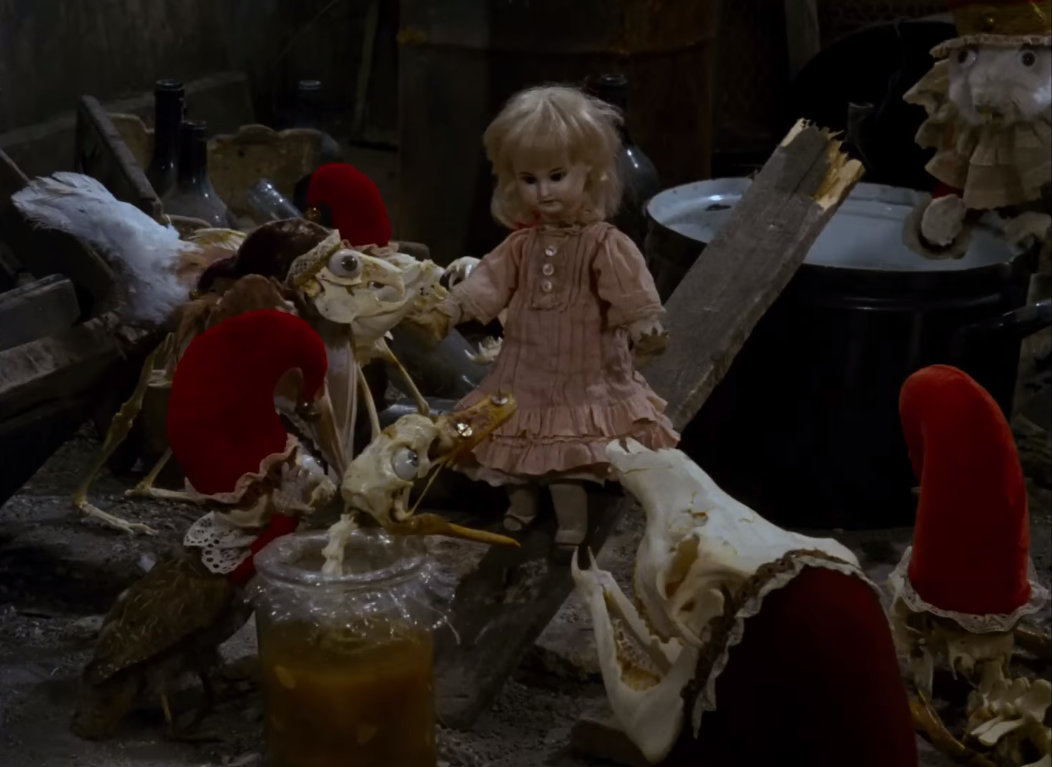
alice 1.pngProbably the most unsettling scene in the film, the infamous tea party.
As in some of his other works (such as Conspirators of Pleasure (1996) and Little Otik (2000) ) we can observe in this work a presence of sexuality in childhood. It is a very subtle and delicate subject, but the honesty and tactility of the director allows these themes to flow in a poignant yet brutal way. The process of coming of age, clear in Dodgson’s original, is a prominent theme in the film overall. The brutal violence of growing in Švankmajer’s version is less evident than in the book, but it burns at a much more deeper level. This is mostly due to the use of the medium of cinema (images and time) combined with the animation and metamorphosis of inanimate objects (especially regarding things like meat and bones, that are a staple of Švankmajer’s, that when back to life create this uncanny feeling of seeing a sort of in-between of life and death).

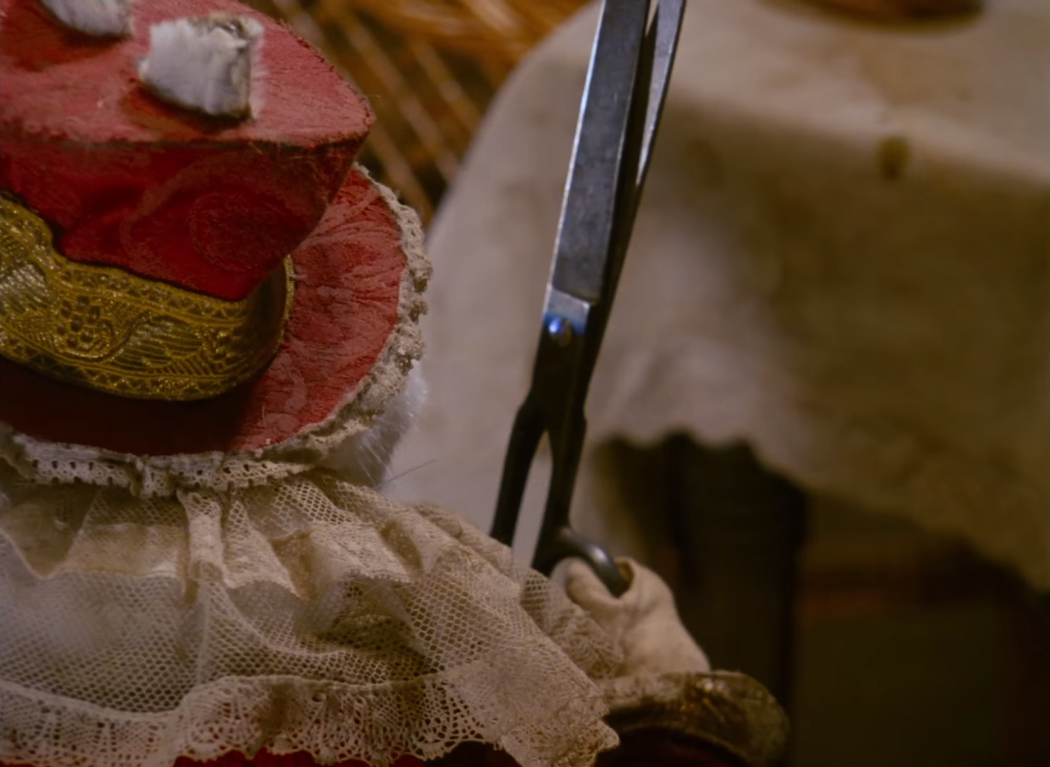
alice 3.png“Off with their heads!”

Alice is a film to feel and not just watch. As the main character said, it is a children’s film, with the exception that it isn’t. It is, though, an incredible revisiting of a timeless classic. Focusing on the coming of age aspect of Alice, the cyclic nature of the story, the transformations and the perception of the real in human imagination, the film is definitely not for everyone. It is highly stylized, sometimes cryptic and ambiguous and it does not follow an easy narrative for the ones that are unfamiliar with the story. One can’t deny all these obstacles to the big audiences, but it is making it injustice when saying it is not a unique experience that will probably change the way you look at film as an art form and reconsider an old but dynamic and always fresh animation technique.